Google turns 28: Searching for answers in a world it helped create
Google has spent nearly three decades shaping the internet and its advertising economy. Now, as AI transforms discovery, the company must navigate an ecosystem it helped create
 by
by
Published: Sep 28, 2026 10:22 AM | 8 min read
 Follow Us

- Google celebrates its 28th birthday, reflecting on its evolution from a search engine to a major player in digital advertising and content distribution, particularly through its acquisition of YouTube in 2006.
- The company has seen significant revenue growth, with advertising accounting for a large portion of its income, but faces increasing competition from other platforms like Meta and regulatory scrutiny regarding its market dominance.
- Generative AI is reshaping the search landscape, prompting Google to integrate AI technologies into its products and advertising strategies, as co-founder Sergey Brin returns to focus on AI initiatives.
- As the digital information ecosystem evolves, Google must adapt to maintain its relevance and continue connecting users, publishers, and advertisers in a more complex environment.
Where does one look up the history of Google for a retrospective on its 28th birthday? "Google it" is still the obvious answer for many, but, increasingly, for others it might be "ChatGPT it," while others still will swear by (and at) Claude.
As Google nears three decades of shaping how the world discovers information, the ecosystem it helped create is evolving beyond the familiar search box. The surfaces of information and advertising are transmuting, new players are entering the fray, and the company itself is having to reinvent the business it helped build.
Read On: Google wants AI to become marketers' strategist. Is the industry ready?
Despite all the change, Google remains mammoth on the landscape, if no longer monolithic. And the company that turned a variation of an obscure mathematical term into a verb for searching will undoubtedly continue to shape it.
The transformation has been extraordinary, particularly considering that advertising, the business upon which Google built much of its empire, wasn't originally part of the equation.
From searching for answers to selling them
When Larry Page and Sergey Brin incorporated Google in September 1998, their proposition was relatively straightforward: make the internet's rapidly expanding body of information easier to navigate. Its PageRank algorithm organised results through the relationships between webpages, rather than simply relying on keyword matches.
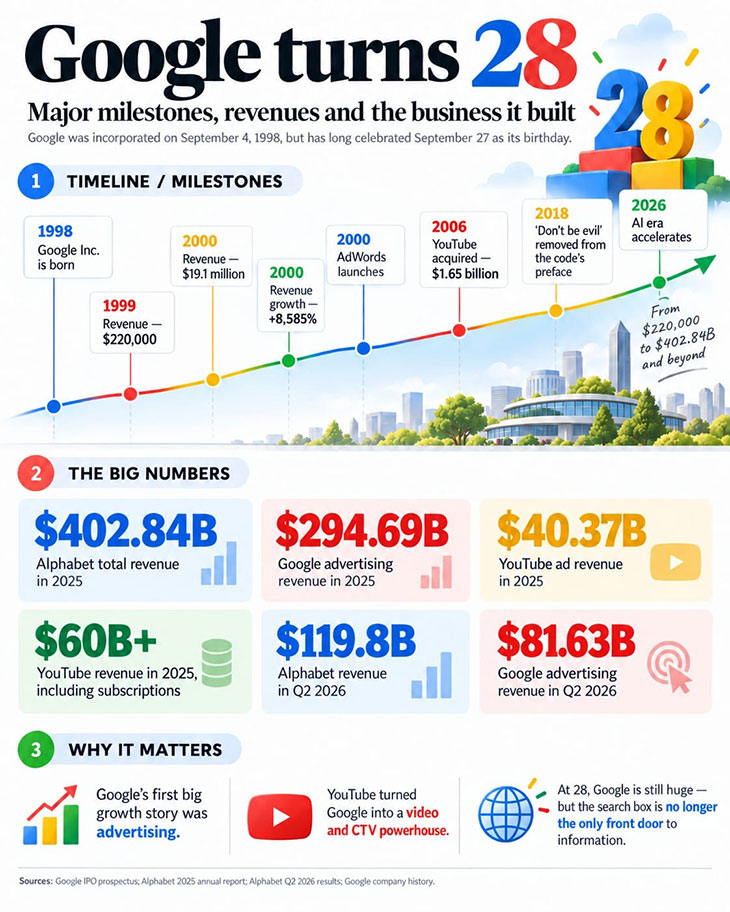
(Incidentally, Google was officially incorporated on September 4, 1998, but has long preferred September 27 as its birthday, marking the occasion with its customary Doodle. Even the company that organised the world's information enjoys a little flexibility with its own history.)
In 1999, Google generated just $220,000 in revenue, largely from licensing its search technology. Then came advertising. Its first sponsored listings arrived in 2000, followed by the launch of AdWords that October.
By the end of that year, revenue had multiplied nearly 87 times to $19.1 million, an increase of approximately 8,585%. While the increase cannot be attributed exclusively to advertising, the business model's importance rapidly became apparent. Advertising accounted for roughly 77% of Google's revenue in 2001 and over 93% by 2002.
The innovation was not merely selling space alongside search results. Google helped commercialise intent itself. Advertisers could reach consumers when they were actively looking for a product, service or answer, rather than simply hoping to catch their attention elsewhere.
The introduction of cost-per-click advertising in 2002 further changed the economics. AdWords, subsequently rebranded Google Ads, became a cornerstone of performance marketing, linking advertising expenditure more directly with measurable consumer action.
Read On: As clicks disappear, India’s SEO agencies rethink what they sell
The company had discovered that answering questions was a lucrative business. Knowing which questions people were asking was arguably even more lucrative.
In the following years, acquisitions and product launches extended Google's influence across digital advertising. AdSense connected advertisers with publishers, DoubleClick strengthened its position in advertising technology, and Android and Chrome expanded its presence across the devices and browsers through which people accessed the internet.
What began as a search engine gradually became part of the infrastructure of the digital economy.
YouTube: The $1.65 billion purchase that kept giving
One of Google's most consequential decisions came in 2006, when it acquired YouTube for $1.65 billion.
At the time, online video was still developing as a commercial medium. Two decades later, YouTube represents considerably more than an extension of Google's advertising inventory. It has become a major destination for entertainment, education, music, creator-led content and increasingly connected television.
The platform helped Google diversify the ways it monetised audiences. Search advertising captures declared intent; YouTube allows advertisers to reach audiences through interests, viewing behaviour, contextual relevance and video engagement. Its evolution has blurred distinctions between social video, traditional broadcasting, creator marketing and television advertising.
And the purchase has aged rather well.
In 2025, YouTube generated $40.37 billion in advertising revenue alone, up from $36.15 billion in 2024. Its fourth-quarter advertising revenue reached $11.38 billion. When subscriptions are included, YouTube's annual revenue exceeded $60 billion, according to Alphabet's full-year results.
Read On: YouTube isn’t changing what a view is worth. It’s changing what success looks like
The subscription business is particularly important. Through YouTube Premium, Music and its other paid offerings, the platform has developed revenue streams beyond advertising, even as its video inventory remains a major component of Google's commercial ecosystem.
For advertisers, YouTube's growth has also fundamentally changed the video landscape. A platform once associated primarily with desktop viewing and viral clips now competes for attention on television screens, supports an extensive creator economy, and brings short-form and long-form video under one enormous distribution network.
As connected television expands, YouTube occupies an increasingly significant position in the convergence of television, digital video and creator-led advertising.
The company that once helped people find videos elsewhere now owns one of the world's major video destinations. Not bad for an acquisition made when buffering was still a fairly routine part of watching anything online.
Growing bigger, facing greater scrutiny
By 2025, Alphabet's annual revenue had crossed $400 billion for the first time, reaching $402.84 billion. Google advertising alone contributed $294.69 billion, approximately 73% of the parent company's total revenue.
That scale has also invited increasingly sustained challenges, both commercial and regulatory.
Earlier this year, EMARKETER projected that 2026 would mark a historic change in the digital advertising hierarchy, with Meta overtaking Google in net advertising revenue globally and in the United States. Its worldwide projections placed Meta at $243.46 billion against Google's $239.54 billion.
Whether that forecast materialises remains to be seen. Google's reported advertising revenue has continued growing, reaching $81.63 billion in Q2 2026, up 14.4% year-on-year. Alphabet's overall quarterly revenue reached $119.8 billion, representing approximately 24% growth.
Google's commercial position, however, is only one part of the story.
The company has faced major antitrust proceedings concerning its dominance in search and advertising technology. US courts have found unlawful monopolisation in aspects of both businesses, with remedies intended to open parts of Google's ecosystem to competition.
Most recently, in September 2026, a US federal court declined to order the breakup of Google's advertising technology business but imposed behavioural remedies, including interoperability with competing advertising systems, greater publisher data portability and restrictions on preferential treatment within Google's own advertising infrastructure.
Google has also demonstrated that even its own plans for the advertising ecosystem are not necessarily set in stone.
After years of preparing publishers, marketers and adtech companies for the removal of third-party cookies from Chrome, it abandoned the planned phase-out. In April 2025, the company confirmed that it would retain its existing approach to cookie choice, rather than introduce a separate consent prompt. Several Privacy Sandbox technologies were subsequently earmarked for retirement.
For an industry that had spent years preparing for a cookieless future, it was an expensive exercise in learning that the future is subject to change without notice.
Even Google's corporate philosophy has undergone some editing. Its once-famous Don't be evil motto was removed from the preface of its code of conduct in 2018, although a reference survived in the concluding paragraph.
The injunction wasn't entirely abandoned; it was simply moved considerably further down the document.
The next search for Google
The most significant challenge to Google's established business model may now be emerging from the evolution of search itself.
For decades, its advertising proposition was built around connecting queries with relevant results, commercial messages and destinations across the web. Generative AI is changing that relationship, with users increasingly able to receive synthesised answers, conduct conversational research and complete more of their discovery journeys without following traditional lists of links.
View this post on Instagram
Google, of course, has no intention of surrendering the answer business.
The company has integrated Gemini across its products, introduced AI Overviews and AI Mode into Search, and increasingly incorporated automation into its advertising products through developments such as AI Max.
The significance of this transition is reflected in the return of co-founder Sergey Brin, who stepped away from day-to-day management in 2019 but has since returned to work closely on Google's AI efforts.
His involvement has extended into the development of Gemini and Google's broader AI strategy. Reporting in August 2026 also highlighted his influence over efforts to accelerate the company's AI programme amid intensifying competition.
There is considerable symbolism in one of the founders returning to help reshape the technology at the heart of the company he helped establish.
For advertisers, meanwhile, the implications extend beyond whether a consumer uses Google Search, Gemini, ChatGPT or another interface.
AI-generated responses are altering where commercial messages can appear, how products are discovered and the visibility brands receive during increasingly complex consumer journeys. Campaign creation, bidding, targeting and optimisation are also becoming more automated, gradually changing the relationship between advertisers and the platforms managing their investments.
Google must therefore negotiate two transformations simultaneously: competing for consumer attention in an increasingly fragmented discovery landscape, while developing new advertising models capable of sustaining its existing commercial scale.
Twenty-eight years after its founding, the company remains a formidable presence across search, video, mobile operating systems, browsers, cloud computing and advertising infrastructure.
Its original mission was to organise the world's information and make it universally accessible and useful. The challenge today is somewhat different. As information becomes increasingly conversational, personalised and AI-mediated, Google must determine how its ecosystem can continue to connect users, publishers and advertisers.
The world may no longer always tell people to Google it. But Google intends to remain somewhere in the machinery that helps them find their answers.
Read more news about Digital Media, Internet Advertising, Marketing News, Television Media, Radio Media
For more updates, be socially connected with us onInstagram, LinkedIn, Twitter, Facebook, YouTube & Google News