Big Tech wants the shopping journey. What remains for brands?
Tech platforms are expanding influence over purchasing decisions. For advertisers, the promise of better conversion comes with harder questions about measurement, customer ownership and growth
 by
Published: Oct 28, 2026 8:24 AM | 5 min read
 Follow Us

- Alphabet and Microsoft are set to report quarterly earnings on October 28, followed by Amazon on October 29, with a focus on the evolving landscape of Big Tech advertising.
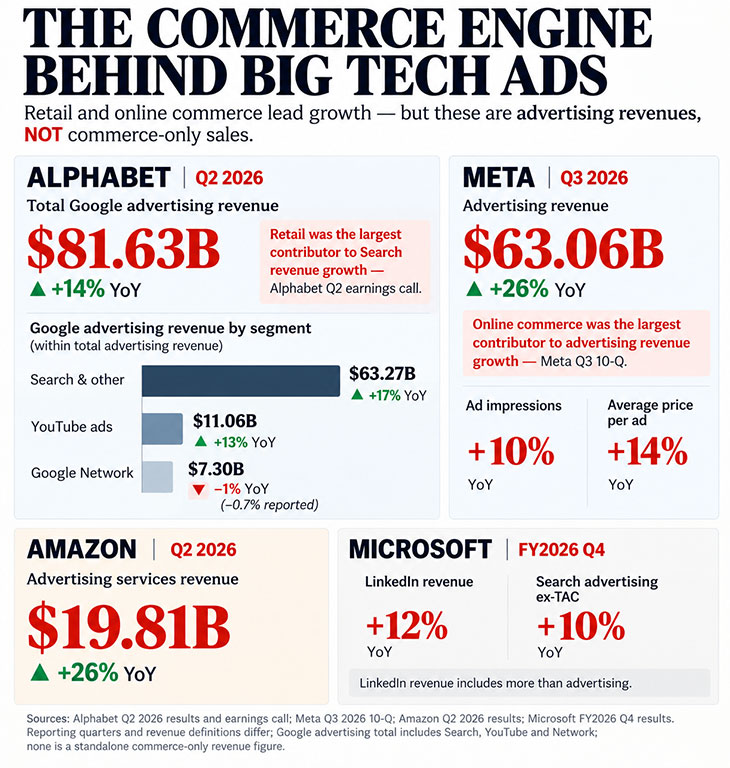
- Meta's advertising revenue increased by 26% in Q3, driven largely by online commerce, highlighting a shift in advertising demand and the blurred lines between advertising and shopping.
- Platforms like YouTube and Google are enhancing shopping features, integrating product comparisons and shoppable listings, which influence consumer decision-making throughout the purchase journey.
- Experts caution that while advertising can drive initial purchases, brands must also focus on customer retention and the complexities of measuring true conversion rates beyond mere orders placed.
As Alphabet and Microsoft prepare to report quarterly earnings today, on October 28, with Amazon following on October 29, attention is again turning to Big Tech's advertising engines. Meta has already offered a revealing clue. Its advertising revenue rose 26% in the third quarter, with online commerce identified as the largest contributor to its year-on-year advertising revenue increase. That tells us where advertising demand is growing. It does not, however, tell us who ultimately benefits most from a more platform-mediated shopping journey.
Read: Meta's ad prices rise 14% globally in Q3, just 1% in APAC: The India equation
Until recently, the industry's division of labour was relatively straightforward: media platforms found audiences, advertisers paid to reach them, and brands or retailers attempted to convert that attention into sales. That boundary is now less distinct. Search results can compare products, creator videos carry shopping links, marketplaces sell advertising against purchase intent, and messaging interfaces increasingly handle everything from enquiries to post-purchase support.
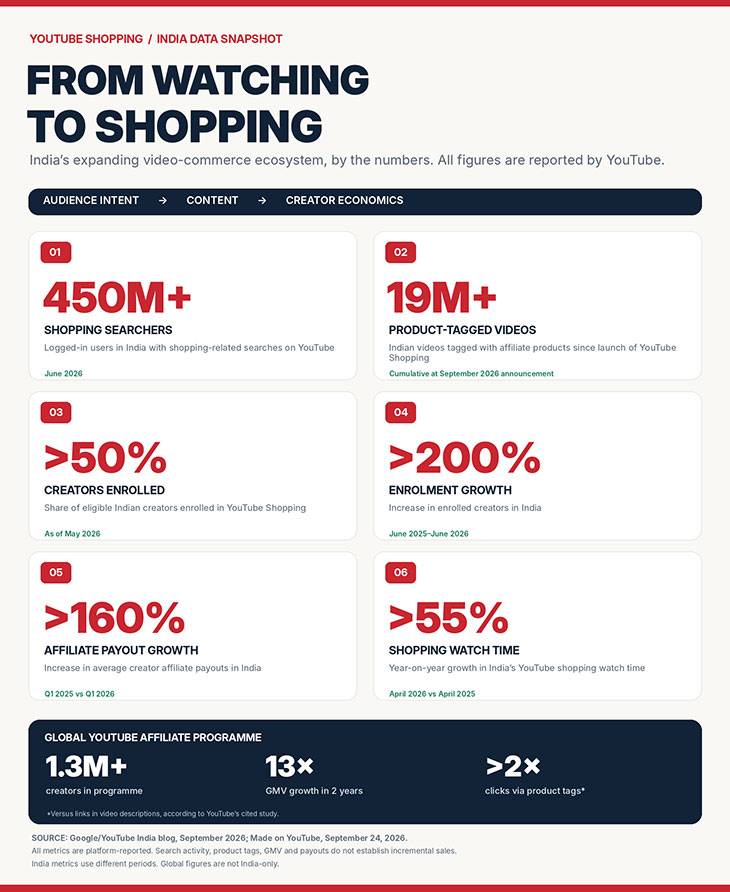
YouTube's recent expansion is illustrative. The company has announced additions to its Indian shopping affiliate partnerships, including Amazon, AJIO, Meesho, Snapdeal and Tata CLiQ, alongside existing retailers, while building tools that let brands amplify creator content through paid campaigns. Its September announcements also outlined AI-supported product questions alongside videos and plans for additional affiliate incentives. Google, meanwhile, has integrated shoppable listings and product comparisons into Gemini and AI Mode in Search in India.
Read: YouTube wants a share of India's shopping carts. Will ad budgets follow?
These initiatives do not necessarily place the final transaction on the platform; they put more of the decision-making process within its reach.
"A brand may still own the website and fulfil the order, but by the time the customer arrives, much of the choice may already have been made," says Yash Dabi, Vice President, Technology Growth at 22feet, part of Omnicom Advertising India.
A purchase-journey map shared by the agency makes the point neatly: discovery, consideration, evaluation, sampling, purchase and advocacy involve overlapping platforms and offline encounters. The journey is becoming more distributed, not invariably more centralised. The commercial contest is over which companies can influence, and monetise, the greatest number of moments along it.
For brands, that reach is valuable. Shaily Mehrotra, CEO and Co-Founder of Fixderma and FCL, says consumers may now discover skincare products on social media, read reviews and buy without visiting a brand's website. But the final decision still depends on trust and whether a product addresses a particular skin concern. Discovery is easier to outsource than credibility, and the first order is not the same as a loyal customer.
"Getting the consumer to buy your product is great, but making him come back again is what makes the difference," Mehrotra says.
The increasingly close relationship between advertising and shopping nevertheless makes a compelling sales pitch. Meta has connected advertising with product discovery and business messaging across its apps, while Amazon's retail and advertising operations give sellers access to a marketplace where shopping intent is already explicit. For advertisers under pressure to demonstrate results, the ability to shorten the route from exposure to purchase is attractive.
Read: Creativity still lies in the hand of the advertisers: Kapil Sharma, Amazon Ads
But shortened journeys do not automatically produce better economics.
Nitin Kosari, Business Head – eMarkets at LS Digital, argues that the central question is not simply whether conversion improves, but whether advertising creates new demand rather than capturing purchases that would have happened anyway.
"Strong ROAS does not, by itself, tell us whether we have generated incremental demand, acquired new customers or built repeat purchase behaviour," he says. Brands, he adds, need to measure growth beyond platform-reported returns and understand how spending affects market share, customer economics and retention.
India adds another complication: even the reported conversion may not represent a completed sale.
Kautilya Pandey, Head, Marketing & Growth at Shiprocket, points to cash-on-delivery orders, failed delivery attempts and returns to origin, especially across markets where fulfilment remains complicated. An order attributed to an advertising campaign can still fail to become realised revenue.
"For advertisers, the real measure of conversion should move beyond orders placed to a sale successfully delivered," Pandey says. He advocates measuring returns against delivered orders, rather than assuming every checkout represents a commercial success.
There is a second accounting problem. A customer might discover a product through a creator, compare it using an AI assistant, search for prices and eventually purchase on a marketplace. Multiple participants can credibly say they influenced the sale. That does not mean each contributed an additional sale.
As platforms offer increasingly comprehensive performance dashboards, the risk is that greater visibility within one ecosystem is mistaken for a complete view of consumer behaviour across ecosystems.
Keyur Dhami, SVP – Customer Success (Key Accounts) & CoE at WebEngage, argues that brands need a parallel direct-to-consumer engagement strategy even as platforms deliver discovery and acquisition. Loyalty programmes, product guidance and post-purchase communication can build consented first-party data and encourage repeat transactions. Without those relationships, changes in algorithms, advertising costs or marketplace policies can leave brands exposed.
As Kosari puts it, dependency begins when a brand is continually buying visibility without understanding its incremental contribution. And Pandey warns that businesses can end up paying repeatedly to reacquire customers they have already won.
None of this makes integrated commerce a bad bargain. For a young brand, access to a large marketplace or creator audience may be far more efficient than building demand alone. Nor does controlling discovery always mean controlling payment, fulfilment or customer data. Google's commerce infrastructure, for example, is designed to let merchants remain the sellers of record even as shoppers interact through Google-powered interfaces.
The larger shift is in bargaining power. The more decisions consumers make inside environments governed by platforms, the more brands must negotiate for visibility, interpretation of performance and access to the next purchase.
The platforms may not need to own the customer outright. Being indispensable to the relationship could prove lucrative enough.
The Google/YouTube team directed exchange4media to previously published company announcements but did not offer additional comments. Meta and Amazon Ads had not responded to requests for comment at the time of publication.
Read more news about Digital Media, Internet Advertising, Marketing News, Television Media, Radio Media
For more updates, be socially connected with us onInstagram, LinkedIn, Twitter, Facebook, YouTube & Google News
