As BFSI embraces AI, marketers spell out where to draw the line
At the Pitch BFSI Summit, six leaders unpack where AI can drive value, where human judgment remains critical and how brands can protect customer trust
 by
by
Published: Sep 24, 2026 8:35 AM | 6 min read
 Follow Us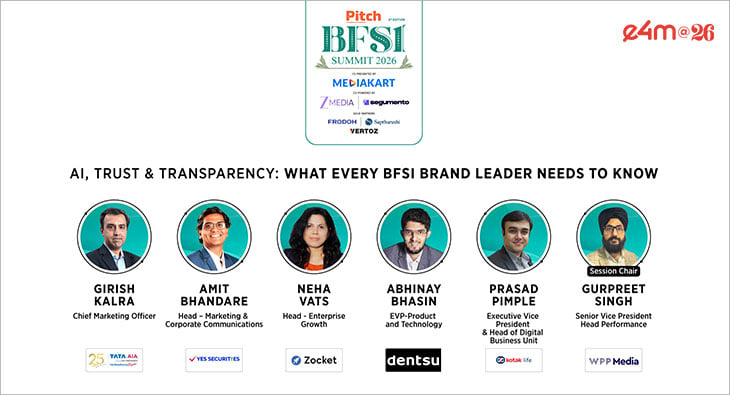

- At the Pitch BFSI Summit, industry leaders from various sectors emphasized that in the BFSI marketing space, the effectiveness of AI hinges on the trust it maintains, particularly given the intangible nature of financial products.
- The panel discussed the importance of genuine use cases for AI, cautioning against adopting technology merely for the sake of following trends, and highlighted the need for AI to solve real customer problems rather than just increase content production.
- Personalization was a key topic, with leaders stressing the importance of relevant, non-intrusive customer interactions and the need for clear consent mechanisms in AI-driven marketing strategies.
- The discussion concluded with a focus on accountability in AI-generated content, advocating for marketing ownership while recognizing the necessity of human oversight to ensure accuracy and compliance in communications.
At the Pitch BFSI Summit, on a panel about AI, trust and transparency in BFSI marketing, six leaders from insurance, broking, asset management, adtech and agency-side technology arrived at a striking consensus: in an industry where the product can't be touched, tested or returned, artificial intelligence is only as valuable as the trust it protects.
The session, ‘AI, Trust & Transparency: What Every BFSI Brand Leader Needs to Know’, chaired by Gurpreet Singh, Senior Vice President and Head of Performance at WPP Media, brought together Girish Kalra (CMO, Tata AIA Life Insurance), Amit Bhandare (Head of Marketing & Corporate Communications, YES Securities), Abhinay Bhasin (EVP, Product and Technology, Dentsu India), Prasad Pimple (EVP & Head of Digital Business, Kotak Life), Shrinivas Khanolkar (Head of Digital, Marketing & Corporate Communication, Mirae Asset Investment Managers India) and Neha Vats (Head of Enterprise Growth, Zocket).
The FOMO problem
The conversation opened with a question that's quietly nagging every BFSI marketer: are we using AI because we have a genuine use case, or because everyone else is? Kalra was blunt about it. Brands, he said, have moved through a curiosity phase and a "can we afford to stay away" phase, and are now finally asking the harder question: what am I actually getting back? "Gone are the days where you just put a tag of AI on any use case and people would lap it up," he said. The real value, in his view, lies less in content generation and more in AI's ability to connect disparate data points and drive predictive "next-best-action," recommendations that evolve into decisions AI can actually execute.
Bhandare drove the point home with a sharper example: AI has made it trivially easy to produce more creatives, but producing more doesn't mean posting more. "That judgment and judiciousness has to be there with the marketers," he said, arguing that AI's measurable value shows up where it genuinely solves a customer problem, such as instant, AI-assisted query resolution that spares customers the IVR maze. Bhasin, representing the technology and product side, framed it as a discipline question: is this a genuine pain point, is the cost-benefit real, or are you simply "burning tokens" to solve a problem that was cheaper to solve without AI?
Why BFSI can't fake trust
If there was one line that captured the room's mood, it was Kalra's comparison of BFSI to a car showroom. With an SUV, he noted, you can open the door, slam it shut, and the sound itself tells you something about build quality. In insurance, there is no equivalent gesture. The "product" is a promise that gets delivered, if at all, years or decades later, often after the buyer is no longer around to see it. That absence of a tangible proof point, he argued, is exactly why trust becomes the category's real currency, built cumulatively through every interaction rather than any single transaction.
Vats reinforced this with a line she attributed to RBI Governor Sanjay Malhotra: trust isn't a marketing strategy, it's an operating discipline, earned transaction by transaction, and lost in minutes. At Zocket, she said, that discipline is engineered in from the start: workflows are fragmented so that compliance and guardrails are embedded into every step of AI-assisted marketing, rather than bolted on as a final check.
Personalization's fine line
The panel's most concrete exchange came on personalization. Kalra described Tata AIA's own website, where each of its roughly 4 million existing customers sees a fully personalized homepage, greeted by name, shown relevant plans, even reminded of an upcoming premium due date. In a category with no real competitive moat (a product, as he put it, "is ultimately a piece of paper" that can be copied overnight), this kind of experience has become less a differentiator than table stakes.
But personalization this granular walks a fine line, and Pimple pressed the panel on exactly where it sits. His own approach at Kotak Life is need-based rather than data-maximalist: just because the company holds extensive medical and financial information doesn't mean every data point gets used. Waived medical retests for existing customers renewing within six months, for instance, are a legitimate use of stored health data, but that same information is never repurposed for targeting.
Vats offered the sharpest articulation of the boundary, distinguishing relevance from intrusion. A customer researching baby products or visiting a pediatrician frequently shouldn't trigger a "congratulations on your new baby" message; that's intrusive, and often wrong. But a customer using a financial calculator to plan for a child's future is signaling genuine intent, and a relevant SIP recommendation at that moment is a service, not a violation. Consent, she added, has to be granular and synchronized: agreeing to chat with an AI agent is not the same as opting into promotional messages, and an opt-out has to propagate instantly across every channel, email, WhatsApp, app, not just the one where it was raised.
Who signs off on the machine?
The discussion's final turn was arguably its most consequential: when AI assists or generates customer-facing content, who is accountable if something goes wrong? Bhandare argued unambiguously for marketing ownership, since the function sits closest to the customer and the communication is ultimately theirs to defend, though he cautioned against mistaking polished articulation for accuracy, a distinction only human judgment can catch. Kalra agreed that ownership sits with whoever creates the content, since only they hold the context behind it. Bhasin's formulation was more federated: legal, product and compliance each contribute a sign-off, but final responsibility rests with the team that actually disseminates the communication, marketing.
For life insurance specifically, Pimple was categorical that speed is not the priority AI should optimize for; accuracy and disclosure are. At Kotak Life, AI assists with briefs, analytics and refinement, but every piece of communication still passes through a 100% human check before release, partly because regulation mandates it. Bhasin summed up the philosophy the panel kept circling back to: AI is "the smartest apprentice" an organization has, invaluable for grunt work, pattern-spotting and acceleration, but never a substitute for the human in the loop who carries ultimate accountability.
Khanolkar offered the panel's one genuinely contrarian note: today's hybrid, human-reviewed model is a transition state, not an endpoint. As real-time personalization becomes hygiene rather than differentiation, much like consumers now expect news to be current to the minute, he predicted organizations will eventually hand more autonomy to AI within pre-set thresholds, with humans shifting from checking every output to continuously recalibrating the system itself.
Whether BFSI brands get there gradually or quickly, the panel's shared conviction was unmistakable: in a category built on promises rather than products, the brands that win with AI won't be the fastest movers. They'll be the ones that never let trust become negotiable.
Read more news about Marketing News, Advertising News, PR and Corporate Communication News, Digital News, People Movement News
For more updates, be socially connected with us onInstagram, LinkedIn, Twitter, Facebook, YouTube & Google News