Pitch CMO Summit 2026: Attention can be bought, affection has to be earned
As creators, AI and fragmented consumer journeys reshape marketing, brand leaders argue that attention may get a consumer to notice, but affection is built through relevance, trust and experience
 by
by
Published: Sep 7, 2026 3:56 PM | 11 min read
 Follow Us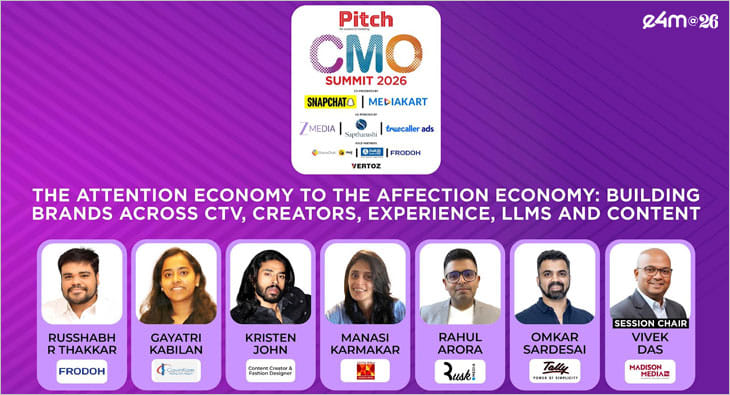

- At the Pitch CMO Summit 2026, industry leaders discussed the transition from an "Attention Economy" to an "Affection Economy," emphasizing the importance of brand love alongside measurable marketing metrics like impressions and click-through rates.
- Panelists highlighted the challenge of quantifying brand affection, noting that while attention can be bought, affection must be earned over time through meaningful consumer relationships and consistent brand experiences.
- The discussion also touched on the role of creators in building brand affection, with a consensus that giving creators freedom to express their narratives can enhance consumer connection to brands.
- The impact of AI on brand perception was debated, with experts suggesting that while AI can optimize functional aspects of marketing, genuine emotional connections and storytelling remain essential for fostering brand loyalty.
Marketing has spent a significant amount of time getting better at buying attention. Impressions, click-through rates and return on ad spend are measurable and defensible, but brand love is neither.
At the Pitch CMO Summit 2026, a session titled “The Attention Economy to the Affection Economy: Building Brands Across CTV, Creators, Experience, LLMs and Content” focused on this central theme. Chaired by Vivek Das, Chief Digital Officer, Madison Media, the discussion was joined by Gayatri Kabilan, Head of Marketing – Personal Care, CavinKare; Kristen John, content creator, better known as John D'Arte; Manasi Karmakar, Head of Digital Marketing for W, Aurelia and Jaypore at Aditya Birla Fashion and Retail; Omkar Sardesai, Brand Head – India, Tally; and Rahul Arora, Head of Ad Sales, Rusk Media.
Finding the balance between the two
Opening the session, Arora highlighted that the two sides of marketing should not be treated as competing priorities. “In my opinion, it's not one versus the other. The trick is in landing a balance. You need attention, you need impressions. At the same time, you can't only survive on that. You need affection, you need brand love, but there is a whole gamut of things available there also.” The discipline, he said, is in laying out the objective for each campaign and each stage of a product's life cycle.
Karmakar agreed, but pointed to the difficulty of putting a number against something as intangible as brand love. “We all, as marketers, want brand love, right? But it's very difficult to measure brand love,” she said. As marketing becomes sales driven, marketers have dashboards for reach, CTRs (Click-through-rates) and ROAS (Return on Ad Spend), but no equally clear measure for affection.
The answer, for her, lies between those measures. “In the end, if we actually create brand love, our entire marketing spends can go down because we, anyways, create a memory or a recall in consumers' mind and that's one form of ROAS.”
Working in personal care presents a different version of this problem for Kabilan. The category is high-frequency and low-involvement, while products themselves are becoming more and more commoditised. “Attention is important, but at the same time, I need to use that attention to convert it into something meaningful,” she shared.
Differentiation becomes mandatory in a market where products can otherwise begin to look much the same. “Using attention to create affection is what all marketers are striving for,” she added.
Sardesai drew a line between attention and affection, while approaching the question from the context of Tally, where the relationship with the consumer can stretch over decades. “Attention is something that you actually pay for. And affection is something that you eventually earn over a period of time.”
For Tally, affection is tied less to advertising than to the product delivering trust, dependency and reliability on an everyday basis. “It's the confidence that you get, considering that your business is safe with a product like Tally,” Sardesai explained. Even something as mundane as creating an invoice can contribute to that relationship when the product consistently takes care of requirements such as GST compliance. The resulting peace of mind becomes part of what the brand means to its users.
John, the only creator on the panel, brought the creator perspective to the discussion. “For affection to take seed, creators need to have the freedom to market a product or an experience in a very creative way rather than just urging people to buy products.”
When attention fails to translate into brand love
The question of what happens when attention fails to translate into something deeper came up next. Asked by Das whether any of them had killed a campaign that was delivering attention and nothing else, Karmakar replied that the money moves rather than stops. She described situations where celebrity collaborations generated reach but did not appear to be building the desired affection. “In such cases, we do not stop the campaign, we divert the spends towards creators and other activities that move the brand towards its longer-term objective.”
“Starting the campaign with the right objective is critical here,” she said. “Achieving affection all the time is difficult so campaigns should be a mix of both.”
Sardesai cautioned against treating attention as an end in itself. Marketers can become “very selfish when a campaign gets you attention”, he observed, without necessarily examining whether that attention is translating further down the funnel. A single campaign can instead use different channels and touchpoints to deliver different roles. “The right balance is the key,” he said.
Arora added that the timing of finding the balance Sardesai talked about is particularly important in creator-led campaigns. For example, brands sometimes approach content partners only after a campaign has launched, when they realise they need something more to connect with the business objective. But by then, some of the opportunity created by the initial attention may already have passed.
John also agreed that timing was one of the biggest issues for creators. Brands often wait for the largest creators to post before activating anyone else, leaving the smaller ones to carry a campaign after the moment has gone. “Sometimes while the hype is happening, if you don't make a move, then what is the point of them asking you to be a part of that campaign?”
Letting creators tell their stories
Taking the discussion forward, Das asked the panellists when and how a creator can build affection, because most creators typically get briefs which expect them to generate more attention for the brand or drive sales at the end of the day.
Karmakar shared that ABFRL treats creators as partners. That includes taking their feedback on products and giving them more freedom in how they communicate. “So, they become part of your journey.” Treating them as partners also means allowing them freedom. Creators, she argued, need to be able to speak to their audiences in their own way, within clear brand guardrails.
The expectation runs both ways. “We also feel the creator should also have affection for the brand,” she said. “Many times we feel that creators are also not brand loyal. And that's how we decide if we want to work with a creator or not.”
In beauty, where consumers are highly influenced by what a creator tells them, Kabilan pointed out that brands have to face the complication of influencers endorsing multiple brands for the same category. “Possibly the same influencer is endorsing four or five brands from the same category. And hence, there is a fight for attention there as well. So the only way an influencer can add to this entire brand affection is if there is a great sync between what the influencer is driving and what the brand is driving.”
Arora made the same case for consistency, arguing that a one-off activity moves nothing in any category. Micro-segmentation and consistency across communications can help turn that relationship into something stronger over time.
In the case of Tally, the role of creators predates the current creator economy. Sardesai explained that the company has worked with creators for decades, originally using them to disseminate knowledge as businesses across India moved from manual systems towards software. The relationship continues today, including with creators who produce content organically because of a shared interest in education.
When brands do pay creators, he said, the brief should begin with a positive intent and not by forcing a sale. The crucial ingredient is permission from the creator's audience. “You have to give him the liberty to make sure my brand and product resonates with his audience in a manner that he creates the content and not the other way around.”
John offered an example of what that freedom can produce. While working on a haircare campaign, he built the idea around the everyday experience of women taking time to wash and style their hair. He turned the situation into a story.
“So, I created this whole story where I want to make them fall in love with the product more by building a really cool story,” he said. “The aim is not to change the whole process, but to make the audience fall in love with the product so much that they want to genuinely use it.”
A creator can have enormous reach, but if the audience does not believe the association, the attention may not translate into affection.
Where does AI leave brand love?
The discussion moved to AI and how it is changing how consumers discover brands. With AI increasingly becoming part of the search and purchase journey, Kabilan sees tension for consumer brands. “AI actually brings in a very interesting paradox... It is commoditising the brand and at the same time making the brand hyper personal,” she said.
A consumer asking an AI tool for the best shampoo is unlikely to be looking for an emotional brand story. They are more likely to ask for a product that addresses a particular functional need. So brands need consistency around the functional attributes they want AI systems to surface, while using other touchpoints to build the differentiation and emotional connection that may ultimately influence the choice.
Arora believes this makes affection more important, not less. If AI serves up what is already available, brands with genuine consumer affection have another route into recommendations. If people love a brand, that affinity can show up organically in the recommendations and sharing that feed the wider ecosystem.
AI and creators are seen as complementary forces by Karmakar. AI can help with functionality, targeting, operations and getting the right product in front of the right audience. But, she argued, “AI can never create any stories or generate emotions.” The fact that the creator economy continues to grow alongside AI suggests that both can coexist, provided marketers understand where each belongs.
Sardesai sees the challenge sharply in business software, where digital search is already deeply embedded in the buying process. “Marketers have to understand and learn how to utilise AI so that these LLMs can also coherently deliver the brand narrative to the person who's seeking something,” he said.
Yet he also believes affection will ultimately depend on what happens beyond the digital ecosystem. “Affection will come into the picture through the experiences that you deliver outside of the digital ecosystem,” he said. For a business software brand, that experience extends across the many interactions a customer has with the product and the wider brand.
Measuring brand love
Next in the discussion, the panelists tackled the question of how a marketer can know if affection is really growing. Kabilan does not believe there is one answer. For a mass-market product such as a one-rupee shampoo, NPS or a conventional customer relationship measure may not be a sufficient metric.
Instead, she looks at three broad sets of signals, namely memory, behaviour and advocacy. Spontaneous recall can indicate whether the brand has built a memory structure; penetration, share gain and purchase reveal behaviour; and recommendations and reviews point towards advocacy. “I think it's a combination of these three parameters, memory, behaviour, and advocacy, together looked at as one rather than one single solution for us.”
Arora uses Google search queries as a simpler signal in his measurement approach. “If we have been able to deliver some impact and value for the brand, that automatically shows up in the queries,” he said. Karmakar suggested bringing these different measures together into a collaborative dashboard, combining reach, preference, searches, reviews and engagement rather than looking for one definitive number.
For Sardesai, digital signals can complement rather than completely replace traditional brand tracking. Search behaviour, Google Trends and social-media conversations can provide faster indications of what is happening, including changes in sentiment and the issues consumers are discussing. Brand tracks can then continue to provide a longer-term view.
The most tangible example of affection becoming visible in consumer behaviour was offered by John. A friend who regularly drank a probiotic beverage began talking about it with her followers. The community response grew to the point that the brand and creator eventually collaborated on a drink of their own.
Closing the session, Das said affection is "hard to earn, harder to measure", and that the next decade belongs to brands that can build memory, earn trust and hold on to it, and "become a brand that a human and an algorithm can both recommend".
Read more news about Marketing News, Advertising News, PR and Corporate Communication News, Digital News, People Movement News
For more updates, be socially connected with us onInstagram, LinkedIn, Twitter, Facebook, YouTube & Google News