AI may speed marketing, but it won’t replace human judgement: Marketers
At the Pitch CMO Summit 2026, top marketers talk about crafting meaningful brand experiences in an AI-first world
 by
by
Published: Mar 13, 2026 6:29 PM | 4 min read
 Follow Us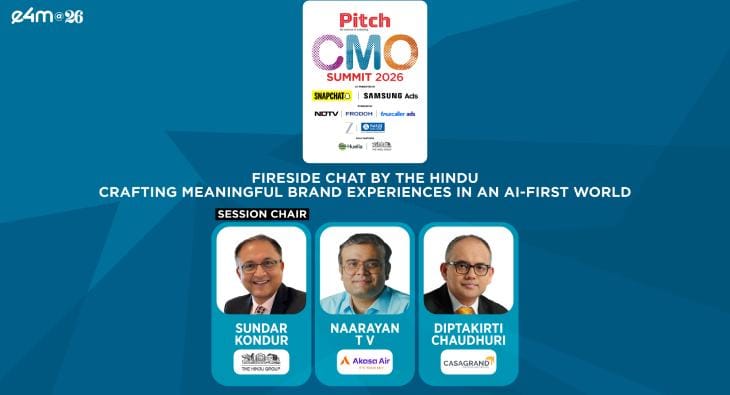

At the Pitch CMO Summit 2026, organised by the exchange4media Group in Mumbai yesterday, marketing leaders discussed how brands can craft meaningful experiences in an increasingly AI-driven landscape. The summit brought together top CMOs and marketing leaders to explore how brands can balance technology, creativity and human insight while building lasting consumer relationships.
In a fireside chat titled ‘Crafting Meaningful Brand Experiences in an AI-First World,’ Sundar Kondur, Chief Revenue Officer, The Hindu Group, was joined by Diptakirti Chaudhuri, Chief Marketing Officer, Casagrand, and Naarayan T V, Chief Marketing Officer, Akasa Air.
Opening the discussion, Kondur referenced AI pioneer Geoffrey Hinton’s thought-provoking question on whether artificial intelligence will eventually evolve into “artificial wisdom.”
“AI can process data at phenomenal speed and answer the what and how very quickly. But the why still comes from humans,” Kondur said.
Sharing his perspective, Naarayan said AI’s rapid evolution demonstrates its long-term relevance for marketers. “Ten years ago, people said data is the new oil. Today, AI is the tool that uses that data to produce meaningful output,” he said, adding that AI’s ability to evolve quickly proves it is not a passing trend.
However, marketers are still exploring the best ways to deploy it.
“We are still grappling with how to use AI to its maximum potential. In areas like customer segmentation, churn prediction and lifetime value modelling, AI is already delivering value. But brand building still requires human insight,” Naarayan noted.
Chaudhuri challenged the traditional understanding of the marketing funnel, arguing that it was never as straightforward as awareness, interest, desire and action. “If you look at it from the side, it looks like a funnel. But from the top view, it’s more like a circle,” he said.
In high-consideration categories like real estate, consumer journeys are often unpredictable. While some customers may convert within weeks, others might pause their journey and return months later with different budgets or requirements.
According to Chaudhuri, AI may accelerate certain processes but does not necessarily shorten the consumer decision journey. “It was always chaotic. Today we simply have better data to prove it,” he said.
The conversation also explored the growing tension between hyper-personalisation and maintaining a consistent brand identity.
Chaudhuri warned that personalisation can sometimes cross the line into being intrusive. “For instance, if someone has already purchased a product and continues to see ads for it, that’s not an AI problem, it’s a data discipline problem,” he said, adding that AI is only as effective as the data feeding it.
He also cautioned marketers against what he called “vibe marketing” — creating large volumes of creatives using AI tools without a clear understanding of customer cohorts. “If you don’t understand your audience properly, even the best AI tools will end up amplifying the wrong message,” he noted.
For Naarayan, one of the biggest challenges for marketers today is balancing short-term performance goals with long-term brand building. He emphasised that while AI can assist with execution and efficiency, brand trust is built over time.
With performance marketing dominating budgets, CMOs must navigate the tension between delivering immediate ROI and building lasting brand equity. Adding to this, Naarayan said, “You cannot ignore short-term outcomes, but you also cannot abandon long-term brand building. The challenge is to balance both.”
Chaudhuri also stressed that marketing cannot be confined to the marketing department alone. From frontline employees to customer service teams, everyone contributes to shaping brand perception.
As AI tools make content creation more accessible across organisations, marketers must focus on their core responsibility, understanding the consumer.
Wrapping up the session, Kondur summarised the discussion by noting that while AI is a powerful engine, the human element remains central. “Technology will continue to evolve, but the person driving that engine still matters,” he said.
Read more news about Marketing News, Advertising News, PR and Corporate Communication News, Digital News, People Movement News
For more updates, be socially connected with us onInstagram, LinkedIn, Twitter, Facebook, YouTube & Google News