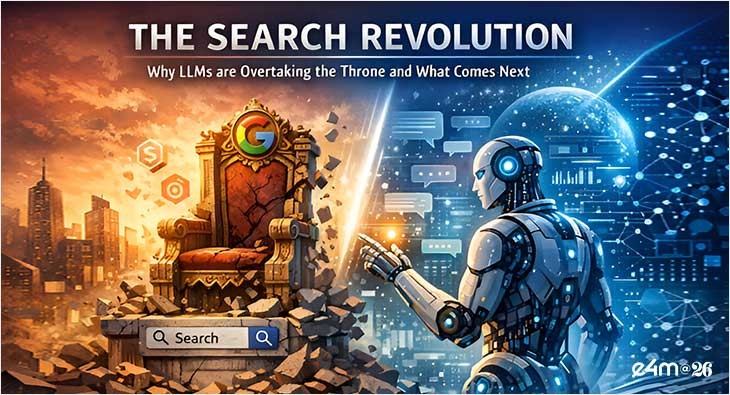
The search revolution: Why LLMs are overtaking the throne and what comes next
Guest Column: Pankaj Belwariar, Director Communications, SRM University-AP, writes on forces reshaping search, decline of traditional search engines, and what the future holds for information access
 by
by
Published: Mar 13, 2026 12:52 PM | 7 min read
 Follow Us

For decades, Google was the undisputed king of search. From navigating basic queries to deep-dive research, the search engine dominated the way we accessed information. Marketers built empires around Google’s algorithms, and its revenue from digital advertising soared. But the landscape is shifting. 2025-26 marked a turning point with the emergence of Large Language Models (LLMs) and powerful AI search tools. These innovations are not just changing how we find information; they are redefining what we expect from a search experience.
In this article, we'll delve into the factors driving this search revolution, analyse the rapid decline of traditional search engines, and predict the future of how we interact with information. Finally, we'll offer concrete advice for marketers and information seekers navigating this brave new world.
The Rise of the Intelligent Conversationalist: Beyond Keywords
The core strength of traditional search engines like Google lies in indexing. They act as vast libraries, connecting keywords in user queries with web pages deemed relevant based on intricate algorithms. While effective, this process requires users to interpret search results, piece together information from multiple sources, and potentially sift through non-relevant content or ads.
LLMs, however, operate on a different paradigm. They are trained on massive datasets, enabling them to understand the nuances of language and context. Unlike simple keyword matching, AI search understands the intent behind a query.
Consider asking, "What are the key differences between marketing strategies A and B?"
- Traditional Search: Provides a list of blog posts or articles comparing the two strategies. The user needs to read multiple sources to synthesize an answer.
- AI Search: Generates a comprehensive summary highlighting the core concepts, strengths, and weaknesses of both strategies, perhaps even creating a comparative table.
- This ability to synthesize and generate rather than just retrieve information is the crucial differentiator. LLMs offer a single, context-aware answer, saving the user time and effort.
- The Multi-Faceted Power of LLMs: From Facts to Foresight
- The capability of LLMs goes beyond merely answering direct questions. They are evolving into comprehensive analytical tools. Today's AI search assistants can provide
- Factual Details: Accurately answer specific questions like "What is the capital of Australia?" or "When was the Magna Carta signed?"
- Analytical Deep Dives: Explain complex concepts like "How does a blockchain work?" or "Analyse the impact of inflation on small businesses."
- Comparative Analysis: Provide side-by-side comparisons of products, services, theories, or historical events.
- Predictive Insights and Recommendations: This is perhaps the most transformative aspect. An LLM can be asked, "Based on these sales figures, what should be my marketing budget for the next quarter?" or "Given the current economic landscape, what are the best long-term investment strategies for a conservative investor?"
These capabilities move search from a passive information gathering exercise to an active problem-solving partnership.
The Declining Dominance of Google: A Perfect Storm
The decline of traditional search isn't solely due to the superiority of AI. A combination of factors has eroded Google’s once-impregnable position:
- Search Quality Erosion: Users frequently complain about cluttered results pages dominated by advertising, repetitive content ("content farms"), and SEO-optimized articles that prioritize keyword stuffing over quality. The "answer" is often buried deep, forcing users to click through multiple links.
- Monetization Frustration: Google’s heavy reliance on advertising has led to a perceived decline in user experience. The emphasis on paid placements over organic relevance can frustrate users looking for unbiased information.
- The "Information Overload" Problem: We are drowning in content. Traditional search can exacerbate this by presenting overwhelming lists of links. AI search, by synthesizing information, offers a lifeline.
- Rise of Alternative Platforms: For specific types of searches, users are already migrating. TikTok and Instagram are becoming go-to platforms for visual product research or local recommendations. Amazon is the king of product search. This fragmentation erodes Google's catch-all dominance.
Predicting the Future of Search: A Hybrid Horizon
The future will not likely see the complete extinction of traditional search engines, but their role will be dramatically altered. Here are some key predictions:
- Integrated Hybrid Search: We will see a convergence. Traditional search engines will deeply integrate LLM capabilities. We already see this with Google's "Search Generative Experience" (SGE) and Microsoft's Bing Chat (now Copilot). This hybrid model will provide a conversational AI summary alongside a list of credible source links for verification.
- Specialized AI Agents: General-purpose AI will be complemented by highly specialized models trained on niche data. We will have AI legal assistants, AI medical diagnosis tools, AI coding partners, etc.
- The Rise of Personalization and Privacy: AI search will become deeply personalized, understanding a user's context, past queries, and preferences. However, this will necessitate robust privacy controls and data handling protocols.
- Beyond Text: The Multimodal Shift: Search will move beyond text to include voice, images, and even video. The ability to ask, "Show me a video tutorial for fixing this leaky faucet" or "Analyse the chart in this image" will become standard.
What This Means for Marketers: From Keywords to Intent
The shifting search landscape requires a fundamental rethinking of marketing strategies.
- Embrace Content Quality Over Quantity: SEO is not dead, but the days of content farms and keyword stuffing are over. AI is excellent at detecting thin, low-value content. Marketers must focus on creating truly high-quality, authoritative, and helpful content that directly answers user queries.
- Optimize for Voice and Conversational Queries: People don't use keywords when speaking to an AI assistant; they ask full questions. Content needs to reflect this conversational style.
- Structure Data and Utilize Schema Markup: This helps AI understand the content and context of your website, making it more likely to be included in synthesized answers.
- Diversify Advertising Channels: Don't rely solely on Google Ads. Explore social media platforms, specialized search engines (like Amazon), and the emerging landscape of advertising within LLM chat interfaces.
- Focus on Brand Authority: LLMs prioritize trustworthy sources. Building a strong brand reputation and establishing thought leadership in your niche is more important than ever.
What This Means for the Audience: Becoming Critical Consumers
For information seekers, this is a golden age, but it also demands a new level of media literacy.
- Question Everything: AI is not infallible. Large language models can "hallucinate" or generate incorrect information, especially on nuanced or obscure topics. Always verify critical facts with reputable sources.
- Analyse for Bias: LLMs are trained on data created by humans, which contains inherent biases. Be aware of this and seek multiple perspectives, especially on political or social issues.
- Become a Prompt Engineer: Learning how to phrase queries effectively is crucial. The better your prompt, the better the AI's response. Be specific, provide context, and define the format of the output you need.
- Embrace the Problem-Solving Partner: Use LLMs not just to find facts, but to brainstorm, analyse data, compare options, and plan.
Conclusion: A New Era of Understanding
The transition from keyword-based search to intent-driven AI conversation is not just a technological upgrade; it's a paradigm shift in how we interact with the sum of human knowledge. The "race of search" is being won by tools that offer understanding, synthesis, and guidance over mere retrieval. This is a profound leap forward, promising a future where information is not just accessible, but truly useful. For both marketers and the general audience, the key to success lies in understanding this shift, embracing the new tools, and maintaining a critical, inquisitive mindset.
Read more news about Digital Media, Internet Advertising, Marketing News, Television Media, Radio Media
For more updates, be socially connected with us onInstagram, LinkedIn, Twitter, Facebook, YouTube & Google News