Indian media’s next act: Where commerce, content and culture collide
Industry leaders decode how reach, results, trust and technology are reshaping the future of advertising at the dentsu-e4m Digital Advertising Report 2026 launch
 by
by
Published: Feb 3, 2026 8:44 AM | 7 min read
 Follow Us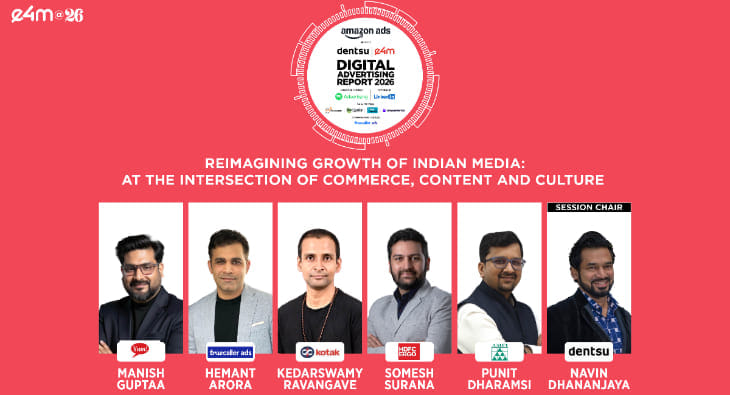

The launch of the dentsu-e4m Digital Advertising Report 2026 set the stage for a wide-ranging and deeply reflective discussion on the future of Indian media, bringing together senior marketing leaders from cement to QSR, BFSI, fintech, insurance and platform businesses.
Chaired by Navin Dhananjaya, Global CXM Lead at Dentsu Global Services, the panel featured Ajay Dang, President and Head – Marketing, UltraTech Cement; Manish Guptaa, Chief Marketing Officer, Pizza Hut; Hemant Arora, VP – Global Ad Business, Truecaller; Kedarswamy Ravangave, Head of Marketing, Consumer and Commercial, Kotak Bank; Somesh Surana, Joint President – Digital Business Group and Marketing, HDFC Ergo General Insurance; and Punit Dharamsi, Senior Vice President – Marketing and Investor Education, AMFI.
Opening the conversation, Dhananjaya anchored the discussion in the report’s headline insight: while the Indian advertising industry is projected to grow at about 8%, digital advertising is expanding at almost double that pace and is expected to account for the majority of ad spends in the coming years. The key question, he said, was whether this growth signals a deeper shift from reach-led thinking to outcome-led media strategies.
Dang was quick to caution against declaring the death of reach. “We are still a penetration market,” he said. “We are not a saturated Western market, and that applies to the media as well. Reach is part of the result. It is not a separate metric that you discard. It will continue to be one of the primary factors in driving outcomes, along with many others.”
Guptaa, however, highlighted how category dynamics are reshaping that balance. “It’s not that simple anymore,” he said. “In impulse categories like ours, if you’re launching three or four innovations a year, building from scratch every time doesn’t make sense. In boardrooms today, the pressure is very real, reach has happened, but what if results haven’t?”
That pressure, he added, is accelerating the move towards clearer attribution and sharper measurement. “There’s a strong push to move from reach and frequency to metrics that can be tied back to business, and attribution frameworks are enabling that shift.”
From a platform vantage point, Arora framed India as a market still early in its digital maturity curve. “I’m extremely excited about India,” he said. “The hustle, the hunger, the talent here is unmatched. Our metrics are more advanced than many global markets. But while the language of marketing has changed, the principles haven’t. Consumers are still human beings, loyalties still need to be built, and outcomes cannot only be about short-term database results.”
Ravangave traced the evolution of media expectations to the rise of real-time measurement. “Media buying is no longer expected to just deliver attention,” he said. “The shift is towards driving outcomes across the funnel. That expectation has expanded from performance marketing to brand marketing as well, largely because it’s easier to justify spending to CFOs and CEOs.”
He also flagged the downside of this trend. “The fallout is that brands often optimise for short-term sales and struggle to charge a premium in the long run. The real challenge for marketers is balancing short-term outcomes with long-term brand equity.”
Surana reinforced the idea that the consumer, not the channel, must anchor marketing decisions. “For me, marketing has never been about traditional versus digital,” he said. “It’s about where the consumer is and what the objective is. Measurement has evolved, but marketers have always been accountable for outcomes. What’s changed is the ability to measure them better and faster.”
For AMFI, Dharamsi said the conversation is also shifting internally. “Reach is extremely important for us as we run one of the largest awareness campaigns in the country,” he said. “But boards are now asking, ‘We’ve reached crores of people, can we start looking at conversions?’ There is a clear movement in that direction.”
As the discussion moved to emerging models, Arora introduced trust as a critical differentiator in a cluttered digital ecosystem. “There’s a marked difference between pure performance campaigns and branding-plus-performance,” he said. “At Truecaller, we talk about the trust graph. Trust has to be the starting value before engagement or conversion. Otherwise, you’re just asking for a deal without building any relationship.”
Influencer marketing emerged as a key theme in the context of trust and relevance. Guptaa pointed to a decisive shift away from celebrity endorsements. “Celebrities hardly have any influence left compared to micro-creators,” he said. “Someone with authority in food has far more impact than a celebrity telling you what to eat. Relevance and authenticity are shaping demand today.”
Ravangave noted that influencer marketing has matured from an amplification tool to a performance lever. “We’ve moved from CPV and cost-per-post to directly linking influencers to card issuance or policy sales,” he said. “But trust can’t be rented. Brands have to be extremely cautious about how they use influencers.”
On retail media networks, Dharamsi highlighted the importance of intent. “Retail media works when you catch the user in the right mindset,” he said. “We’ve seen better results advertising on banking and finance apps because the user is already thinking about money. Intent matters more than inventory.”
Dang added that retail media is not new in principle. “We’ve always tried to speak to consumers when they are ready to listen,” he said. “Digital has just given that behaviour a new name. The fundamentals haven’t changed.”
The panel then turned to technology, particularly AI-led search and discovery. Dhananjaya summarised the shift succinctly: “The question today is no longer ‘Are you on page one?’ but ‘Are you part of the answer?’”
Surana backed this up with hard numbers. “In the last four months, the leads we’re getting from LLM platforms are three times what we used to get earlier, and conversion rates are 3.5 times higher,” he said. “Volumes are smaller today, but this will grow. AI is real, and marketers have to figure out how to feature meaningfully on these platforms.”
Arora stressed that AI also amplifies the importance of permission and purpose. “AI processes data faster than ever, and consumers worry about control,” he said. “That’s why sticking to purpose and permission-based engagement becomes critical. Trust is where the buck stops.”
Looking ahead, the panel agreed that while tools and platforms will continue to evolve rapidly, the constants are human needs and trust. Dang summed it up by grounding the future in fundamentals. “When things change too fast, you ground yourself in what doesn’t change,” he said. “Human search, the need to solve problems and get ahead in life will always remain.”
As Dhananjaya closed the session, one theme stood out clearly: India’s next phase of media growth will not be driven by commerce, content or culture in isolation, but by how thoughtfully brands integrate all three, balancing technology with trust and outcomes with long-term value.
Read more news about Marketing News, Advertising News, PR and Corporate Communication News, Digital News, People Movement News
For more updates, be socially connected with us onInstagram, LinkedIn, Twitter, Facebook, YouTube & Google News
