dentsu’s Narayan Devanathan bets on ‘attentive reach’ as next currency of digital impact
Narayan Devanathan, President and Chief Strategy Officer, South Asia at dentsu, spoke at the dentsu-e4m Digital Report 2026 launch on developing a proprietary metric, AI-driven agents and more
 by
by
Published: Feb 3, 2026 8:24 AM | 3 min read
 Follow Us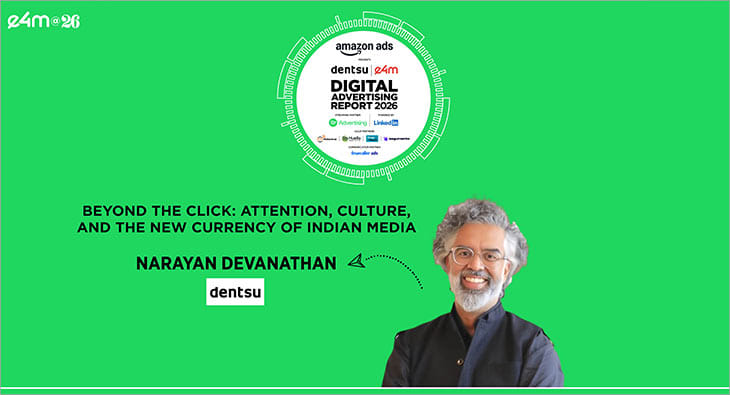

As the advertising industry sorts issues like declining trust in likes, impressions and click-based metrics, dentsu has been pushing for a new way to measure digital impact, one that goes beyond visibility to focus on attention itself.
Speaking at the dentsu-e4m Digital Report 2026 launch, Narayan Devanathan, President and Chief Strategy Officer, South Asia at dentsu, revealed that the network has been developing a proprietary metric called “attentive reach”, positioning it as a more reliable indicator of real impact in a fragmented, AI-driven media ecosystem.
“Why are we obsessing so much about saying maybe likes and engagements and impressions are not the right way to measure impact in the digital-first world?” Devanathan said, adding that the renewed industry focus on attention is rooted in a fundamental truth. “Without passing through the bottleneck of attention, we are not getting anywhere.”
According to Devanathan, attentive reach has emerged after extensive experimental research and aims to replicate what television measurement once achieved for broadcasters and advertisers. “In the same way that TV meters made for reliable and consistent and replicable measurement of TV viewing and the impact of that, attentive reach is a valid enough measure for digital,” he said, while acknowledging that the metric is still evolving.
The push comes at a time when the very nature of attention is changing. Devanathan argued that the industry can no longer assume attention is purely human-led. “Today is probably not far when we outsource most of our consumption decision-making to agents that we create,” he said, pointing to AI-driven agents that will soon handle everything from price checks to purchase decisions.
As machines increasingly make decisions on behalf of consumers, Devanathan questioned whether traditional advertising interventions will remain effective. “Will attention still be a bottleneck to thought when machines are thinking, and machines are talking to machines?” he asked.
This shift is already visible in performance marketing, where brands are moving beyond search engine optimisation. “We have just now graduated from search engine optimisation to generative engine optimisation,” Devanathan noted, calling it an early but significant signal of how machine-led discovery is reshaping visibility and influence.
Despite widespread anxiety around AI, Devanathan struck a measured tone, arguing that control has not been lost. “The smartest people in the realm of AI are not scared by it. They are not terrified by it. They are saying — how can we use this to our advantage?” he said.
For dentsu, attentive reach is an attempt to future-proof measurement in a world where attention may no longer sit solely with humans, screens or even conscious choice. “Shaping attention, or shaping the shape of attention, is something that is still entirely in our hands,” Devanathan said.
As AI agents, generative platforms and emerging technologies redraw the boundaries of perception and decision-making, the battle for attention is no longer about scale alone—but about whether brands are reaching moments that actually matter.
Read more news about Internet Advertising India, Marketing News, PR and Corporate Communication News, Digital Media News, Television Media News
For more updates, be socially connected with us onInstagram, LinkedIn, Twitter, Facebook YouTube & Google News