The radio spot isn’t enough anymore! Up to 45% of festive briefs go multi-platform
As festive ad spends climb 10-15%, nearly half of high-value campaigns are going multi-platform, forcing broadcasters to bundle airtime with digital, creators and activations to stay in the game
 by
by
Published: Sep 23, 2026 9:39 AM | 8 min read
 Follow Us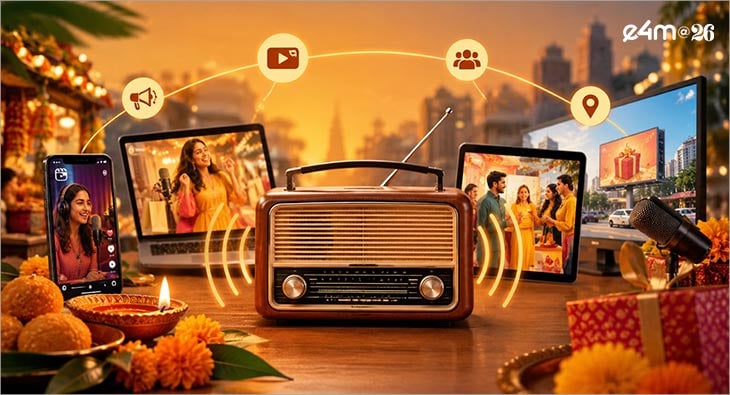

- Radio advertising is experiencing a festive season boost, with Red FM reporting double-digit growth in festive spends and Mirchi anticipating an 8-10% increase in overall budgets compared to last year.
- Advertisers are increasingly shifting from traditional spot buys to multi-platform campaigns, with 35-45% of high-value festive briefs now incorporating various media and activation strategies.
- Despite the festive growth, overall radio advertising volumes grew only 1.2% in the first half of 2026, with a significant reliance on a few sectors, particularly real estate, which contributed 17% of the total volume.
- The radio industry is adapting to a more integrated media approach, emphasizing the need for contextual relevance and collaboration with digital and OOH platforms, rather than competing directly with them.
The festive season may still be bringing more money into radio, but the way advertisers are spending that money is changing. As per Red FM, festive radio spends are tracking at double-digit growth, while Mirchi is expecting overall festive budgets to rise 8-10% over last year. Mirchi highlighted pure-spot effective rates are up 10-15% during the peak period, with 35-45% of its high-value festive campaign briefs now coming in as multi-platform packages.
The numbers suggest a strong festive window. But zoom out and the picture is less straightforward.
Radio advertising volumes grew just 1.2% in January-July 2026, according to TAM AdEx. The top 10 sectors accounted for nearly 92% of volumes, with real estate alone contributing 17% and growing 20% year-on-year. Pitch Madison, meanwhile, puts radio's 2025 AdEx at ₹2,515 crore, up just 2% from 2024, while its share slipped marginally from 2.3% to 2.2%.
Read On: Radio advertising grows 1.2% in Jan-Jul 2026; real estate leads with 17% share: TAM AdEx
So, the festive opportunity is real. But for radio broadcasters, the bigger question is what advertisers are actually buying. Increasingly, it isn't just spots!
The humble spot is getting company
Red FM's Director & COO Nisha Narayanan said the medium is seeing a shift in the nature of advertiser conversations.
“The more interesting change we are seeing is not necessarily in how early or how long advertisers are booking. It is in how they are thinking about their festive presence. The conversation is increasingly moving from, “How many spots can I buy?” to, “How do I stay connected with the consumer through the festive journey?””
For advertisers, that is turning radio from an inventory purchase into a broader activation opportunity.
“Very few advertisers today come to us looking for a radio-only campaign. Radio continues to be a strong starting point because of its reach, trust and frequency, but brands are increasingly looking to build around it with digital content, RJ-led social media, influencer collaborations, branded content, on-ground activations and experiences,” said Narayanan.
That shift is visible across broadcasters. Narayanan said Red FM is seeing stronger participation from retail, lifestyle, BFSI, automotive and consumer durables, alongside growing interest from D2C brands, regional businesses and experience-led marketers.
Read On: Festive media bets shift upstream as brands chase intent before Diwali ad inflation
Mirchi is seeing the same movement, but with a more measurable commercial proposition. Chandan Das, Vice President & Business Director, Mirchi, said festive budgets are increasingly moving towards networks that can combine multiple touchpoints. “The real driver behind this double-digit growth, though, isn't traditional airtime (FCT) alone. Advertisers aren't just buying ad spots; they want full-funnel presence. Budgets are flowing heavily toward networks that can stitch on-air reach with digital extensions, creator-led storytelling, and physical activations.”
Mirchi estimated that 35-45% of its high-value festive briefs are now multi-platform. “Easily 35% to 45% of our high-value festive campaign briefs are now multi-platform packages, and that number keeps climbing.”
The festive rush isn’t just a metro story
The categories driving demand also underline why radio remains relevant to marketers looking for local scale.
Das said real estate remains a major contributor to Mirchi's volumes, at roughly 15-17%, while Auto, Jewellery, Consumer Durables, Mobile Devices and Organised Retail are seeing stronger festive momentum.
“Compared to 2025, Jewellery and Auto have stepped up their spending significantly to clear inventory and capture high festive demand,” he added.
Geography is equally important. While metros continue to attract corporate campaigns, Das pointed to Surat, Ahmedabad, Jaipur, Indore and Nagpur as markets seeing strong festive traction. “It is a heavily regional and Tier-2 story.”
That aligns with TAM AdEx data, which shows Gujarat and Maharashtra contributing 17% and 15% respectively of radio advertising volumes in January-July 2026. Jaipur was the leading city, followed by Nagpur and Indore, while the top 10 cities accounted for 63% of volumes.
Read On: Radio advertising can reinvent itself. The opportunity is bigger than the challenge
Big FM CEO Ashit Kukian also sees regional amplification as one of radio's key festive advantages. “India's media market is becoming increasingly fragmented, but consumer attention remains local and contextual. That is where radio continues to have a very distinctive role to play.”
“For brands, festivals are increasingly local consumer moments. The communication therefore needs to reflect the language, culture, retail environment and consumption behaviour of individual markets. That plays directly into the radio's strengths,” he added.
He added that the medium is increasingly being evaluated for its ability to fit into a larger campaign rather than simply deliver frequency. “Advertisers are looking for frequency, contextual integration, regional relevance and the ability to connect radio with their wider digital and on-ground campaigns.”
The festive rush is making airtime dearer
Beyond the push for integrations, the old battle for prime-time inventory hasn't gone away. Das said demand rises sharply in the four to six weeks before Diwali, with morning and evening prime-time bands accounting for nearly 70% of festive demand. Since commercial airtime is capped, he said pure-spot effective rates are rising 10-15%.
“Since commercial airtime is capped to keep the listening experience clean, high demand pushes effective ad rates (ERs) up by 10-15% on pure spot buys.”
But Big FM's Kukian drew a distinction between premiumisation and simply raising rates. “However, I would distinguish between genuine premiumisation and blanket rate inflation. Advertisers today are considerably more disciplined about ROI, so simply increasing rates across the board is not necessarily sustainable.”
What advertisers appear willing to pay more for is not necessarily more FCT, but higher-impact inventory, integrations, sponsorships and branded content. “There is also a clear shift towards earlier planning. Brands and agencies that know their festive requirements are increasingly looking to secure relevant inventory ahead of the peak period rather than treating radio as a last-minute tactical medium.”
It’s not radio versus digital anymore
For all the talk of radio gaining from festive budgets, broadcasters themselves are careful not to frame the trend as a migration from digital or OOH.
Kukian put it bluntly: “I don't think the market is seeing a wholesale shift of budgets from digital or OOH into radio. That would be an oversimplification of how brands are planning today.”
Instead, each medium is being assigned a different role. “Digital continues to be central to festive planning because of its targeting, performance and commerce capabilities. OOH provides scale and physical visibility. Radio brings frequency, immediacy, local language and the ability to build a conversation with consumers through trusted voices and contextual programming.”
That integrated approach is also reflected in Mirchi's pitch. “It’s less about pulling budgets from digital or OOH and more about a smarter, integrated media mix.”
For Mirchi, the argument is that radio can complement rather than cannibalise digital, particularly during periods when digital acquisition becomes more expensive. “Rather than cannibalizing other media, brands are unlocking fresh festive budgets for hyperlocal audio solutions that seamlessly bridge on-ground presence with digital and on-air reach.”
The festive bump can't hide radio's larger challenge
That distinction matters because radio's broader advertising growth remains modest. TAM AdEx recorded just 1.2% growth in radio ad volumes in the first seven months of 2026. At the same time, more than 140 categories recorded positive growth, suggesting the medium isn't dependent on just a handful of advertisers even though its overall growth remains limited.
ENIL's FY26 numbers provide another indication of the pressure. Its consolidated revenue rose 3.9% to ₹565 crore, but the growth was driven by its digital business while the radio advertising market remained under pressure.
Read On: ENIL Q4 profit down 32% YoY; FY26 slips into loss despite marginal revenue growth
The structural pressure is visible elsewhere too. HT Media and its subsidiaries surrendered licences for Radio Nasha in Mumbai, Radio One in Delhi, Mumbai and Bengaluru, and Fever FM in Chennai. The affected radio operations had generated ₹29.19 crore in FY25 but carried a combined negative net worth of ₹172.08 crore as of March 31, 2025. HT Media described the stations as financially and strategically unviable.
Read On: HT Media exits key radio markets in Chennai
Against that backdrop, the festive season becomes more than another quarterly spike. It is a test of whether radio can expand its role in the advertiser's media plan.
Kukian believes the answer lies in moving beyond inventory. “The other significant shift is from inventory-led planning to solution-led planning. Advertisers are becoming more selective about where they spend, but they are also willing to invest more when a medium can provide a combination of reach, relevance, content and measurable amplification.”
And that is perhaps the clearest change in the radio pitch this festive season. Broadcasters are not necessarily asking advertisers to take money away from digital, OOH or other media. They are asking them to give radio a bigger job to do.
As Kukian put it: “The festive opportunity for radio is not about taking budget away from digital or OOH; it is about becoming more valuable within the total consumer journey.”
For an industry whose traditional proposition has long been built around spots, frequency and reach, that may be the more consequential shift: the radio spot isn't disappearing. It is simply no longer being sold as the whole product.
Read more news about Radio Media, Digital Media, Television Media, Marketing News, Advertising India
For more updates, be socially connected with us onInstagram, LinkedIn, Twitter, Facebook YouTube & Google News