AI can make infinite content. But can it make anyone care?
As AI content floods the open web, there is worry about a growing disparity between production and audience attention, and whether anyone is willing to consume?
 by
by
Published: Sep 23, 2026 9:08 AM | 7 min read
 Follow Us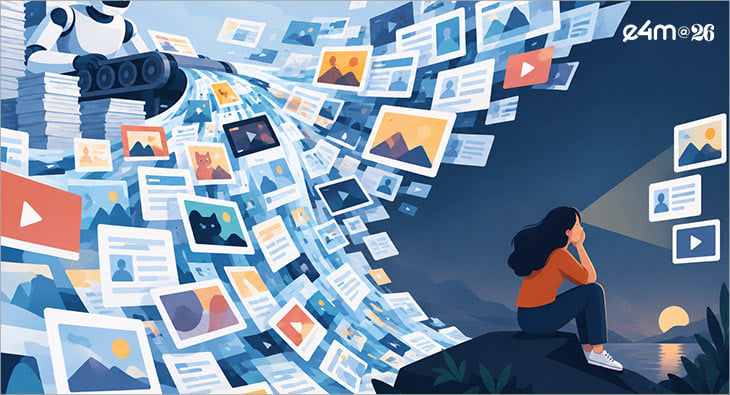

- A recent NP Digital survey revealed that while 52.1% of new content produced by companies is AI-generated, it only attracts 4.9% of organic traffic, indicating a disconnect between production and audience engagement.
- Human-created content significantly outperforms AI-generated material on social media, receiving 2.15 times more likes and three times more saves, suggesting that originality and trust are key factors in audience preference.
- Despite the scalability of AI in content creation, the challenge lies in capturing audience attention in a saturated market, where generic AI content often fails to stand out against numerous alternatives.
- Experts emphasize the importance of quality and audience understanding over sheer volume in content production, arguing that AI should complement human creativity rather than replace it, as the effectiveness of content ultimately depends on its ability to engage and resonate with audiences.
For those in the business of creating, consuming and contextualising content, as most of the people reading this article are, spotting AI-generated material can seem pretty easy. After years of reading, writing, editing, approving, and rejecting reams of audio, textual and visual content, we like to think we've developed a sense of what was made by a person versus what was made by a machine.
It seems we are not the only ones with this gift. And alas, it is not a superpower shared by only those in the media industry. So much for that blockbuster IP idea.
Research suggests that audiences may be rather less enamoured of machine-generated content than the industry producing it. An August 2026 NP Digital survey of 100 companies found that fully AI-generated material accounted for 52.1% of their new content but attracted just 4.9% of organic traffic. In a separate analysis, human-created social posts received 2.15 times as many likes and three times as many saves as their fully AI-generated counterparts.
Of course, none of this means AI-generated content is inherently bad. A compelling idea doesn't become less compelling simply because a machine helped bring it to life. Nor does a thoroughly mediocre advertisement acquire artistic merit because several humans spent three weeks producing it.
The problem may be rather more elementary: quantity.
As we covered in our preceding article, there is an avalanche of AI-generated content drifting across our screens, with advertising contributing to the glut in no small measure. And while the technology has made creating content almost infinitely scalable, the human capacity to consume it remains stubbornly finite.
Given that advertising is built on grabbing attention and, ideally, converting it into some kind of transaction (money spent, time invested, or even a finger persuaded to swipe in the desired direction) how does one persuade a potential customer to distinguish that specially curated individual snowflake from the avalanche?
Or, more importantly, to care enough about that particular snowflake to do something about it?
The great attention deficit
The disparity between content production and discoverability extends beyond NP Digital's relatively small survey.
In October 2025, Graphite published an analysis of Google search results for 31,493 keywords across ten categories. It found that 86% of English-language articles appearing in its sampled results were classified as human-written, compared with 14% classified as AI-generated. At the top position, AI-generated articles accounted for just 7%.
The findings suggest a gap between machine-generated content production and organic visibility, although they do not establish that AI authorship itself causes poor rankings.
Kunal Kothari, Chairman, Founder & COO, Mobavenue AI Tech Limited, argues that the distinction becomes clearer when comparing the open web with platforms that already have an established audience.
"In a closed, habitual-use product, the platform controls distribution. The user has already shown up, and the feed decides what they see. On the open web, content has to earn attention against unlimited alternatives, and people reward originality, a point of view, and trust," he says.
For Kothari, production itself has become less valuable as a differentiator. The advantage increasingly lies in understanding the audience and determining what is worth communicating.
Aditya Kathotia, CEO & Founder, Nico Digital, agrees. "On the open web, nobody is obliged to stay with you. Readers can compare five sources in a few seconds, and generic AI content rarely gives them a reason to pick yours," he says.
The commercial problem is straightforward. Lower production costs allow marketers to publish more articles, explainers and social posts, but additional supply does not automatically create demand.
If the material offers little that audiences cannot find elsewhere, the savings achieved during production may prove considerably less impressive when measured against the attention it earns.
Is AI the problem, or how we're using it?
There is, however, an important complication.
Research by Ahrefs, published in May 2025, found that 74.2% of 900,000 newly detected English-language web pages contained some AI-generated material. Yet just 2.5% were classified as purely AI-generated.
In a separate analysis of 600,000 pages, Ahrefs found virtually no correlation between the proportion of AI-generated content on a page and its Google search ranking.
In other words, using AI does not necessarily make content less discoverable. Nor does producing something entirely by hand guarantee that anyone will find it interesting.
Dhiraj Sharma, Head of Marketing and Public Relations, Panasonic Life Solutions India, believes that while AI has transformed the speed and scale of content creation, the underlying idea remains the fundamental differentiator.
"On the open web, every piece of content has to earn attention and give audiences a reason to engage, return or share it," he says. "The opportunity for marketers is therefore not to look at AI versus other forms of content creation, but at AI and other capabilities working together."
Sharma argues that brands must move beyond traditional content metrics to understand the signals of genuine audience interest, relevance and engagement.
Saurabh Kumar, Founder, Envigo, similarly believes the issue is closely connected to audience trust and the quality of human intervention. "It is not a ceiling on what AI can do. It is a ceiling on AI content nobody bothered to edit," he says
Google's own guidance distinguishes between AI assistance and indiscriminate mass production. Its spam policies address large volumes of unoriginal, low-value content created primarily to manipulate rankings, regardless of whether humans or machines produced it.
The implication for marketers is that the ability to generate another hundred pieces of content is not, in itself, a reason to publish them. Especially when each must compete with everything already available to the same audience.
Ankesh Kumar, Director – Marketing, Ingram Micro India, argues that weak briefs, insufficient context and repetitive execution are responsible for much of any disappointing output, saying that marketers must provide the technology with a clearer understanding of their brands and audiences.
When abundance meets indifference
The equation changes somewhat when content is produced for platforms with established, habitual audiences.
Pulkit Narayan, Founder and CEO, AudienceConnect, argues that AI-generated material can benefit from built-in distribution within closed platforms, whereas content on the open web must actively persuade audiences to seek it out.
"AI makes content production easier to scale, but scale doesn't automatically create attention," he says.
This distinction matters for advertising. A marketer producing creative variations for an established audience operates under different conditions from a publisher attempting to build organic readership from scratch.
Similarly, an AI-assisted advertisement that answers a specific consumer need may be commercially useful without attracting substantial organic engagement. The research on organic content cannot, by itself, establish whether AI-generated advertisements deliver weaker conversions or sales.
Amit Verma, Founder and CEO, DigitUp, offers a pragmatic perspective. He compares AI to electricity: a general-purpose technology that will eventually become so commonplace that describing a business as AI-enabled will cease to be a meaningful distinction. "Very soon, simply saying you're AI-enabled will be a foolish thing to say."
He argues that AI can help people articulate their ideas without necessarily replacing the person responsible for them.
And if every business has access to broadly similar content-generation capabilities, possessing those capabilities is unlikely to distinguish one business from another.
The available research does not yet establish that every additional AI-generated asset delivers progressively smaller returns, or that human-created content will always outperform it. What it does suggest is that production volume and audience attention are not increasing in lockstep.
Which brings us back to the uncomfortable arithmetic of the content glut.
An advertiser can now produce a hundred creatives where it once produced ten. A publisher can generate a month's worth of articles in an afternoon. A brand can fill its social calendar before the marketing team has finished its morning coffee.
The machines can keep generating. The platforms can keep publishing.
The audience, meanwhile, still has only so many hours in the day, and only so much attention it is prepared to surrender to advertising.
The law of diminishing returns may not have been written with generative AI in mind. But as the industry discovers the joys of producing almost everything for almost nothing, it may also be discovering that making more content and making more people care are two very different businesses.
Read more news about Digital Media, Internet Advertising, Marketing News, Television Media, Radio Media
For more updates, be socially connected with us onInstagram, LinkedIn, Twitter, Facebook, YouTube & Google News