Smartphone Slump: Will brands rein in festive ad spends?
With smartphone shipments to India falling and device prices rising, brands face a tougher upgrade market; nearly ₹3,000 cr in annual ad spend in focus, with 40–50% concentrated around festive season
 by
Published: Oct 29, 2026 9:10 AM | 7 min read
 Follow Us

- India's smartphone market is experiencing significant pressure, with shipments declining by 20% year-on-year in Q3 2026, the lowest level in a decade, primarily due to rising component costs affecting mass-market devices.
- Shipments in the sub-₹20,000 category have decreased by 47%, and overall market contraction is expected to be around 13% for the year, despite a projected 5% increase in market value due to higher average selling prices.
- Brands are adopting a selective approach to festive advertising budgets, with premium brands focusing on brand building and mass-market players emphasizing affordability and purchase incentives to stimulate demand.
- The advertising strategy is shifting towards a more integrated approach, combining traditional and digital media to enhance consumer engagement and drive measurable conversions, as brands seek to justify their marketing expenditures amidst cautious consumer spending.
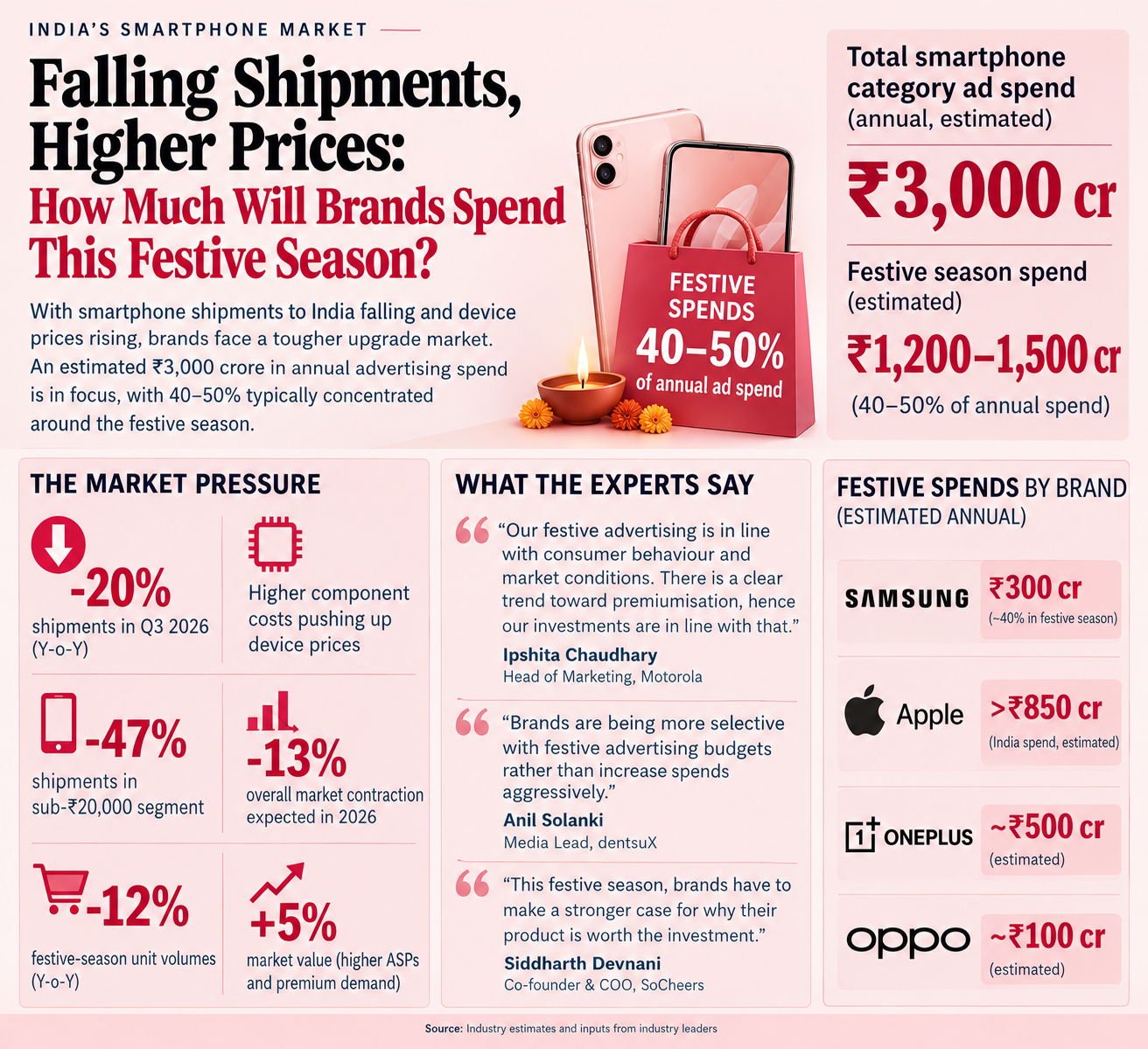
India’s smartphone market is heading into the festive season under pressure. Shipments fell 20% year-on-year in the third quarter of 2026, marking their lowest level in a decade, according to Counterpoint Research. The decline comes as higher component costs push up device prices, particularly weighing on the mass-market segment.
Shipments in the sub-₹20,000 category fell 47%, while Counterpoint expects the overall smartphone market to contract around 13% in 2026. Festive-season unit volumes are projected to decline 12% year-on-year, even as market value rises 5%, reflecting higher average selling prices and demand for more expensive devices.
For smartphone makers, the challenge is no longer simply generating interest in new launches. With consumers holding on to their devices for longer and weighing upgrades more carefully, advertising must do more to translate consideration into purchases, industry leaders noted.
“Market conditions may be cyclical, however, brand building is a resilient and long term process,” Ipshita Chowdhury, Head of Marketing, Motorola India, told e4m. She explains, “Our festive advertising is in line with the consumer behaviour and market conditions. There is a clear trend toward premiumisation, hence our investments are in line with that. Our focus has always been on delivering the most compelling and complete value proposition for each consumer segment, and our campaign ‘It’s the time to moto’ does just that.”
Read more: Market turbulence puts festive season spends to test
Chowdhury further says, “Our campaign strategy has been balanced between the upper and lower funnel, and we continue with that approach. Conversion levers are different and rely more on final affordability triggers, but for that to come into action, consumer awareness and through the funnel approach is needed. Eventually it is all ROI driven.”
e4m reached out to other smartphone brands to understand their perspective. Their response was awaited till the time of writing these lines.
Anil Solanki, Media Lead, dentsuX, says smartphone brands are responding by becoming more selective rather than uniformly increasing or cutting festive investments. “In the current scenario, smartphone brands are being more selective with festive advertising budgets rather than increase spends aggressively. Premium brands may continue investing in brand building, while mass-market players will focus on value propositions, exchange offers and financing schemes to stimulate demand.”
Why GenZ's attention is becoming a catch-22? Read more here
This points to a more nuanced outlook for the advertising industry. Smartphone brands were expected to increase marketing and advertising spends by 15–20% over the previous festive quarter. But falling shipments, higher prices and longer replacement cycles have raised questions about whether they will maintain those plans or reallocate budgets across products, markets and media channels.
₹3,000 Crore Annual Ad Spend: Festive Bets in Focus
Industry estimates put smartphone brands’ annual advertising spend at around ₹3,000 crore, with an estimated 40–50% concentrated around the festive season. That puts approximately ₹1,200–1,500 crore of advertising investment in focus as brands navigate falling shipments, higher device prices and consumers delaying upgrades.
Samsung spends around ₹300 crore annually on advertising and promotions, with nearly 40% of its spend concentrated around the festive season. Apple’s India spend is estimated at over ₹850 crore, while OnePlus spends close to ₹500 crore and Oppo around ₹100 crore.
Can stars drive microdrama monetisation? Read here
The pressure on marketers is not necessarily to cut visibility, but to justify how each campaign contributes to sales. As consumers become more cautious about upgrading, brands may need to sharpen their propositions and concentrate spending on products and segments with the strongest conversion potential.
Siddharth Devnani, Co-founder and COO, SoCheers, says, “This festive season, brands have to make a stronger case for why their product is worth the investment. As we’ve explored in our festive report, The Festive Rupee, consumers are making choices about where their money goes, and every brand is competing for a share of that spending.”
“I think we’ll see a bigger push towards bottom-of-the-funnel marketing this season, with brands focusing more on converting people who are already considering a purchase. Consumers are checking reviews, comparing specifications and looking for the best deal before making a decision. Digital campaigns, influencers and performance marketing can help brands reach them at these crucial moments, while exchange bonuses, bank discounts and no-cost EMIs can help close the sale,” Devnani said.
He further noted, “Ultimately, it’s about connecting consumer interest to an actual purchase. When people are being more selective about their spending, brands need to demonstrate value, make the buying decision easier and give consumers a compelling reason to choose them over the competition.”
Premium and Mass-Market Brands May Take Different Routes
The market slowdown is unlikely to affect every brand or price segment in the same way. Premium players can continue to build aspiration around innovation and product differentiation, while mass-market brands may need to sharpen their emphasis on affordability and purchase incentives.
Shradha Agarwal, Co-founder and CEO, Grapes, does not expect a uniform pullback. “I don't see smartphone brands uniformly cutting their festive advertising budgets. What I expect is a more selective allocation of spends compared with 2025, with brands prioritising models, price segments and markets where they see the strongest potential for conversion,” she says.
Agarwal says the divergence could become more pronounced as brands respond to different consumer priorities. “Premium brands may continue investing in innovation, aspiration and brand equity, while mass-market players could become more tactical, focusing on affordability, exchange offers, financing and festive promotions.”
The distinction matters as higher average selling prices lift market value even while unit shipments decline. Brands seeking growth will have to balance the value of premium positioning against the need to maintain volumes in price-sensitive segments.
Promotions could become more important in the purchase decision. Exchange benefits, easy financing and time-bound festive offers can help address the upfront cost of upgrading, though their effectiveness will depend on the model, target audience and consumer demand.
For marketers, the larger question is how to balance visibility with measurable business outcomes. “The bigger shift will be from share of voice to share of wallet. Brands will not necessarily reduce their visibility, but they will demand greater accountability from every advertising rupee,” Agarwal says.
Beyond Digital: The Case for an Integrated Media Mix
The stakes extend beyond the size of the overall advertising pie. The distribution of spending across television, digital platforms, influencers and commerce media will also determine which channels benefit as brands seek to convert consumer interest into purchases.
Greater pressure on conversions does not necessarily mean a wholesale shift away from traditional media. Smartphones are high-consideration purchases: consumers compare specifications, watch reviews, evaluate prices and exchange offers, and then decide where to buy. Advertising has to influence several stages of that journey.
Solanki says the allocation of budgets is increasingly reflecting this need for more targeted and measurable communication. “We are seeing a clear shift towards digital, influencers and performance-led campaigns, where brands can target consumers by region, price segment and purchase intent, with more measurable conversions. TV and print will continue to support major launches and mass awareness, but the emphasis is increasingly on efficient media investment and conversion-led marketing.”
Digital platforms, influencers, retail media and performance marketing can influence consideration and help drive measurable conversions. Technology reviewers, in particular, can help consumers assess product features and credibility. Television and other mass-reach platforms can continue to build awareness and brand salience during the festive season, including among audiences beyond brands’ existing digital reach.
Agarwal sees the opportunity in combining these roles rather than treating the choice as a simple contest between traditional and digital media. “I don't think this is simply a shift from traditional media to digital. It is a shift towards a more integrated, full-funnel media strategy,” she says.
She expects brands to use mass media selectively to build trust and awareness, technology influencers to establish product credibility, and performance and commerce media to convert demand.
The challenge for marketers will be to connect these channels rather than evaluate each in isolation. As budgets come under greater scrutiny, the ability to demonstrate incremental sales—not simply reach or engagement—could increasingly shape allocation decisions.
“The winning strategy won't be choosing between brand building and performance. It will be making brand building improve performance,” Agarwal says. “Ultimately, the question for marketers should not be which channel delivers the cheapest impression, but which combination of channels delivers the most incremental sales at the most efficient cost.”
Read more news about Festive Season, Marketing, PR and Corporate Communication, Internet Advertising, People Movement
For more updates, be socially connected with us onInstagram, LinkedIn, Twitter, Facebook, YouTube & Google News