Winning games, losing money? Global esports’ exit exposes business model problem
As India’s oldest esports organisation shifts from competitive teams to gaming services, industry leaders point to profitability, publisher support and community monetisation as critical to future
 by
Published: Oct 29, 2026 9:10 AM | 5 min read
 Follow Us


- Global Esports (GE), one of India's oldest esports organizations, has ceased its competitive operations due to unsustainable business practices, despite the growing popularity of gaming.
- Founded in 2017, GE transitioned from competing in various games to focusing on VALORANT, becoming a partner team in the VALORANT Champions Tour (VCT) Pacific in 2023.
- The organization plans to pivot towards its gaming studio and services business, which had been financially supporting its teams, as it seeks to create sustainable revenue streams beyond competitive gaming.
- The closure reflects broader challenges in the esports industry, including high operational costs, the need for publisher support, and the necessity for organizations to build loyal fan communities and diverse revenue sources.
Global Esports (GE), one of India’s oldest esports organisations, has shut down its competitive operations, raising questions about the commercial viability of running esports teams even as gaming continues to attract players, audiences and brands.
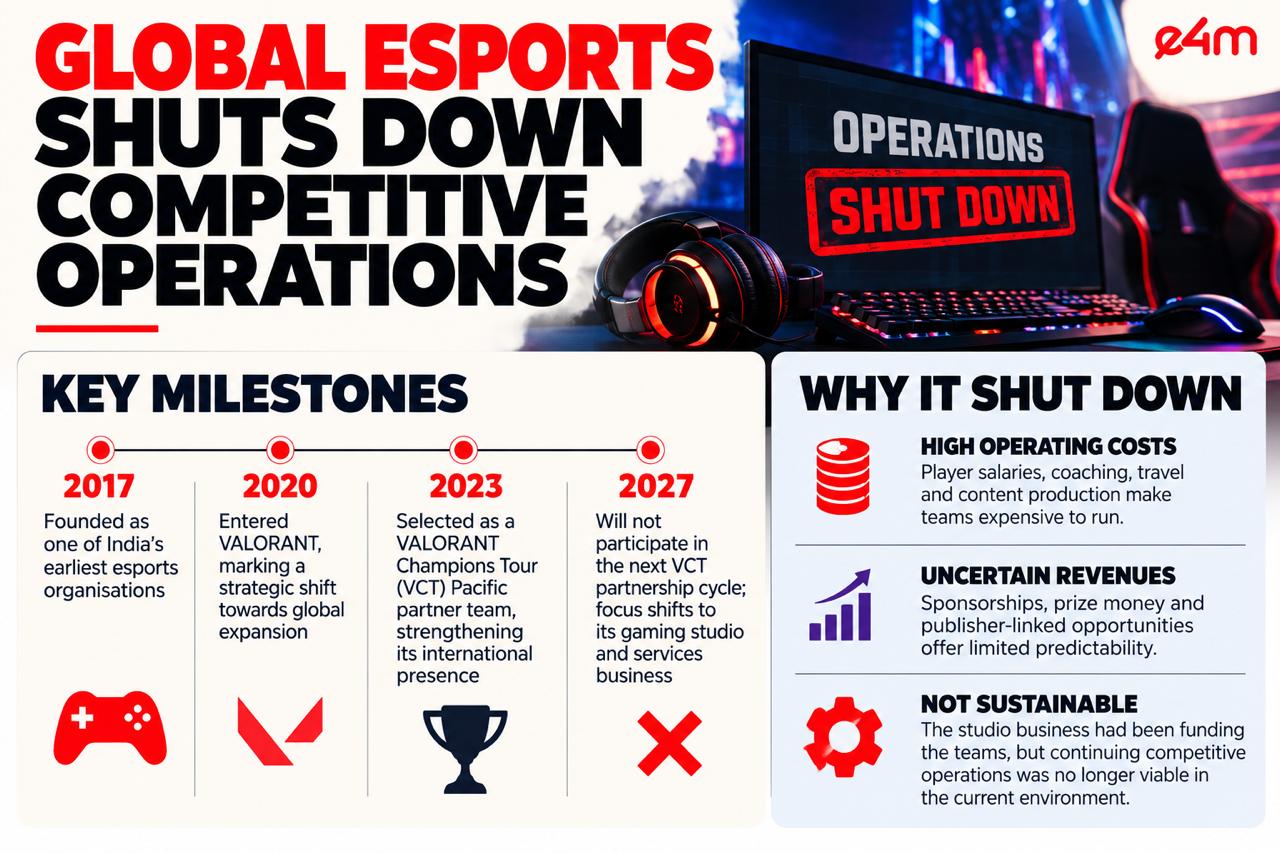
Founded around 2017, GE competed across Counter-Strike, Dota 2, Overwatch and PUBG Mobile before focusing on VALORANT. Its entry into VALORANT in 2020 and selection as a VALORANT Champions Tour (VCT) Pacific partner team in 2023 marked its international expansion. The organisation will not participate in the next VCT partnership cycle beginning in 2027, instead prioritising its gaming studio and services business.
When competitive success does not translate into a viable business
Rushindra Sinha, founder and chief executive of Global Esports, said the studio business had been funding its teams, but continuing to operate them was no longer sustainable.
“We’re pivoting to focus more on our studio than before and making that our primary business instead of the teams. The studio anyway paid for the teams but we’re just dropping the teams side of the business. It’s non-sustainable in its current form,” Sinha said.
He added that the current environment favoured players, creators, athletes and publishers, but challenged organisations.
“It’s great for players and creators and athletes and publishers etc — just terrible for an organization,” he said.
Teams face substantial expenses, including player salaries, coaching, travel and content production, while sponsorships, prize money and publisher-linked opportunities offer varying levels of predictability. Competitive success and audience growth do not automatically translate into recurring revenue or profitability.
Building fandom beyond tournament results
Rohit Jagasia, founder and chief executive of Revenant Esports, said sustainability depends on building a loyal community rather than relying solely on competitive results.
“Esports thrives when organizations build a genuine fandom rather than just focusing on winning tournaments. Staying relevant to fans is critical,” Jagasia said.
He said the approach helped Revenant become the first team to fully sell out its jersey sponsorship slots, with partners including iQOO, Lenovo Legion and Monster Energy.
“Building sustainable esports business is a highly time and energy-consuming business. To be truly sustainable, organizations must move beyond relying on prize pools and build diverse, monetizable revenue streams through sponsorships, merchandise, and dedicated content verticals,” he added.
The emphasis is on building audiences that remain engaged between tournaments and creating commercial opportunities beyond prize money.
From esports teams to gaming services
GE plans to monetise its experience by providing services to other businesses across the gaming ecosystem.
“Our focus will be on vertical integrated solutions for gaming companies. GTM, media, content, socials, growth all of it for esports orgs, publishers, TOs, EOs, brands etc anyone and everyone in the gaming space. Everything we’ve learned in the last decade we will scale up and offer as services to all operators in the gaming space,” Sinha said.
The proposed services cover go-to-market strategy, media, content, social media and growth. Sinha also outlined ambitions to build an operating system for gaming companies using processes developed over the past decade.
Esports valuations give way to profitability
Akshat Rathee, managing director and co-founder of NODWIN Gaming, said GE’s decision reflected a wider correction in the global gaming and esports industry.
“I think companies go over certain life cycles and founders are either designed to be wartime founders or peacetime founders. Esports at a time when the valuations were ripe and everyone was going after esports,” Rathee said.
He argued that the industry was reassessing business models built around high valuations rather than sustainable earnings.
“Gaming is not dying but the business model of gaming was predicated on either strong valuations that were not linked to profitability or sustainability or metrics that were not conducive to ongoing sustainability of the ecosystem per se,” he said.
Rathee said the industry was moving away from being a “sexy cool thing” towards becoming a stable business. The shift means organisations must demonstrate commercial viability rather than depend on future investment, sponsorships or audience growth to justify their costs.
Publisher support remains a critical gap in India
Indian esports organisations also face challenges around competitive titles, tournament calendars and publisher-created revenue opportunities.
Rohit Agarwal, founder and director of Alpha Zegus, said publisher support was essential to attracting sustainable brand investment.
“For esports to truly grow in India, we need publisher support before brand support. Publishers need to create viable monetization path for orgs, introduce more recurring IPs for new orgs to participate, and set a year long calendar that orgs can map their ROI to,” Agarwal said.
He added that PC esports organisations had been shutting down amid high operating costs, a lack of new talent and insufficient new titles and publisher opportunities.
More predictable competitions could help organisations plan investments, but publishers alone cannot guarantee profitability. Teams must diversify revenue, demonstrate sponsor returns and align spending with realistic income.
What GE’s exit signals for the industry
GE’s withdrawal highlights the gap between esports’ growing popularity and the economics of operating competitive teams. Sustainable businesses require more than participation and visibility: they need recurring revenue, stronger partnerships and audiences that translate into commercial value.
For GE, the immediate challenge is establishing its studio and services business as a viable alternative. For the wider industry, the priority is aligning publishers, players, teams and brands around a model that rewards competitive success while supporting financial sustainability.
The future of esports will depend not simply on audience growth, but on how effectively the industry converts that growth into sustainable businesses.
Read more news about Digital Media, Internet Advertising, Marketing News, Television Media, Radio Media
For more updates, be socially connected with us onInstagram, LinkedIn, Twitter, Facebook, YouTube & Google News
