Selling cricket without hallmark: BARC blackout puts India’s bilateral premiums on trial
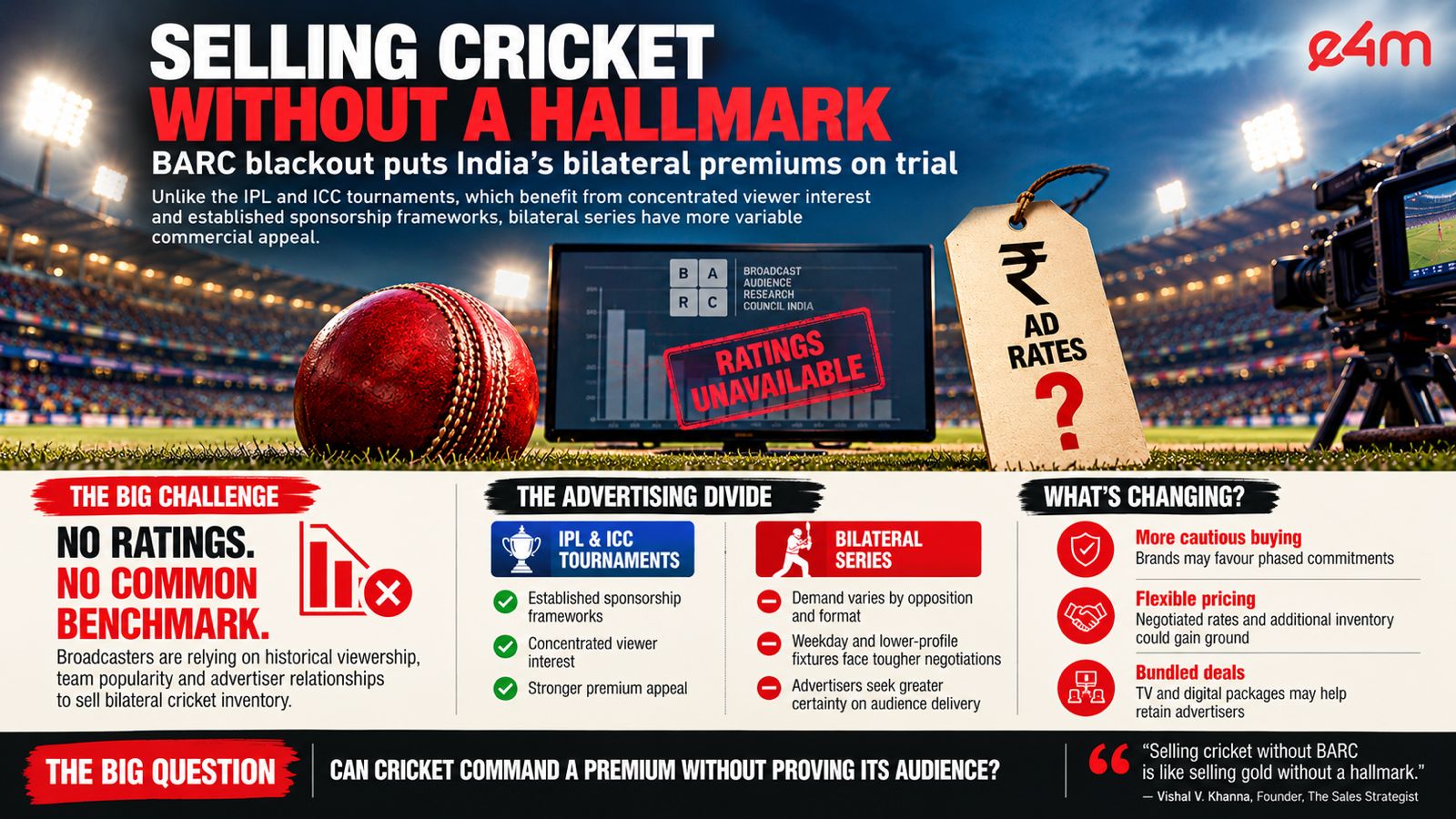
Unlike the IPL and ICC tournaments, which benefit from concentrated viewer interest and established sponsorship frameworks, bilateral series have more variable commercial appeal
 by
by
Published: Oct 13, 2026 8:38 AM | 6 min read
 Follow Us

- India's cricket calendar is set for a busy period with multiple bilateral series, but broadcasters face challenges in selling advertising due to a lack of independent audience ratings, relying instead on historical data and team popularity.
- The absence of current ratings complicates pricing strategies for advertisers, particularly for less popular matches, leading to cautious spending and a potential two-speed market where established advertisers may continue long-term investments while others seek flexible commitments.
- Historical ratings may not accurately reflect current viewership patterns, especially with changes in broadcasting habits and the upcoming return of ratings potentially introducing new comparability challenges.
- Broadcasters may resort to negotiated pricing, bundled series packages, and performance guarantees to mitigate advertiser risk, but the ongoing lack of audience verification could impact the perceived value of bilateral cricket properties.
India’s bilateral cricket calendar is entering one of its busiest stretches, but broadcasters face a challenge beyond the pitch: selling advertising without an independent measure of television audiences. With ratings unavailable, they are relying on historical viewership, team popularity and advertiser relationships to defend cricket premiums, even as brands seek greater certainty on audience delivery.
India’s cricket calendar includes the ongoing West Indies series, an extensive away tour of New Zealand in October and November, Sri Lanka’s visit in December and the five-Test Border-Gavaskar Trophy against Australia beginning in January 2027. India’s women will also host Zimbabwe in a six-match international series this month.
Blackout puts linear TV under pressure. Read on
These fixtures offer broadcasters an extended opportunity to sell advertising during the festive and year-end spending period. But the commercial value varies by opposition, format and match timing, making it difficult to apply a uniform pricing strategy without current audience benchmarks.
“Bilaterals are harder to monetise than IPL or ICC right now. Those properties carry their own scarcity. The rating was confirmation, not the reason. For standard bilateral inventory, the traditional cricket premium is tougher to hold without an independent currency. India weekends are still clear. Non-India matches and weekday windows are where the resistance sits,” said Bhairav Shanth, Co-Founder and Managing Director, ITW Universe.
Blackout exposes limits of industry forums. Read more
Unlike the IPL and ICC tournaments, which benefit from concentrated viewer interest and established sponsorship frameworks, bilateral series have more variable commercial appeal. The absence of ratings is therefore likely to weigh most heavily on properties that cannot command a premium on team popularity and event significance alone.
Advertisers lean on historical data
Broadcasters maintain that historical performance and digital indicators continue to help advertisers assess cricket investments, particularly when India is playing.
“Historical viewership data continues to be an important reference point for advertisers and media agencies when evaluating cricket investments. There is a fairly established understanding of how different cricket properties perform, particularly when India is playing. Beyond that, advertisers are also looking at indicators such as search uplift to assess the impact of their association with a property. These inputs help brands make informed investment decisions even in the absence of weekly ratings,” said Akshay Agrawal, Head of Linear Ad Sales, Sony Pictures Networks India.
TV programming heads in blind as festive season nears
However, historical ratings and search activity cannot establish the current audience for an individual match. This leaves advertisers weighing expected reach against the price being charged, particularly for fixtures with less predictable viewership.
The uncertainty is influencing buying decisions, though it has not necessarily prompted a wholesale shift towards short-term commitments.
“The measurement uncertainty has understandably made some advertisers more cautious about committing their entire budgets upfront, particularly for lower-profile series and non-prime-time fixtures. However, it would be premature to conclude that the market has universally shifted towards last-minute buying or shorter commitments,” said Rohit Potphode, President of Sports, Gaming, Entertainment and Influencer Marketing at dentsu.
Potphode further said, “Established advertisers with annual sports calendars and sponsorship commitments may continue to make long-term investments, while tactical and performance-led campaigns are likely to be more sensitive to uncertainty and favour flexible, phased buying.”
The result could be a two-speed market. Established advertisers with annual cricket plans may continue investing, while brands focused on campaign-level returns could negotiate harder, seek flexible commitments or ask for additional inventory.
Yasin Hamidani, Director, Media Care Brand Solutions, said the issue was ultimately one of confidence in the value being offered.
“Cricket will continue attracting advertisers, but without a common measurement currency, it becomes harder to demonstrate whether a particular series justified its premium. Broadcasters can sell on historical performance, team strength and expected interest, but advertisers are naturally more cautious when the eventual audience delivery cannot be independently benchmarked in the usual manner,” he said.
Historical ratings may not reflect today’s market
The challenge is compounded by changes in broadcasting and viewing habits. Australia last played a Test series in India in early 2023, while the next Border-Gavaskar Trophy is scheduled for January 2027. Since then, times have changed and experts suggest that viewership patterns have changed too.
These shifts complicate comparisons with older editions, particularly when historical television ratings may not capture current viewing across linear television and connected devices.
Vishal V. Khanna, founder of The Sales Strategist and a connected-TV expert, said the eventual return of ratings could create another comparability challenge if the measurement framework changes.
“When BARC returns, it returns with a new rupee. The 2026 policy excludes landing-page viewership, and BARC has indicated CTV will enter published ratings. The old series and the new series won’t be like-for-like. You’ll be pricing tomorrow’s inventory with yesterday’s notes. So yes, price discovery is fundamentally weakened,” he said.
“Selling cricket without BARC is like selling gold without a hallmark. Nobody doubts it’s gold. Everybody negotiates as if it’s 18-carat.”
The concern is that restoring ratings may not immediately settle pricing disputes if the new framework makes historical comparisons less reliable. Broadcasters could have to establish fresh benchmarks while convincing advertisers that their rates reflect the audiences they can deliver.
Bundling may cushion the impact
A prolonged blackout could push broadcasters towards negotiated rates, bundled series packages, additional inventory, cross-platform deals and performance guarantees to reduce advertiser risk.
“A prolonged blackout could put greater pressure on bilateral properties than marquee tournaments. We could see more negotiated pricing, bundled series packages, added inventory, cross-platform deals and performance guarantees as broadcasters try to reduce advertiser risk,” Hamidani said.
“Premium bilateral contests should still command strong demand, but weaker properties may find it harder to defend historical rates. Over time, if buyers cannot independently validate audience delivery, that uncertainty could also start influencing how broadcasters assess the commercial value they assign to certain rights,” he added.
Bundling television and digital inventory could help broadcasters retain advertisers and allow brands to spread spending across a series. But it would not resolve questions about the audience delivered by an individual match.
The pressure is likely to be uneven. High-profile India matches against established rivals may retain greater bargaining power, while lower-profile fixtures and non-prime-time windows could face tougher negotiations. Long-term sponsorship commitments may hold, but tactical campaigns are likely to remain more sensitive to uncertainty.
The BARC blackout has not eliminated demand for cricket advertising. It has weakened broadcasters’ ability to substantiate pricing through a common audience benchmark. As the New Zealand tour, Sri Lanka series and Australia Tests approach, the test will be whether team popularity and historical performance can sustain bilateral cricket premiums without independent verification. The longer the gap persists, the greater the risk that negotiations, rather than measurable audience delivery, determine what cricket inventory is worth.
Read more news about Television Media, Digital Media, Advertising India, Marketing News, PR and Corporate Communication News
For more updates, be socially connected with us onInstagram, LinkedIn, Twitter, Facebook YouTube & Google News
