Prasar Bharati may revise DD Free Dish auction rules as collections fall, slots go vacant
Annual MPEG-2 auction collections have plunged from Rs 1,157 crore to Rs 642 crore in about two years. The public broadcaster is assessing market conditions ahead of the January 2027 auction cycle
 by
by
Published: Oct 13, 2026 8:38 AM | 10 min read
 Follow Us

- DD Free Dish, a free-to-air DTH platform in India, has seen its reach grow to approximately 49 million households in 2024, up from 33 million in 2018, with projections of 53 million homes by 2025.
- The auction market for DD Free Dish slots has shifted, with declining collections and repeated vacancies, prompting Prasar Bharati to consider revising its auction methodology ahead of the next bidding cycle in January 2027.
- Despite a significant revenue spike during the 2023-24 period, recent auctions have seen a sharp decline in collections, with FY2026-27 generating around Rs 642 crore, down 44% from the previous peak.
- The changing dynamics reflect broader pressures on linear television, with smaller broadcasters struggling against high carriage fees, leading to calls for greater flexibility in auction rules and exit provisions.
There was a time when a slot on DD Free Dish was among the most fiercely contested pieces of television real estate in India. For broadcasters chasing the Hindi heartland and price-sensitive television homes, Prasar Bharati's free-to-air DTH platform offered something difficult to replicate elsewhere: enormous mass reach without asking the consumer to pay a monthly subscription. That proposition has not disappeared.
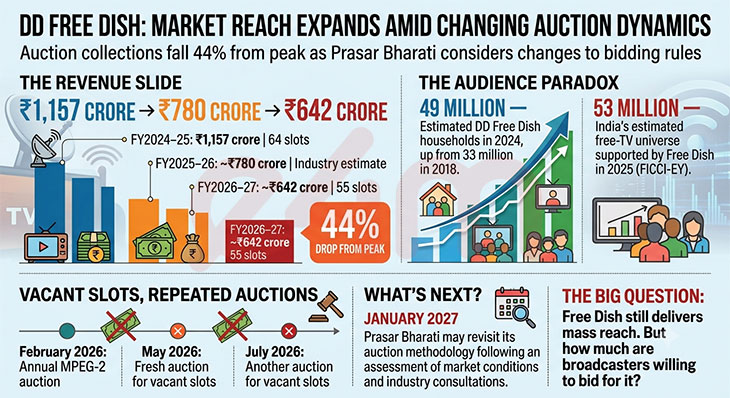
Government data put DD Free Dish's reach at approximately 49 million households in 2024, up from 33 million in 2018, while the latest FICCI-EY estimates put the free-TV universe supported by Free Dish at around 53 million homes in 2025. Yet the auction market around that audience is beginning to look markedly different. The platform that once generated frantic bidding for scarce MPEG-2 capacity is now repeatedly putting vacant slots back on the block.
Against this backdrop, Prasar Bharati may revisit its DD Free Dish auction methodology ahead of the next annual bidding cycle in January 2027, sources indicated.
The possibility of changes comes as the public broadcaster examines declining auction collections, repeated attempts to fill vacant capacity and the broader pressures on linear television. Any modifications would follow an assessment of market conditions and consultations with industry stakeholders.
Also Read: Prasar Bharati invites bids to appoint agency for e-auctions of DD Free Dish slots
Artificial scarcity debate returns as govt readies DD Free Dish FY26 slot auctions
IBDF calls for transparency in DD FreeDish slot auctions
When the auction became a gold mine
The high point came during the 2023-24 period. Prasar Bharati's annual MPEG-2 auction collection jumped from around Rs 645 crore from 59 slots in 2022 to Rs 1,069.6 crore in 2023, when 65 slots were allotted. In the following cycle, FY2024-25, collections climbed further to around Rs 1,157 crore from 64 MPEG-2 slots. The two-year increase was extraordinary: auction collections were nearly 80% higher in 2024 than in 2022. But even Prasar Bharati has subsequently cautioned against treating those years as the permanent baseline. CEO Gaurav Dwivedi said in 2025 that the preceding two years had seen an unusual revenue spike as news broadcasters bid aggressively during a period covering nine Assembly elections and the Lok Sabha election. In his telling, the subsequent moderation represented a ‘return to normal’ rather than a collapse in Free Dish's underlying value.
When a slot could cost Rs 20 crore-plus
At the peak of the scramble, the numbers could become eye-watering. The 2023 auction fetched Rs 1,069.6 crore over eight days, then the longest DD Free Dish auction, with the average slot price working out to around Rs 16.5 crore. Zee Anmol Cinema paid Rs 24.05 crore for a movie-channel slot, then the highest bid in its category; Zee Biskope paid Rs 22.1 crore in Bucket B; and News18 India bid Rs 19.85 crore in the Hindi news bucket. The previous 2021 annual auction had already demonstrated how scarcity could distort economics: 11 news slots generated Rs 190.3 crore, an average Rs 17.3 crore per slot against a reserve price of just Rs 7 crore, while the highest winning bid touched Rs 22.05 crore. Broadcasters were effectively paying a premium not merely for carriage but for access to millions of incremental homes, particularly across Uttar Pradesh, Bihar and other Hindi-speaking markets where Free Dish had become critical to ratings and advertiser reach.
But the bidding war had another side
The same economics were considerably tougher for smaller independent broadcasters. Large networks are better positioned to absorb a Rs 15-20 crore carriage bill through established advertising operations and draw on vast libraries of existing programming. Smaller channels, meanwhile, had to compete for the same slots while also investing in content.
“Large broadcasters like Star, Colors and Goldmines can afford multi-crore bids, while small broadcasters struggle to compete under the same auction system,” an executive at an independent television broadcaster told exchange4media.
The executive argued that high reserve prices and carriage fees make it difficult for smaller channels to recover their investments.
The broadcaster also called for greater flexibility in exit provisions, particularly for channels struggling to generate adequate advertising returns.
“Clear exit rules and proportionate refunds or adjustments should be considered in mid-year exit from the platform,” the executive suggested.
From Rs 1,157 crore to Rs 642 crore
The bidding temperature has since cooled dramatically. After the approximately Rs 1,157-crore collection in FY2024-25, the 2025 auction saw prices soften sharply. Winning Hindi news bids, for instance, were reported at roughly Rs 13.4-14.4 crore compared with Rs 17-18.5 crore a year earlier, while several entertainment and movie slots also cleared at lower prices. Industry estimates put the 2025 annual collection at around Rs 780 crore. The 8th annual MPEG-2 auction for FY2026-27 then reportedly generated around Rs 642 crore from 55 slots, a 17.7% decline from Rs 780 crore and roughly 44% below the Rs 1,157-crore 2024 peak. The decline cannot be attributed to one factor alone. Fewer slots were allotted; the auction methodology and eligibility framework changed; some broadcasters have reconsidered FTA economics and TRAI's framework requiring a channel carried free on DD Free Dish to remain FTA on other distribution platforms has complicated the trade-off between advertising reach and subscription revenue.
A senior Prasar Bharati executive, speaking on condition of anonymity, attributed the moderation in collections to a combination of factors affecting the broader television industry.
“The exceptionally high collections during those two years were, to an extent, driven by news channels seeking greater reach during the election cycle. Since then, there has been some decline in linear television, including cord-cutting and pressure on broadcasters’ overall operations. That is reflected in what they are willing to bid. The withholding of ratings over the past several months has also had an impact,” the executive said.
For broadcasters, however, the calculation ultimately comes down to returns.
“At the end of the day, it’s a question of economics. Free Dish gives you access to a very large audience, and that has real value. But every broadcaster has to look at what they’re paying for a slot and what they’re able to recover through advertising. You can’t keep bidding higher if the incremental revenue doesn’t justify it,” a senior executive at a leading broadcast network told exchange4media.
The executive also cautioned against reading the fall in auction collections as evidence that Free Dish itself is losing relevance. “There are several factors at play, including how aggressively different genres bid and the overall advertising environment. Broadcasters are perhaps being more disciplined about what they’re willing to pay, but that doesn’t necessarily mean Free Dish has become less important.”
The audience, paradoxically, has not disappeared
That is what makes the trend more complicated than a simple decline story. DD Free Dish remains one of India's most formidable television distribution pipes. Government figures put its estimated footprint at around 49 million homes in 2024, against 33 million in 2018. FICCI-EY's 2026 report estimates that India's free-TV universe, supported by Free Dish, added another 4.5 million connections during 2025 to reach approximately 53 million homes. Its economics for viewers are difficult to beat: unlike conventional DTH or cable, DD Free Dish charges consumers no monthly subscription fee. Its footprint also extends deep into rural, remote, border and otherwise difficult-to-serve areas. That explains why major broadcasters have repeatedly returned. In the 2025 auction, Zee Anmol reportedly paid Rs 18.6 crore, Sony Pal Rs 18.55 crore, Colors Rishtey Rs 18.35 crore and Star Utsav Rs 18.25 crore for carriage.
For networks able to monetise tens of millions of additional eyeballs through advertising while largely using library content, Free Dish can still make considerable economic sense.
A senior executive at a leading broadcast network cautioned against underestimating the platform’s continuing importance. “That’s a massive audience, and no serious broadcaster can afford to ignore that kind of reach, especially in a market like India.”
Nor, the executive argued, should the growth of digital platforms necessarily be seen as replacing Free Dish. “Yes, you have YouTube, OTT, CTV and other platforms today, but they don’t necessarily reach the same consumers. A large part of the Free Dish audience is still heavily dependent on television for entertainment. So, I don’t think it’s a question of Free Dish versus digital. Both have a role to play.”
“What has changed, perhaps, is that broadcasters are more conscious of what they’re paying for distribution. Free Dish remains an important piece of the puzzle, but that doesn’t mean you should be willing to pay any price for it,” the executive added.
Then why does Prasar Bharati keep returning to the auction table?
This is where the latest auction calendar becomes revealing. The 8th annual, or 94th overall, MPEG-2 auction in February 2026 allotted 55 slots for April 1, 2026 to March 31, 2027. But that was not the end of the exercise. On May 11, Prasar Bharati issued another notice, the 98th e-auction, specifically for vacant MPEG-2 slots, with carriage beginning May 29 on a pro-rata basis. The reserve price still ran as high as approximately Rs 13.67 crore for the remaining period for Bucket A+ channels, followed by around Rs 10.98 crore for Bucket A, Rs 8.58 crore for Bucket B, Rs 6.86 crore for Bucket C and Rs 5.93 crore for Bucket D. Then, less than two months later, Prasar Bharati returned yet again: on July 9 it announced the 100th e-auction, once more inviting applications for vacant MPEG-2 slots, this time for allotment from July 23, 2026 through March 31, 2027.
The recurrence matters. Prasar Bharati's own methodology provides for mid-year auctions when a slot remains unfilled after the annual auction or becomes vacant during the year. The fact that MPEG-2 capacity had to be offered again in May and again in July therefore raises a question that the topline revenue number alone cannot answer: if Free Dish's audience is still expanding, why is all of its most widely accessible MPEG-2 inventory not being absorbed and retained in the first place?
The contrast is particularly striking because just a few years earlier the industry debate was about scarcity rather than vacancies. Broadcasters complained that an insufficiently transparent supply of MPEG-2 slots encouraged hyper-competitive bidding.
The Indian Broadcasting & Digital Foundation subsequently asked Prasar Bharati to disclose the total number of slots being auctioned, unsold inventory after each round and bucket-wise applicant information. It also suggested converting unused MPEG-4 capacity into MPEG-2 capacity.
Today, however, repeated invitations for vacant MPEG-2 slots suggest the debate may be shifting from ‘how much will broadcasters pay to get in?’ to ‘at what price are they still willing to stay?’
The Prasar Bharati executive added that the public broadcaster is examining the changing market conditions and could consider adjustments to its auction framework ahead of the January 2027 cycle.
“There may be modifications, but those decisions will follow Prasar Bharati’s own analysis and consultations with the industry. The approach has always been to ensure that the industry grows, because when the industry grows, everyone benefits. The objective is to arrive at a framework that works for all stakeholders rather than benefiting one at the expense of another,” the executive said.
The bottom line
For DD Free Dish, the challenge is no longer simply attracting broadcasters to a platform with enormous reach, but ensuring that the price of accessing that audience remains commercially viable. With collections moderating, smaller players questioning the economics of participation and vacant slots repeatedly returning to auction, the next bidding cycle could prove an important test of how Prasar Bharati balances revenue generation with broadcaster demand.
The audience is still there. The question is how much broadcasters are prepared to pay to reach it.
Read more news about Television Media, Digital Media, Advertising India, Marketing News, PR and Corporate Communication News
For more updates, be socially connected with us onInstagram, LinkedIn, Twitter, Facebook YouTube & Google News
