Premium pours, popular spirits falter: Is India's alcobev market looking at a divide?
While premium portfolios are driving growth for several alcohol makers, declining volumes in popular segments, coupled with pressure on profitability, point to increasingly divided consumption market
 by
Published: Nov 11, 2026 9:03 AM | 7 min read
 Follow Us


India's alcoholic beverages market is increasingly showing two distinct consumption patterns, with premium portfolios driving disproportionate growth for several leading manufacturers even as lower-priced spirits struggle to keep pace. The divergence is becoming particularly visible in the September quarter earnings of some of the country's largest alcobev companies, where growth in higher-value brands is contrasting with declining volumes in regular and popular offerings.
The numbers also raise questions about the quality of growth being reported by the sector. While companies are increasingly relying on premium portfolios to improve their product mix, the expansion is not always translating into stronger overall financial performance. At some players, headline revenue growth is accompanied by declining profitability, while at others, acquisitions and favourable product mix are influencing the reported numbers.
Premium growth a mask?
United Spirits' Q2 FY27 performance offers one of the clearest illustrations of the widening gap between premium and popular spirits. The company reported net sales value (NSV) of Rs 3,258 crore, up 2.8% year-on-year. However, the overall growth seems to conceal a significant difference in the performance of its two key portfolios.
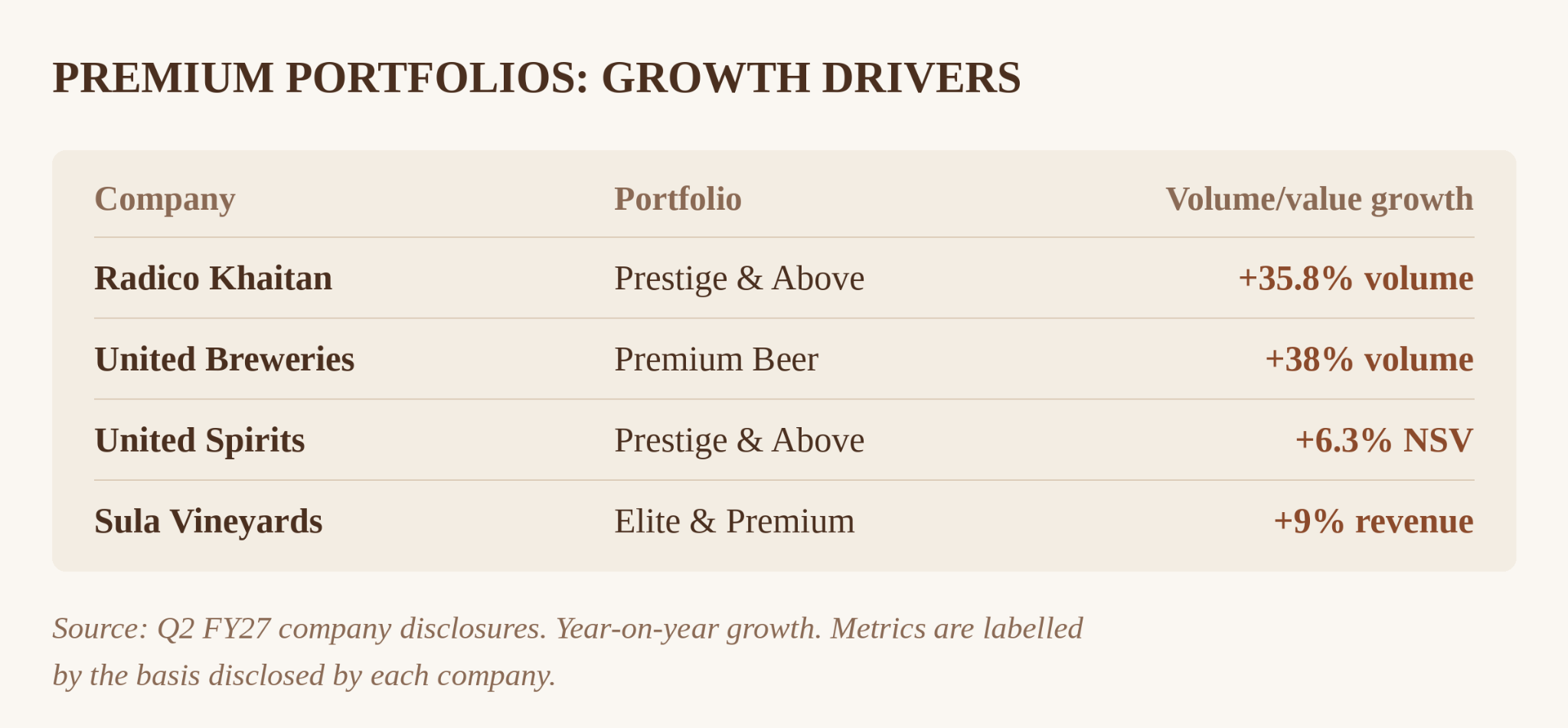
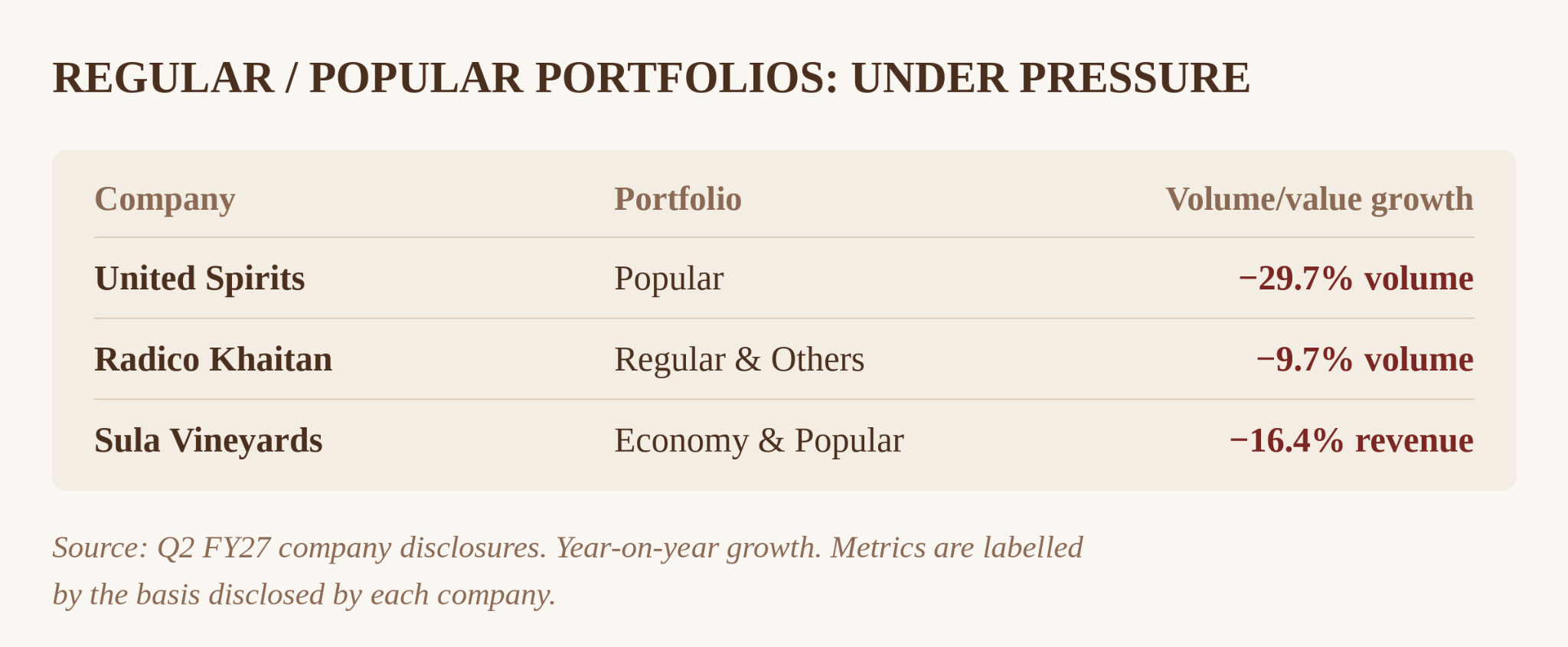
Its Prestige & Above segment recorded 6.3% growth in NSV to Rs 3,065 crore, while the Popular segment declined 22.7% on a like-for-like basis to Rs 181 crore. Volumes in the Popular segment fell 29.7% to 1.58 million cases.
Read more: United Spirits Q2 results: Ad spends surge 57% ahead of festive season
The decline is significant given the relatively small contribution the segment now makes to the company's overall NSV. Prestige & Above accounted for 94.1% of United Spirits' NSV during the quarter.
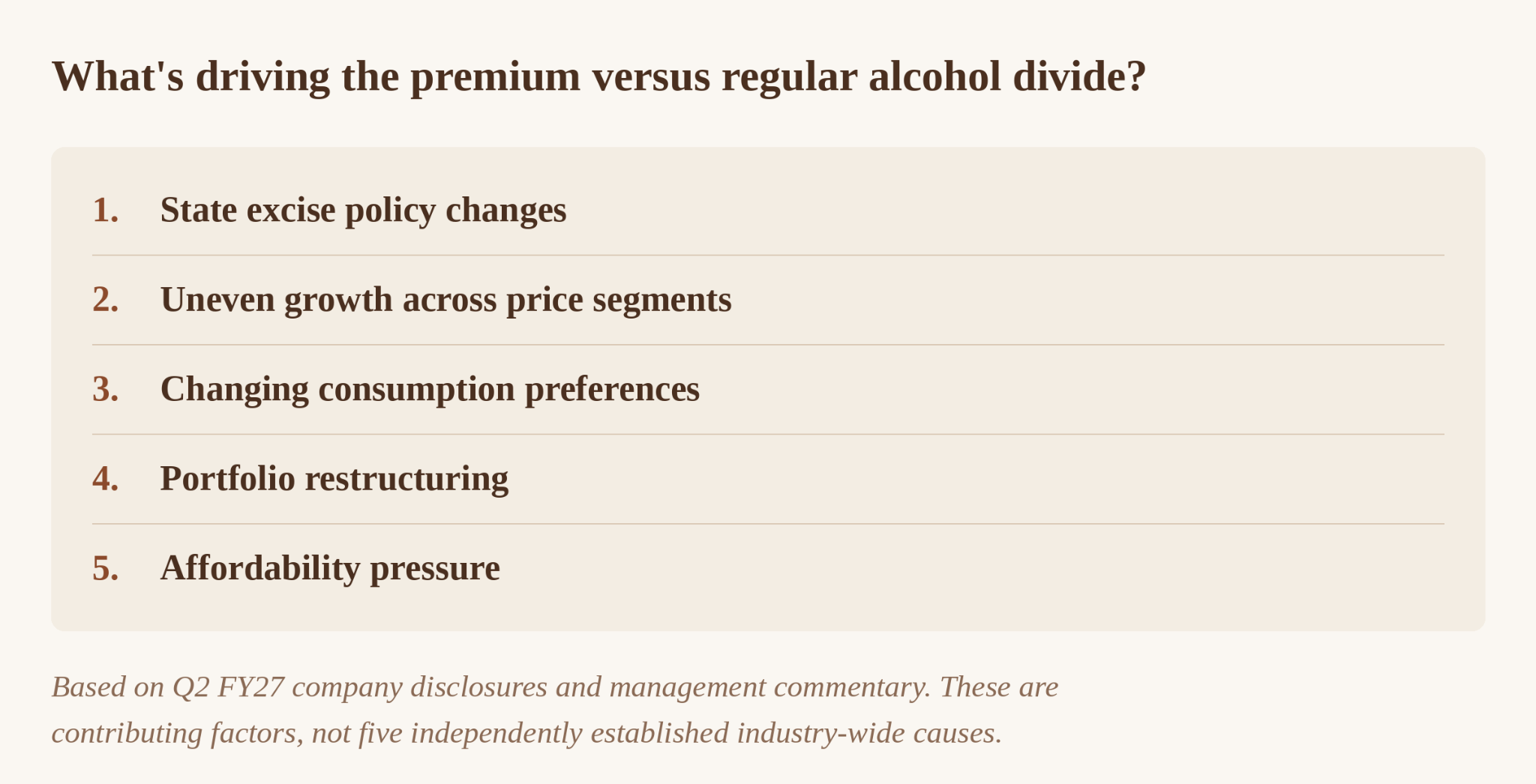
The company attributed the Popular segment's performance to the impact of minimum mandatory labelling requirements in Maharashtra and policy changes in Karnataka, which affected realisations following excise slab changes. However, the management also flagged pressure on lower-income consumers.
United Spirits CEO and Managing Director Praveen Someshwar said during the earnings discussion that the India 1 consumer, which forms a target audience for the lower half of the company's IMFL portfolio, was showing signs of fatigue due to the impact of inflation on household wallets.
The pressure is also visible in the company's profitability. While gross profit grew 4.7%, reported EBITDA declined 4.3% to Rs 643 crore and profit after tax fell 2.1% to Rs 462 crore on a standalone basis. The premium portfolio's growth, therefore, has not translated into stronger earnings across the board.
Radico Khaitan is reporting a similar divergence, although its overall financial performance remains stronger. Its consolidated revenue from operations increased 10.4% year-on-year to Rs 5,582.7 crore, while net profit rose 66.5% to Rs 232.3 crore.
However, its standalone IMFL portfolio shows a sharper divide between price segments. Volumes in the Prestige & Above category surged 35.8% to 5.28 million cases, while the Regular & Others portfolio declined 9.7% to 4.55 million cases.
The premium portfolio's contribution to the company's own IMFL volumes increased to 53.7% from 43.6% a year ago, while its share of IMFL revenue rose to 77.1% from 68.6%.
The company attributed the decline in regular volumes to a higher comparative base following a route-to-market change in Andhra Pradesh, alongside policy changes in Maharashtra and Karnataka.
The growth in premium spirits, meanwhile, has been driven partly by the vodka portfolio, which expanded 49% in volume terms to 2.96 million cases. This has also brought changing consumption preferences into the discussion, with the company pointing to growing interest in white spirits among younger consumers.
The gap between the two portfolios raises a larger question about how much of the industry's growth is increasingly dependent on consumers who can afford higher-priced offerings.
The premium push extends beyond spirits
The shift towards higher-value offerings is not restricted to whisky and vodka manufacturers. United Breweries reported a 16% increase in sell-in volumes in Q2 FY27, while premium beer volumes grew 38%. Its net sales increased 24% year-on-year to Rs 2,536 crore.
The premium portfolio's performance was led by Heineken Silver, which grew 67%, and Kingfisher Ultra, which expanded 44%.
However, the profitability numbers need closer examination. The company's reported profit after tax rose to approximately Rs 135 crore, up nearly 191% year-on-year. The increase included around Rs 36 crore in interest income from an income-tax refund, making the reported profit growth an imperfect indicator of recurring operating performance.
Input costs also remain a concern. United Breweries has estimated the impact of higher input costs at Rs 350-400 crore for FY27, putting pressure on the company to sustain its profitability gains even as premium volumes expand.
Sula Vineyards is seeing a similar shift within its wine portfolio, but its overall growth remains modest. The company reported net revenue from operations of Rs 145.4 crore in Q2 FY27, up 4.1% year-on-year, while net profit increased 34% to Rs 8.1 crore.
Its Elite & Premium portfolio grew 9% and accounted for a record 82% of own-brand sales. In contrast, its Economy & Popular portfolio declined 16.4% to Rs 23 crore. The premium contribution is therefore increasing, but the overall revenue growth of just 4.1% indicates that the stronger performance of higher-value wines has not translated into a comparable expansion of the company's topline. Higher blended grape costs also weighed on gross margins, which contracted 278 basis points to 66.2%.
Acquisition-led growth
The premiumisation narrative is also influencing how companies report and present their growth, although acquisition-led expansion makes some comparisons difficult.
Tilaknagar Industries reported a 160% year-on-year increase in volumes to 8.9 million cases, while revenue from operations, adjusted for subsidy income, grew 172% to Rs 1,033 crore. The sharp expansion follows its acquisition of Imperial Blue from Pernod Ricard. Its reported EBITDA, adjusted for subsidy income, increased 143% to Rs 146 crore, with a margin of 14.1%. Adjusted profit after tax, excluding exceptional items and acquisition-related amortisation, rose 26% to Rs 66 crore.
However, the headline growth cannot be read as an equivalent increase in underlying demand. The acquisition has substantially expanded the company's reported scale. Its secondary volumes grew 7.8% sequentially, including 8.5% growth for Imperial Blue and 7.1% for its existing business. The distinction between acquired scale and organic growth is important, particularly when assessing how much of the industry's reported expansion is coming from existing portfolios.
Profitability - a separate concern
The premiumisation-led growth story also sits alongside pressure on profitability at some manufacturers.
Globus Spirits reported consolidated revenue from operations of Rs 1,098.9 crore in Q2 FY27, up 26.1% year-on-year. However, profit after tax declined 35.7% to Rs 14 crore. Operating profit remained broadly flat at Rs 60 crore, compared with Rs 59 crore in the year-ago quarter, while the operating margin contracted to 8% from 9%.
The company operates across manufacturing and consumer-facing businesses, making its overall financial performance difficult to compare directly with premium-focused IMFL portfolios. Nevertheless, the gap between revenue growth and bottom-line performance highlights the pressure that topline expansion alone can conceal.
Allied Blenders and Distillers also reported volume growth of 11.1% to 10 million cases, with its Mass Premium & Others portfolio growing 15.5% in volumes and 16% in value. However, its reported EBITDA stood at Rs 148 crore, with a margin of 14.1%. The company indicated that disruption-related supply-chain costs affected profitability, with its estimated EBITDA excluding these costs at Rs 172 crore.
The contrast across companies suggests that premiumisation is increasingly shaping the industry's growth mix, but does not automatically resolve cost and profitability pressures.
The divide is becoming harder to ignore
The September-quarter numbers point to a market where premium portfolios are accounting for an increasingly larger share of growth, while regular and popular offerings are losing ground at select manufacturers.
For United Spirits and Radico Khaitan, the contrast is particularly pronounced, with premium volumes and value growth running ahead of their lower-priced portfolios. United Breweries and Sula Vineyards are also seeing premium offerings contribute a larger share of their businesses.
While its Q2 FY27 results are still awaited, Pernod Ricard's latest reported performance offers another interesting contrast. The company's global organic sales declined 0.9% in Q1 FY27, while India recorded 19% growth. However, the 19% growth needs to be viewed with some caution. It was partly supported by higher stock movement into the distribution network and a relatively weak base in the previous year, when excise policy changes in Maharashtra disrupted sales.
For the industry, the more consequential question is whether premiumisation is creating an incremental consumption opportunity or increasingly becoming the primary source of growth as parts of the lower-priced market come under pressure. The next few quarters will indicate whether the widening gap between premium and regular portfolios is a temporary outcome of regulatory disruptions and high comparative bases, or a more sustained change in the way India's alcobev market is evolving.
Read more news about Marketing News, Advertising News, PR and Corporate Communication News, Digital News, People Movement News
For more updates, be socially connected with us onInstagram, LinkedIn, Twitter, Facebook, YouTube & Google News