BFSI marketers rethink acquisition as costs rise and AI reshapes discovery
Rising acquisition costs, AI-led discovery and creators dominated the conversation at the e4m Pitch BFSI Summit 2026
 by
by
Published: Sep 25, 2026 1:23 PM | 9 min read
 Follow Us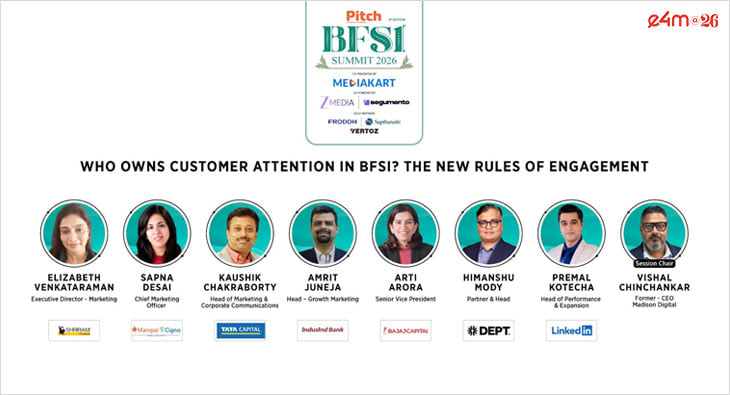

- Vishal Chinchankar, former CEO of Madison Digital, led a panel discussion at the e4m Pitch BFSI Summit 2026, focusing on the evolving landscape of customer attention in the BFSI sector and the challenges of acquiring consumer attention amidst increasing competition.
- Panelists, including marketing leaders from various financial institutions, emphasized the importance of a strong top-of-the-funnel strategy, customer lifetime value, and the need for engaging content to maintain customer relationships and drive sales.
- The discussion highlighted the shift towards data-driven marketing while balancing creativity, with a focus on the growing role of AI and the need for brands to adapt their content for discoverability and relevance in a rapidly changing digital environment.
- The session concluded with panelists identifying key factors for success in marketing, such as trust, relevance, data, empathy, and the anticipation of client needs, underscoring the importance of understanding and connecting with customers in the BFSI space.
"Attention can't be owned. It needs to be rented from moment to moment." With that, Vishal Chinchankar, Former CEO, Madison Digital, opened the session "Who Owns Customer Attention in BFSI? The New Rules of Engagement" at the e4m Pitch BFSI Summit 2026.
On the panel were Amrit Juneja, Head – Growth Marketing, IndusInd Bank; Arti Arora, Senior Vice President, Bajaj Capital Limited; Elizabeth Venkataraman, Executive Director – Marketing, Shriram Finance; Himanshu Mody, Head, DEPT India; Kaushik Chakraborty, Head of Marketing & Corp Com, Tata Capital; Premal Kotecha, Head of Performance & Expansion, LinkedIn Marketing Solutions; and Sapna Desai, CMO, ManipalCigna Health Insurance.
Venkataraman agreed that acquisition was getting harder and costlier. Everything from a 15-second reel and WhatsApp thread to LinkedIn and CTV are competing for the same consumer attention. "All of us are facing an information explosion. The same people are being targeted by a lot of brands in the same category. This war is real and we fight it every day," she said.
Attention alone does not win preference. So, a strong top-of-the-funnel strategy is essential, but Venkataraman also highlighted the importance of reaching customers beyond digital channels. For Shriram Finance, particularly in commercial vehicles and semi-urban and rural markets, on-ground engagement continues to play a significant role.
She also stressed the opportunity within existing customers. "If new is difficult, your existing customer could buy much more from you across categories because they are already experiencing you. So step up on service, step up on engagement, and step up on upsell and cross-sell," she added.
Desai said ManipalCigna, now in its planning cycle, has started looking at a different dimension altogether, which is customer lifetime value instead of acquisition cost. In health insurance, that means persistency (the percentage of life insurance policies that remain active and continue to have their premiums paid by policyholders) and renewal.
"In our renewal book, one or two per cent more in persistency gives me the funding for the increased acquisition cost," she explained. "Getting a customer once should be just the beginning of a relationship. It has to be a five-year or a 10-year plan."
Her second priority is content. "With this fight for eyeballs and clicks, relevant content and creativity are going to be the next holy grail. Data plus creativity is going to be the area of play."
Chinchankar asked Kotecha whether performance marketing could still scale. "Financial services is a high-trust category. What a marketer should look at is not how many leads, but whether we are creating sustainable customer value," Kotecha said.
Customers now encounter brands across multiple touchpoints, from discovery and research to content consumption and the final decision. This has made discoverability more important. “Today, to create content that is discoverable has become all the more important,” Kotecha said, pointing to the growing influence of LLM-sourced (Large Language Models) content alongside SEO.
He highlighted GEO (Generative Engine Optimisation) as an increasingly important area for marketers, with brands needing to establish thought leadership across industry, product and company content. Meanwhile, AI is making it possible to create content and build predictive audiences faster, allowing marketers to focus more closely on reaching the right customer rather than vanity metrics.
On scale itself, the answer was measured. "It's a long-term game, to be honest. You may not see results immediately, but that is how customer behaviour is changing. Performance marketing in itself may not be sufficient, but these elements added to performance marketing are needed."
Mody, whose firm DEPT helps brands make their content discoverable, finds that SEO agencies still approach it from a perspective "which is no longer relevant". "The reset button on how content is envisaged for discoverability needs to change for every brand. It needs to be more conversational. You can't think in just keywords anymore," he said. "The brands getting the conversational aspect right are the ones that are winning."
The discussion then moved to whether performance marketing can continue to scale as costs increase. Chakraborty argued that it can, particularly as the search environment changes with the rise of AI.
Google once handled about 95% of search, so optimising for one engine was enough. Now there is ChatGPT, Google Gemini and more, with no clear leader, and organic customers are declining. "In an AEO (Answer Engine Optimisation) world, we are seeing impressions increase but clicks decrease."
Performance marketing, in his view, becomes the way to grow, with Google's lead quality "still decent". "If there are enough searches happening and people have that intent, it is scalable."
Juneja questioned the idea of chasing attention at all. "Attention is a very old, legacy way of looking at marketing. The market has moved on. It's now more about capturing intent," he said. Users type questions into ChatGPT or Claude at moments no brand can predict, and "that intent has become the new moment of truth".
He wants brands to invest in owned media and stop reading CAC (Customer Acquisition Cost) on a standalone basis. "We have seen in our own efforts that when performance spends are reduced, there's an impact on cross-sell as well. So the media mix has to be looked at holistically, and attribution models have to be updated to reflect the new reality."
The data versus creativity debate brought different perspectives from the panel. Arora placed data at the centre of the marketing process.
“For me, it has to be data. Data validates everything else. It is the connecting link between product, marketing and business,” she said. Creativity helps brands innovate and connect with audiences, but data provides the facts that guide the journey.
Chakraborty argued for a mix. “Data will always give you the truth. But unless and until you go creatively to the customer with a solution that, at that point in time, he's looking for, I think it has to be a mix,” he said.
Adding a note of caution around how data is used, Venkataram said, “Data will confess what you torture the data to do.” She pointing to the risks of manipulating data through different time periods, cuts and segments.
For BFSI marketers, she said, there is no escaping data given the complexity of segments, geographies and products. But marketers also have to be truthful, factual, compliant and interesting. “It's no mean task for any of us here, but we have to do both,” she added.
Desai added relevance to the debate. "Data is definitely the bedrock. But data without relevance will not connect, and data without creativity will not give you any real action."
As the conversation turned to AI, Chakraborty described a shift from B2C and B2B towards B2A, or marketing to agents. This requires brands to reconsider how their content is structured and presented. "At the risk of our reputation, I'll say that much of our content historically has not always been accurate, and many times we have been ambiguous. That cannot remain in an era where agents are trying to find the right, trustworthy information."
“Our content has to be much more accurate, much more structured so that it can be easily discoverable,” he said. Consistency across touchpoints and evidence-based information will become increasingly important as machines use brand content to help customers make decisions.
Juneja illustrated the change through the way consumers can now use AI tools to compare financial products. "Earlier, you had a couple of analysts and a six-week project to compare value propositions across credit cards. Now an agent does it. If I type in my salary bracket and ask for a credit card with lounge access on domestic flights, ChatGPT or Claude will give you 10 credit cards in a full table, exactly how a consulting firm would have done it five or six years back."
After a strong product, the information has to be ready for the agent, like an insurer's claims ratio upfront. "Think like a machine. What parameters would a machine throw out to a human in response to a high-intent question?"
Mody's team at DEPT uses platforms like Adobe to track citations. For one e-commerce brand, it tracked all 50 pages, found too few citations and added content. "The citations went up by 200% in a month's time," he said.
For Kotecha, thought leadership is central to this new environment. He also stressed that AI still requires human input. “There is human intervention needed in AI,” he said, particularly when it comes to understanding customer needs and creating content with human appeal.
The panel later explored creators, communities and user-generated content. Desai highlighted regional content as an area where ManipalCigna has been experimenting, particularly because of the role of advisors and the trust built by local creators.
“Reach is one thing but how do you borrow their credibility?” she said. For a service brand, she added, that borrowed credibility can be valuable. However, BFSI's regulatory environment makes content creation more complex.
Mody noted that financial brands also need to be cautious about user-generated content, given the prevalence of customer complaints on platforms such as LinkedIn and Facebook. Financial literacy and initiatives encouraging greater participation in financial decisions as areas where user involvement can form part of content strategies.
Asked how Tata Capital plans to reach Gen Z and Gen Alpha, Chakraborty rejected the premise. "It is quite a myth that their needs are different. Maybe they consume content in a particular way because they're born into that kind of world."
For financial creators, authenticity remains important. “I seriously don't want a financial influencer or a financial content creator to talk like a brand. Their strength is in their genuineness and their authenticity,” Chakraborty said. Rather than one-off activities, he advocated building an ecosystem of creators.
Arora noted that influencers can help make financial topics more relatable and comprehensible, while the role of financial brands remains important when customers move from basic awareness to decisions around financial goals and products.
The session closed with each panellist naming the factor they considered most important. Venkataraman and Kotecha chose trust, Desai and Chakraborty chose relevance, Juneja and Arora chose data, while Mody pointed to empathy and anticipation of client needs.
Read more news about Marketing News, Advertising News, PR and Corporate Communication News, Digital News, People Movement News
For more updates, be socially connected with us onInstagram, LinkedIn, Twitter, Facebook, YouTube & Google News