Creator economy gets a commerce push as brands move closer to checkout
Industry players say YouTube expanding brand partnerships in terms of product tagging to help high-value or high-margin categories to scale; brands can also track ROI from creator campaigns
 by
by
Published: Sep 25, 2026 8:42 AM | 7 min read
 Follow Us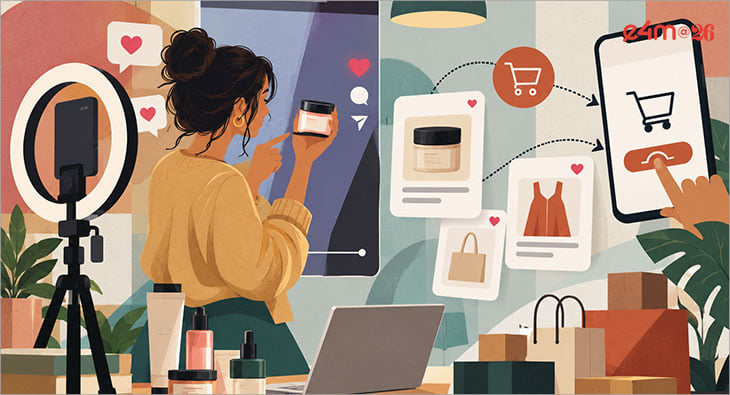

- YouTube has expanded its Shopping affiliate program in India, adding partnerships with major retailers like Amazon, AJIO, Meesho, Snapdeal, and Tata CLiQ, enhancing monetization opportunities for creators by integrating product tags directly into videos.
- The shift reflects a growing trend in creator-led commerce, where product discovery occurs within the viewing experience, allowing brands to connect more effectively with consumers at the moment of recommendation.
- YouTube reports a 55% year-on-year increase in shopping-related watch time in India, with over 450 million users engaging with shopping content, and a significant rise in average affiliate payouts for creators.
- This evolution in commerce strategies highlights the importance of creators in influencing consumer purchasing decisions, as platforms increasingly view them as integral to the distribution and discovery process rather than just advertising channels.
For years, creator-led affiliate commerce has depended on links sitting in video descriptions, bios or comments, requiring viewers to take an additional step to find and click them.
YouTube's latest expansion in India is a case in point. The platform on Thursday announced that Amazon, AJIO, Meesho, Snapdeal and Tata CLiQ will join its YouTube Shopping affiliate programme, adding to existing partnerships with Flipkart, Myntra, Nykaa, Purplle, Shopsy and Tira. The development is less about introducing product tagging, which YouTube brought to India in 2024, and more about expanding the number of merchants and products that creators can monetise through their content.
Read news report on YouTube expanding shopping affiliate ecosystem
For brands and marketers, the shift matters because the product no longer has to compete with the description box or a creator's bio for attention. A product image and shopping tag can appear within the viewing experience, putting the brand closer to the moment a creator demonstrates, reviews, or recommends it.
The timing is significant. YouTube says shopping-related watch time in India has grown 55% year-on-year, while more than 450 million logged-in users search for shopping-related content on the platform. Average affiliate payouts to Indian creators increased by more than 160% between Q1 2025 and Q1 2026. More than half of eligible Indian creators are now enrolled in the Shopping programme, with creators tagging more than 19 million videos.
Festive creator marketing moves beyond Diwali. Read e4m report
The shift reflects a broader change in how brands are using creators. Creator marketing was initially built largely around reach, engagement and sponsored integrations. Affiliate commerce adds another layer: the creator can influence discovery, the platform can facilitate that discovery, the retailer can complete the transaction, and the resulting sale can be attributed back to the content.
Gunjan Soni, Managing Director – India, YouTube, described the expansion as a point where “trusted creator voices, a comprehensive retail catalogue, and AI meet at a massive scale”. The company says the objective is to create an economy where “creativity directly leads to commerce”.
For YouTube, therefore, the strategic opportunity is not simply to put more products inside videos. It is to make the platform a larger part of the path between discovery and purchase.
As creator supply grows, are agencies still fighting for exclusive talent? Read e4m deep dive
That path is also becoming more valuable for brands because creator-led commerce can provide a clearer commercial outcome than a conventional awareness campaign.
“It will be a massive opportunity in select segments like fashion, consumer electronics etc., as the value of the transaction matters. The creator earns a percentage of the transaction value,” said Vikas Chawla, Co-founder, Social Beat and Influencer.in, part of Cheil. “High-value or high-margin categories are likely to scale. It also helps brands track the ROI from creator campaigns seamlessly and not be restricted only to partnership ads.”
According to Roxanne Chinoy, Head of Content Partnerships, Snap Inc., the growing role of creators in product discovery is also changing how platforms define creator success. “Seven in 10 Gen Z consumers say creator content helps them discover products, according to our recent Snapchat and GWI study. But discovery does not happen in isolation. It is built through repeated interactions, conversations and the trust that creators develop with their communities over time. That is why creator success is increasingly about more than reach. It is about consistently showing up, understanding what an audience responds to and becoming a credible source of opinions, recommendations and inspiration.”
Chinoy pointed to creators such as Paayal Jain and Tena Jain as examples of creators who have built stronger communities by understanding not only what their audiences want to watch, but also what makes them return.
That relationship is becoming particularly relevant to brands as creator-led discovery increasingly feeds into purchase decisions. “The strongest creator partnerships are not about simply replicating a campaign message. They are about giving creators the space to interpret a brand in a way that feels natural to their audience,” Chinoy said. “When creators bring their own voice, context and understanding of their community into a brand partnership, the content can become part of the conversation rather than just another advertisement.”
Platforms are not waiting for YouTube
YouTube's announcement comes amid a wider push by ecommerce platforms and social networks to establish their own creator-commerce connections.
In June, Flipkart Group partnered with Meta to bring Flipkart and Myntra products into affiliate integrations on Facebook, with Instagram planned as the next phase. Meta owns the discovery environment and creator relationship, while Flipkart and Myntra provide the catalogue, transaction and affiliate layer.
Ravi Iyer, CFO, Flipkart Group told a media briefing, that the company recognised that “discovery was moving from search bars to social feeds, and that creators were becoming the new storefront.”
Amazon is taking a similar approach, but with a wider creator ecosystem around its marketplace.
Its 1.65 lakh-strong Amazon Influencer Program allows creators to use affiliate links across platforms including WhatsApp, Telegram, Instagram and YouTube. In September, Amazon also launched Creator Connections, connecting creators directly with brands selling on Amazon. The programme launched with 50,000 brands and 5,000 creators, with creators able to earn through cost-per-click campaigns in addition to affiliate commissions.
Nidhi Thakkar, Head of Social Commerce - Emerging Countries, Amazon, told e4m, “Brand deals were the primary monetisation route for creators six years ago. Today, creators are increasingly looking for multiple income streams,” she said.
Amazon's model also illustrates an important distinction in the emerging creator-commerce economy. The creator does not necessarily need to be on the marketplace to influence a transaction. Social platforms can act as the distribution and discovery layer, while Amazon retains the commerce infrastructure and attribution.
Marketplaces want creators inside own commerce ecosystems
Myntra is building another version of the model around its own creator ecosystem.
The fashion platform has expanded its Ultimate GlamClan Affiliate programme, allowing creators to monetise recommendations through personalised storefronts, curated collections, content and affiliate links across social platforms. It is also offering 3X earning opportunities on select festive styles.
The scale of Myntra's existing creator activity gives the programme a broader base. The company says more than 8 million users have signed up for its UGC programme and that more than 12 million pieces of content have been generated. Its Glamstream platform has seen 7 million users engage with creator content, with Gen Z accounting for 52% of views.
The company is targeting participation from one million creators in India's digital commerce ecosystem.
Deepash Jain, Vice President, Marketing, Myntra, said the focus was on creating “stronger monetisation opportunities for creators” while helping them build influence and communities.
Why the commerce layer is growing now
The shift is being driven by a change in where consumers discover products.
For years, ecommerce discovery was dominated by search: a consumer knew what they wanted, searched for it and compared products. Social feeds and creator content have introduced another route, where discovery happens before the consumer has necessarily decided what to buy.
That makes creators commercially useful at an earlier point in the purchase funnel.
Flipkart's 2026 report with Bain & Company, cited by the company, says Gen Z accounts for 40-45% of India's e-retail shoppers and drives nearly half of incremental e-retail orders, with influencer-led discovery and social content playing an increasing role across categories.
This helps explain why ecommerce companies are increasingly treating creators as part of their distribution infrastructure rather than only as an advertising channel.
The economics are also becoming more measurable. A brand integration can establish reach or engagement, but an affiliate model can connect a creator's recommendation to clicks, conversions and transaction value. That makes it particularly relevant to categories where margins or average order values can support commissions.
At the same time, platforms have an incentive to keep more of that transaction journey within their own ecosystems.
YouTube is expanding its merchant catalogue. Meta is connecting social discovery with Flipkart and Myntra's commerce infrastructure. Amazon is taking its affiliate and brand ecosystem beyond Amazon itself. Myntra is building creator storefronts around its own catalogue.
The competitive question, therefore, is no longer simply which platform has the biggest creator audience. It is increasingly about which platform can build the most effective infrastructure between a creator's recommendation and a consumer's purchase.
And that is pushing the creator economy from a business primarily built around views and brand deals towards one in which discovery, influence, attribution and commerce increasingly sit on the same value chain.
Read more news about Marketing News, Advertising News, PR and Corporate Communication News, Digital News, People Movement News
For more updates, be socially connected with us onInstagram, LinkedIn, Twitter, Facebook, YouTube & Google News