Agentic commerce will make trust the new layer of digital payments: Rishi Chhabra, Visa
Speaking to Nawal Ahuja, at Pitch BFSI Summit, Chhabra said next phase of digital commerce will be built around a new layer of trust as consumers increasingly allow AI agents to act on their behalf
 by
by
Published: Sep 24, 2026 9:17 AM | 6 min read
 Follow Us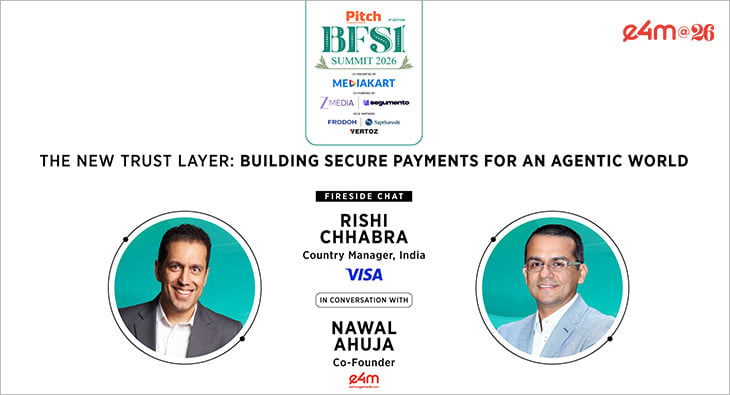

- Rishi Chhabra, Country Manager for Visa India, highlighted that the rise of artificial intelligence (AI) will transform consumer product discovery, shopping, and payment processes, leading to a new concept called "agentic commerce" where AI agents handle transactions on behalf of consumers.
- Trust will be a crucial factor as consumers may need to rely on AI agents for both product recommendations and payment processing, with Visa developing security protocols to ensure safe transactions and distinguish legitimate agents from fraudulent ones.
- The evolving landscape of agentic commerce raises questions about fraud liability, necessitating a reevaluation of existing rules regarding responsibility in transactions where AI agents are involved.
- Chhabra noted that India's rapid adoption of digital payments and established infrastructure positions it well for this transition, while emphasizing the importance of consumer education and trust in AI systems for successful implementation.
The rapid adoption of artificial intelligence is set to fundamentally change the way consumers discover products, shop and make payments, with AI agents potentially taking over much of the decision-making and transaction process, according to Rishi Chhabra, Country Manager, India, Visa.
Speaking to Nawal Ahuja, Co-Founder, exchange4media, at the Pitch BFSI Summit 2026, Chhabra said the next phase of digital commerce will be built around a new layer of trust as consumers increasingly allow AI agents to act on their behalf.
Visa, which has operated in India for more than four decades and globally for more than six decades, has historically built its payments infrastructure around trust, Chhabra said. The same principle, he added, will remain central as commerce moves from e-commerce and mobile commerce towards agentic commerce.
Trust will become particularly important as AI agents move beyond helping consumers search for products to actually completing transactions.
According to Chhabra, the AI-driven shopping journey can broadly evolve in two stages. The first is product discovery, where an AI system understands a consumer's preferences and identifies what they may want to buy. The second is payment, where the agent potentially makes the transaction on the consumer's behalf.
“The question is, would you trust a system to pay for you?” Chhabra said, noting that some consumers may still want a human to remain in the loop before a transaction is completed.
He said the fundamental proposition behind agentic commerce is to remove the cognitive burden of searching and comparing products. Instead of navigating multiple websites and choosing from dozens of options, consumers could increasingly rely on an AI agent that understands their preferences and makes recommendations based on previous behaviour.
Chhabra illustrated the shift by pointing to changing expectations among younger consumers, who may question why they need to search through dozens of results when an AI system can understand what they want.
However, allowing an AI agent to make payments introduces an entirely different dimension of risk.
Visa works on trusted agent protocols
Chhabra said Visa has been working globally for more than 18 months on the infrastructure required to make agentic payments secure. The company is looking at several layers of authentication, verification and control.
One of these is a trusted agent protocol that would establish a relationship between the consumer, the AI agent and the merchant. Such a protocol could verify that an agent is authorised by the consumer and establish the permissions that have been granted to it.
Visa is also working on an agent directory to distinguish legitimate agents from rogue ones.
“The good actors have access to AI, the bad actors have as much access to AI as well,” Chhabra said, highlighting the need to determine whether an AI agent acting in a transaction is legitimate.
The third layer involves merchants. As agentic commerce develops, merchants will need systems capable of distinguishing between an authorised AI agent and an automated bot. Visa is therefore also working on protocols that can help merchants become ready to accept legitimate agents while rejecting unauthorised bots.
Chhabra said interoperability would be critical because the ecosystem will involve consumers, merchants, payment networks and AI platforms. The various trust mechanisms will need to work across different players rather than operate as isolated systems.
Human authentication could remain part of agentic payments
Even as AI agents take over most of the shopping journey, Chhabra said the question of whether a human should remain involved at the point of payment remains open.
One potential model could involve an AI agent completing 90% of the process, with the consumer providing final authentication before the transaction is completed.
He pointed to Visa’s authentication platform, which he said can allow transactions to be authenticated through mechanisms such as biometrics rather than relying on OTPs.
Under such a model, the agent would operate within defined permissions and protocols, while the consumer could authenticate the final transaction. If the agent acts outside the consent provided by the consumer, an alert could be triggered.
Chhabra stressed that the architecture is still evolving and that regulators, payment networks, merchants, issuers and other ecosystem participants will need to work together to establish the rules.
Fraud liability rules will need to evolve
The growing autonomy of AI agents also raises questions around fraud and liability.
Chhabra said Visa has invested more than $3 billion in AI over the past decade specifically in fraud risk prevention. The company has developed models to detect fraudulent transactions and established liability frameworks determining when responsibility rests with the issuer, cardholder or merchant.
However, agentic commerce could require those rules to be reconsidered.
“If the merchant is the one authenticating a transaction, there’s no consumer in the loop. How do we rewrite the liability rules?” Chhabra said.
Visa is therefore working on mechanisms that provide greater recourse and allow the different stages of an AI-driven transaction to be examined. These could include checking whether the agent was verified, whether it operated within the controls granted by the consumer and whether the merchant had systems capable of accepting authorised agents.
Chhabra said these safeguards cannot be developed by Visa alone and will require alignment across issuers, cardholders, acquirers and merchants.
India positioned for agentic commerce
On whether India is ready for the transition, Chhabra pointed to the country's rapid adoption of digital payments and the infrastructure created through UPI and the wider digital public infrastructure ecosystem.
He said India has repeatedly leapfrogged through successive waves of technology, from online commerce to mobile commerce and digital financial services.
Chhabra said tokenisation has also helped establish consumer confidence in digital payments. Visa currently has more than half a billion tokenised credentials in India, according to him.
While the infrastructure is developing, he said consumer education will remain important as new technologies emerge.
“Caution is the right word,” Chhabra said, while adding that India has demonstrated a strong appetite for adopting new technologies.
Agentic AI could transform marketing
The shift towards agentic commerce could also have significant implications for marketers, with Chhabra predicting greater personalisation in advertising and brand communication.
He said AI could eventually allow brands to target consumers at an “n equal to 1” level, with messaging, creative and calls to action dynamically adapted to individual consumers.
Instead of conventional audience cohorts and broad targeting, AI agents could allow brands to change creative and messaging in real time based on individual consumer data and behaviour.
Chhabra said the process could eventually move beyond conventional A/B testing to simultaneous testing of multiple creative and messaging combinations.
For marketers, this could mean that creative development and optimisation become increasingly dynamic, with campaigns changing in real time rather than requiring weeks or months for revisions.
The broader shift, however, will depend on whether consumers trust AI systems sufficiently to allow them to make decisions and transactions on their behalf.
As agentic commerce develops, the technology may reduce the effort involved in shopping, but the trust architecture underpinning those transactions will determine how far consumers are willing to delegate control to AI.
Read more news about Marketing News, Advertising News, PR and Corporate Communication News, Digital News, People Movement News
For more updates, be socially connected with us onInstagram, LinkedIn, Twitter, Facebook, YouTube & Google News