e4m D2C Summit: What comes after 10 minutes? Quick commerce bets on discovery and demand
Ten-minute delivery was only the beginning for quick commerce. From groceries, it has expanded into gifting, wellness and electronics, as brands weigh fulfilment against demand creation
 by
by
Published: Sep 14, 2026 5:01 PM | 7 min read
 Follow Us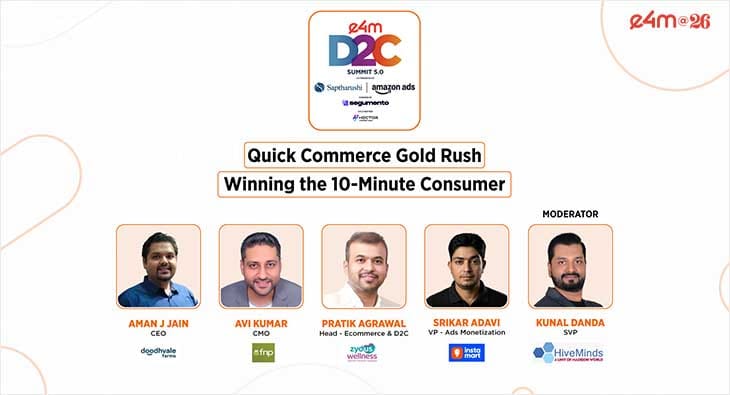

- Quick commerce is evolving beyond grocery fulfillment, with non-grocery items now accounting for over 30% of the business, prompting brands to leverage this channel for consumer discovery and demand creation.
- Panelists at the e4m D2C Summit 2026 discussed how quick commerce caters to both planned and last-minute purchases, creating new consumption occasions and opportunities for brands to engage with consumers.
- The discussion highlighted the importance of strategic planning and collaboration between brands and quick commerce platforms to address challenges such as inventory management and seasonal demand fluctuations.
- Panelists emphasized the need for brands to adapt their marketing strategies for quick commerce, focusing on profitability and customer experience rather than traditional trade marketing approaches.
Quick commerce, which once meant little more than grocery fulfilment, is now a route to new consumption occasions across categories. With non-grocery already making up more than 30% of the business and dark-store networks growing rapidly, brands are looking at the channel for discovery, demand creation, and a larger share of the consumer’s basket.
At a panel discussion, at the e4m D2C Summit 2026, panellists held a discussion on the same. Titled “Quick Commerce Gold Rush: Winning the 10-Minute Consumer”, the panel had opinions from Aman J Jain, CEO, Dhoodhvale Farms; Avi Kumar, CMO, Ferns N Petals; Pratik Agrawal, Head – Ecommerce & D2C, Zydus Wellness; and Srikar Adavi, VP – Ads Monetisation, Quick Commerce, Instamart. It was moderated by Kunal Danda, SVP, Hiveminds.
Opening the discussion, Danda pointed to the scale of the shift. “Earlier it was just a grocery fulfillment kind of a scenario, but now almost 30% upwards is non-grocery,” he said, suggesting that the definition of ecommerce itself is changing. “Is it a distribution channel? Is it a media channel? Or is it a demand creation channel?” he asked.
For Ferns N Petals, quick commerce has created a new customer, the person who remembers an occasion just in time.
“It has opened up a lot more avenues,” Kumar said. Alongside customers who plan birthdays, festivals and other occasions in advance, there are now those who suddenly realise, “Oops, I forgot.” Quick commerce can fulfil that need in minutes, while also creating opportunities around smaller moments such as a promotion or simply wanting to thank someone. “If it’s a small moment of joy and you want to celebrate it, you can instantly order,” he said.
That does not mean planning and curation have disappeared. Kumar pointed to the brand’s omni-channel presence, which caters to consumers who still want to visit a store, select flowers themselves, personalise a product and build a hamper.
At Zydus Wellness, the role of the channel depends on how familiar consumers are with the product. “In categories where we are strong, where consumers know us, it’s more about fulfillment through quick commerce channels,” Agrawal said. However, for newer categories, the focus shifts towards building and harvesting demand, with visibility on the platform becoming critical to entering the consumer’s consideration set.
Next in the discussion, the question of impulse buying drew a nuanced response from the panel. Jain argued that consumer behaviour has already moved beyond the conventional quick-commerce impulse purchase. “This has literally become one of the places where people go and shop,” he said, noting that some purchases are now planned and that platforms are competing for customers’ share of shopping.
Adavi offered the platform perspective, saying quick commerce is working to create the occasions that eventually appear impulsive to consumers. “For a customer, it might be an impulse, but we’re trying to create that impulse, working with the brands, and creating reasons for a customer to shop,” he said, citing Daughter’s Day and wellness occasions such as World Lung Day as examples. The objective, he added, is to work with brands to create more moments rather than remain focused purely on last-minute urgency.
That approach is also influencing which categories gain traction. Adavi said categories with last-minute urgency, low consideration or an element of impulse have naturally taken off. “But newer growth is coming from brands finding a “wedge” around better-for-you propositions,” he said, pointing to examples such as protein-led products and a magnetic-cord power bank designed to fit more easily into a pocket.
Seasonality presents a different challenge. For products such as Glucon-D, where a large share of consumption is concentrated in the summer, traditional distribution models involve loading trade well in advance. Quick commerce operates differently, with limited inventory capacity at dark stores and demand capable of spiking sharply when summer arrives.
Agrawal said the solution has involved closer coordination with platforms, including advance planning, greater backend capacity, and faster replenishment cycles. “We have to kind of also educate them that we will have to plan in advance,” he shared. Zydus has also worked to reduce lead times, while using consumption insights to develop products that can extend demand beyond the traditional summer window.
Since milk is a high-frequency, low-margin category with little shelf-life flexibility, the economics of quick commerce are more difficult for Dhoodhvale Farms. Yet Jain maintained that there is a viable model. “There is a way to make money,” he said, pointing to the importance of meticulous planning across both brands and platforms and the economics of scale. Returns, damages, and excess inventory can all affect margins, while deeper penetration and availability are needed to make the model work.
The rise of quick commerce is also raising questions around subscription-led purchases. Jain said changing household structures and increasingly busy lifestyles are altering how consumers buy everyday products. Families with children, for example, may still plan their purchases more carefully. For the brand, however, the relationship with quick commerce is not framed as a battle with traditional channels. “Quick commerce is an enabler,” Jain highlighted. “It is actually creating more use cases. It has to be leveraged and not really looked at as a competitor.”
Discovery emerged as another area where the old assumptions are being challenged. While search remains important, Adavi said browsing and merchandising generate almost equivalent impressions. “It opens up space for categories consumers may never actively search for,” he discussed, citing hydration-based chewing gum as an example of a product that can emerge through browsing and basket-building behaviour.
Kumar similarly described discovery as a combination of search, trust and merchandising. “You will have people who will search for flowers, and flowers come up on the top. You have three seconds, and that’s where the trust of 30 years comes into play,” he said. At the same time, curated occasions and visual merchandising can prompt consumers to discover products they had not intended to seek out.
Adavi chimed in the discussion by stating that the basic infrastructure of quick commerce is now the “right to play”. “Having the right dark store, experience, or delivery speed is our right to play,” he said. “The right to win is where we are able to give differentiated customer experience and differentiated assortment.”
Agrawal added that the data generated by quick commerce platforms is helping brands understand sales, supply chain and SKU-level performance at a much deeper level. The remaining challenge lies in influencing the movement of inventory from hubs to dark stores, with each platform operating its own model.
Supply chain capabilities have also improved, particularly around last-mile fulfilment. Jain pointed out that the bigger challenge for temperature-sensitive products now lies further upstream. “The bigger problem to fix is not the last 10 minutes for these products,” he said. “It is actually the brand being able to fulfil it in a manner that is reaching the right sort of properties and temperature to their warehouses.”
Whether quick commerce is creating new consumption or merely shifting purchases from traditional channels depends on the category. Agrawal sees clear expansion in impulse-led categories, while planned categories continue to experience substitution. Jain, however, believes the combined ecosystem is generating more demand overall, with some cannibalisation but greater consumption holistically.
Kumar pointed to gifting as evidence. If a product cannot arrive on the day of an occasion, the purchase may disappear altogether. “And thus it will fuel consumption,” he said. Discovery brings consumers to brands and products they may never have considered before. “You may not need it, but you buy it.”
As the discussion closed, the panel turned to what brands should stop doing on quick commerce. Adavi urged brands to stop treating it simply as another channel for trade marketing spends, while Agrawal argued that excessive discounting should be reduced. “Ecommerce is solving for convenience. Let’s use it for the same,” he said.
Kumar prescribed, “Make it work for the business. Make it profitable. Not just a place where you sell products but also make some money.”
Jain closed the session by asking brands to stop bidding on competitors’ keywords.
Read more news about Marketing News, Advertising News, PR and Corporate Communication News, Digital News, People Movement News
For more updates, be socially connected with us onInstagram, LinkedIn, Twitter, Facebook, YouTube & Google News