The race for advertising's control panel: What Nielsen really gets with DoubleVerify
Knowing who saw an ad isn't worth much on its own anymore; advertisers also want to know the exposure was real, that it did something, and where the next dollar should go
 by
by
Published: Aug 11, 2026 8:54 AM | 7 min read
 Follow Us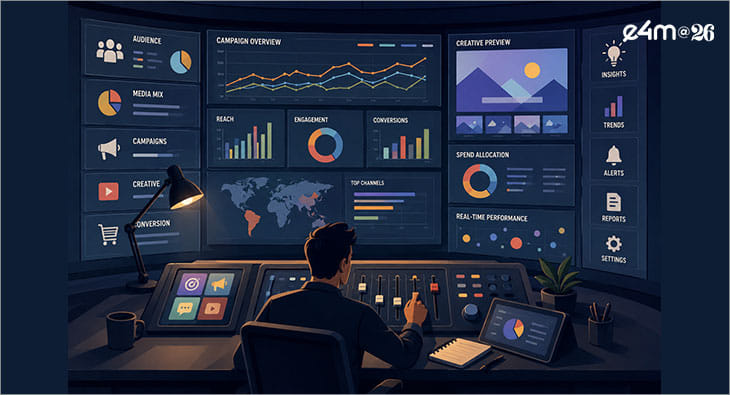

- Nielsen has announced a $2.15 billion acquisition of DoubleVerify, a company specializing in digital ad verification, to enhance its capabilities in measuring ad exposure and effectiveness in a changing advertising landscape.
- The merger aims to create an integrated platform that combines Nielsen's traditional media measurement with DoubleVerify's focus on programmatic advertising, potentially providing advertisers with a more comprehensive view of ad performance.
- The deal is expected to generate approximately $4 billion in annual revenue and will serve advertisers responsible for over $300 billion in ad spending, pending regulatory approval by Q1 2027.
- Concerns remain about the implications of consolidation on measurement independence, as both companies historically positioned themselves as impartial referees in the advertising ecosystem.
Why would a company whose entire personality has been “we count who watched” spend $2.15 billion buying a business best known for checking whether digital ads are fraudulent, viewable, or accidentally sitting next to something a brand would rather not be seen near?
Because knowing who saw an ad isn't worth much on its own anymore. Advertisers also want to know the exposure was real, that it did something, and where the next dollar should go instead. Nielsen appears to be betting that whoever answers all three questions in one place gets to stop being a vendor and start being infrastructure.
The companies announced the all-cash deal on August 6, with the combined business expected to clear $4 billion in pro-forma annual revenue and touch advertisers responsible for over $300 billion in spend.
Read more on the Nielsen-DoubleVerify announcement
It's subject to the usual regulatory and shareholder theatre, and expected to close by Q1 2027. The individual numbers behind each company are healthy enough and not really the point. The point is what happens when you weld two different ecosystems together and call the result “end-to-end.”
Two ecosystems that have been circling each other for years
Nielsen's ecosystem is the old one: television, streaming, cross-media planning, the whole apparatus built on People Meters and panel data and a century of advertisers trusting its numbers because there wasn't a better option. Nielsen ONE is its attempt to drag that legacy into a single deduplicated view across linear, streaming and digital, with Ad Intel and Media Impact orbiting it for spend tracking and planning.
Read more on TV and measurement
Lately it's also been teaching that stack to make decisions instead of just filing reports, with Predictive Sales Lift in April, Ad Intel AI in July, the latter explicitly built to be queried by advertisers' own AI agents rather than read by a human with a coffee.
DoubleVerify's ecosystem is the newer, uglier, and perhaps more currently relevant, one Nielsen was never built for: programmatic, walled gardens, the endless plumbing of verifying whether an impression served inside Meta or TikTok or the open web actually happened the way someone was billed for it.
It started as brand safety, added viewability and fraud detection, then bought its way into optimisation with Scibids in 2023 and attribution with Rockerbox in 2025, until it could plausibly describe itself around three verbs (Verify, Optimise, Prove) rather than one.
Put those two ecosystems side by side and the acquisition stops looking like Nielsen buying a brand-safety company. It looks like Nielsen buying its way into the plumbing it never had.
But the acquisition may also be about reach rather than simply adding capabilities.
“More than anything, Nielsen is getting a much larger publisher coverage vs what it had over time. Along with everything else that DV provided to advertisers,” says Prabhvir Sahmey, CEO and co-founder, Stratpulse Labs.
The question, however, is how broad the eventual market for such an integrated proposition really is. “I'm not sure how much of all of this will be appreciated by advertisers beyond the top 50 users,” Sahmey adds.
It's worth sitting with why publisher coverage and independence matter so much right now. The open internet has spent the better part of a decade tilting at Alphabet and Meta like a pair of exhausted Quixotes, and mostly losing. Google and Meta don't just sell the most ad inventory, they increasingly grade their own homework on it, offering advertisers their own dashboards, their own attribution, their own definitions of a job well done.
Every independent measurement or verification vendor exists, in some sense, as a rebuttal to that arrangement, a promise that someone outside the walled garden is still checking the receipts.
The trouble is that rebuttals need scale to matter, and scale has been the one thing the open internet's champions have chronically lacked. DoubleVerify's actual value to Nielsen may have less to do with its technology and more to do with the sheer publisher footprint it drags along, the access it already has inside environments that would otherwise treat an outside measurement company as an uninvited guest.
Combine that with Nielsen's decades of relationships and cross-media reach, and you get something closer to a coalition than an acquisition, two smaller windmill-tilters deciding it's more efficient to charge together. Whether that coalition can actually hold a platform like Meta accountable in a way neither company could alone is a separate question, and a fair one.
Meta’s morphosis: Read more here
From universal dashboard to control layer
Every few years, adtech rediscovers the fantasy of one screen with everything on it: audience, reach, frequency, viewability, attribution, ROI, all reconciled and blinking politely at a media planner. Nielsen ONE and DV Media AdVantage are both, in their own ways, versions of that fantasy. But the dashboard may not actually be the prize here.
“I think we’re getting closer, but we shouldn’t confuse better data integration with true comparability. Nielsen combining measurement with verification and optimisation is a meaningful step, but the bigger challenge is that much of digital still operates inside walled gardens, with different definitions, signals and levels of access,” says Gopa Menon, co-founder and COO, theblurr.
Menon believes a genuinely unified cross-media layer is technically possible, but “it will need common standards and greater interoperability across platforms, not just smarter ways of stitching together datasets that were never designed to talk to each other”.
Verification doesn't become attribution just because it's now under the same corporate roof, but it does supply the evidence attribution has always been missing, to wit, was the exposure real, viewable, in-context, and not already double-counted elsewhere? And as buying automates further, that evidence stops being something you read after the campaign ends and starts being something the buying system consumes in real time.
Scibids already nudges bids off it. Nielsen is already making its own data queryable by AI agents. Plan, buy, verify, measure, attribute, feed it back into the next buy, basically automate that loop end to end, and the company sitting underneath it isn't running a dashboard anymore. It's running the switchboard.
Independent and integrated are not the same word
DoubleVerify CEO Mark Zagorski has floated the most ambitious line in the announcement: a single currency scoring both audience delivery and media quality. That's a bigger claim than it sounds, and the more interesting test of this deal than whether Nielsen can bolt one more platform onto its stack without it falling over.
Both companies built their entire value proposition on being the outside referee, the one not selling the inventory, checking the homework of the people who are. Fold measurement, verification, attribution and optimisation into a single company, and you can tell a tidy story about fewer conflicting methodologies and less reconciliation grief for agencies.
Agencies are going AI-native. Know why?
You can also, less tidily, end up with one company increasingly deciding what “performance” even means, across CTV, social, retail media and whichever AI-mediated ad format shows up next. Both stories are plausible. Neither cancels the other out just because the press release says “independent” a lot.
We reached out to both Nielsen and DoubleVerify for comments but responses were awaited at the time of writing.
Seen narrowly, this is a century-old ratings company buying an 18-year-old verification vendor. Seen properly, it's two ecosystems that have been walking toward each other for years finally shaking hands, with the usual adtech caveat attached: whether the market beyond the biggest fifty advertisers actually wants (or can afford) what they're building.
Read more news about Digital Media, Internet Advertising, Marketing News, Television Media, Radio Media
For more updates, be socially connected with us onInstagram, LinkedIn, Twitter, Facebook, YouTube & Google News