#e4mXplains: Can CRED & Kunal Shah finally help Meta make WhatsApp commerce work?
For years, WhatsApp has enjoyed what every digital platform dreams of: unparalleled scale with more than 500 million users in India. Commerce, however, has remained elusive
 by
by
Published: Jun 25, 2026 8:39 AM | 7 min read
 Follow Us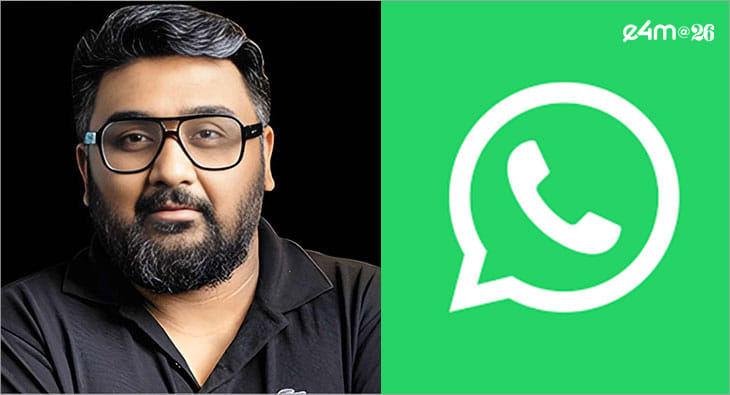

- Meta announced a $900 million investment in fintech company CRED, elevating its founder Kunal Shah to lead WhatsApp globally, signaling a potential shift in WhatsApp's approach to commerce.
- Despite WhatsApp's extensive user base in India, the platform has struggled to establish itself as a payment option, with users preferring established apps like Google Pay and PhonePe for transactions.
- Experts suggest that WhatsApp's challenge lies in changing consumer behavior rather than technological limitations, as users have developed habits around existing payment platforms.
- The investment in CRED may enhance WhatsApp's commerce capabilities, but marketers advise caution, indicating that significant changes in consumer payment behavior are unlikely to occur immediately.
If there's one app I, along with millions of other Indians, interact with brands on almost every day, it's WhatsApp. Restaurant bookings, airline notifications, customer support, delivery updates, promotional messages, warranty reminders and even conversations with neighbourhood stores have all migrated to the messaging app. Yet, despite using WhatsApp for almost every stage of my interaction with a brand, I've never once felt the need to complete a payment through WhatsApp Pay. Also, like millions of other Indians, that final step has always happened elsewhere, usually on Google Pay or PhonePe.
That behaviour, however, could soon begin to change.
Read: Meta to invest $900 million in Cred, names Founder Kunal Shah as WhatsApp chief
That's because, on Monday, June 22, the Indian business, financial and media industries were shaken by the news that Meta would invest $900 million in fintech unicorn CRED at a post-money valuation of $4.5 billion, while simultaneously elevating CRED founder Kunal Shah to lead WhatsApp globally. At first glance, it looked like another marquee investment into India's startup ecosystem. But for marketers, it raises a much bigger question: is Meta trying to solve WhatsApp's unfinished commerce story?
For years, WhatsApp has enjoyed what every digital platform dreams of: unparalleled scale. With more than 500 million users in India, it is comfortably the country's most widely used messaging platform and arguably its most important digital communications infrastructure. Businesses have embraced Click-to-WhatsApp campaigns, customer service has shifted onto the app, and brands increasingly rely on WhatsApp Business for everything from lead nurturing to post-purchase engagement.
Commerce, however, has remained elusive.
Despite launching WhatsApp Pay in India in 2020 after a prolonged regulatory process, Meta never managed to convert its messaging dominance into payments leadership. The contrast with India's UPI ecosystem is striking. Even as UPI became the world's largest real-time payments network, PhonePe and Google Pay established themselves as the default consumer payment apps. As recently as May 2026, the two platforms still accounted for nearly 80% of all UPI transaction volume, underscoring how firmly consumer behaviour had settled around the incumbents.
That raises an obvious question. If WhatsApp already had half a billion users, why didn't those users simply begin paying on the platform?
According to veteran marketer Shubhranshu Singh, the answer has little to do with reach.
“WhatsApp Pay didn't ever struggle because of reach. It just never managed to create a habit. Consumers already had established UPI behaviours elsewhere and brands continued to treat WhatsApp as a messaging channel rather than a commerce destination.”
That distinction between reach and behaviour is perhaps the most important lens through which to view Meta's latest move.
Rahul Vengalil, co-founder and CEO of tgthr, said Meta's payments ecosystem has yet to become a meaningful marketing channel because brands already have access to rich transaction data. "There's more than enough first-party data available from almost every UPI platform and payment gateway," he said. "We can build multiple customer cohorts and push them into programmatic advertising. So, at least from my perspective, WhatsApp isn't a very viable option right now."
Unlike many technology platforms, WhatsApp never suffered from an adoption problem. It had already become embedded in everyday communication long before payments arrived. But messaging habits do not automatically translate into transaction habits. Consumers may happily receive an order confirmation on WhatsApp while instinctively reaching for another app when it's time to make the payment.
For marketers, this meant WhatsApp settled into a very specific role within the customer journey.
“WhatsApp launched into an India where UPI was already the default and then we had PhonePe and Google Pay, so there was no real space for a third entrant on payments alone,” says Gopa Menon, COO and co-founder, Theblurr.
“From a planning perspective, that meant WhatsApp stayed a messaging and CRM layer, not a transaction layer, where you could nurture a lead, but you couldn't close the loop and measure it the way you can on platforms with native checkout. Click-to-WhatsApp ad products worked because they fed into payment elsewhere, not because payment happened inside the app itself.”
That observation neatly captures WhatsApp's paradox. It became indispensable for conversations but remained peripheral when money changed hands.
So, what exactly does CRED bring that WhatsApp does not already have?
Contrary to popular perception, the answer isn't simply payments.
WhatsApp already possesses unmatched distribution. CRED, by comparison, serves a far smaller but highly valuable audience. The platform reports around 17 million monthly active users, processes more than 40% of India's credit card bill payments and has built its business around affluent, credit-active consumers who engage with the app repeatedly through rewards, financial management and premium merchant experiences.
In other words, CRED has spent years solving a problem WhatsApp never quite cracked: creating repeat financial engagement.
That does not necessarily mean Meta intends to merge products or immediately transform WhatsApp into a financial super app. Reports around the investment have emphasised that Meta will neither receive access to CRED's customer data nor take a board seat (as of now!).
Yet, the strategic significance lies less in ownership and more in direction.
Kunal Shah has spent the better part of a decade building products around consumer trust, rewards, payments and financial behaviour. His elevation to lead WhatsApp globally, alongside Meta's investment into CRED, suggests the company sees commerce and financial engagement as increasingly central to WhatsApp's next phase of growth.
The ambition itself is hardly new.
Industry observers have long argued that Meta wants WhatsApp to evolve beyond messaging into a broader commerce platform, much like WeChat did in China. India, with its massive WhatsApp user base and mature digital payments ecosystem, is perhaps the company's most important testing ground.
The challenge, however, remains behavioural rather than technological.
For now, marketers are advising caution.
“As of now, nothing changes,” says Menon.
“For brands, I'd treat this as a watch-and-prepare moment and look for real commerce signals once these integrations are ready and Shah's product roadmap at WhatsApp actually becomes clear. This should currently be treated as a leadership as well as capital investment move.”
That measured approach is echoed by Singh, who believes the acquisition strengthens the narrative around WhatsApp's commerce ambitions without fundamentally changing them overnight.
“The CRED acquisition makes the story more credible, but not yet transformational,” he says.
“I'd watch whether Meta can reduce friction across the entire commerce journey beyond just payments. If that happens, WhatsApp could evolve from a conversation platform into a genuine transaction platform.”
That may ultimately be the biggest takeaway from Meta's latest India bet.
For years, marketers have thought of WhatsApp primarily as a CRM and customer engagement channel. The CRED investment does not immediately rewrite that playbook. But it does suggest Meta is still searching for a way to connect conversations, commerce and payments inside a single ecosystem.
Whether that vision finally succeeds will depend less on technology than on whether Meta can persuade consumers to change habits that have already become deeply ingrained. WhatsApp won the battle for communication years ago. The next challenge is convincing users that it deserves to own the transaction as well.
We reached out to Meta and WhatsApp for comments, but are yet to get a response.
Read more news about Digital Media, Internet Advertising, Marketing News, Television Media, Radio Media
For more updates, be socially connected with us onInstagram, LinkedIn, Twitter, Facebook, YouTube & Google News