Quick commerce boom set to rewrite rules of India’s packaged F&B market?
Experts say quick commerce is making consumption “immediacy-led and intent-rich,” with split-second decisions and algorithm-driven discovery
 by
by
Published: Mar 27, 2026 9:35 AM | 5 min read
 Follow Us

The rise of quick commerce is converging to fundamentally alter what Indians eat, and where they buy it from. What started as a convenience-led solution for last-minute grocery needs is now entering a decisive phase of scale, with implications that go far beyond top-up shopping.
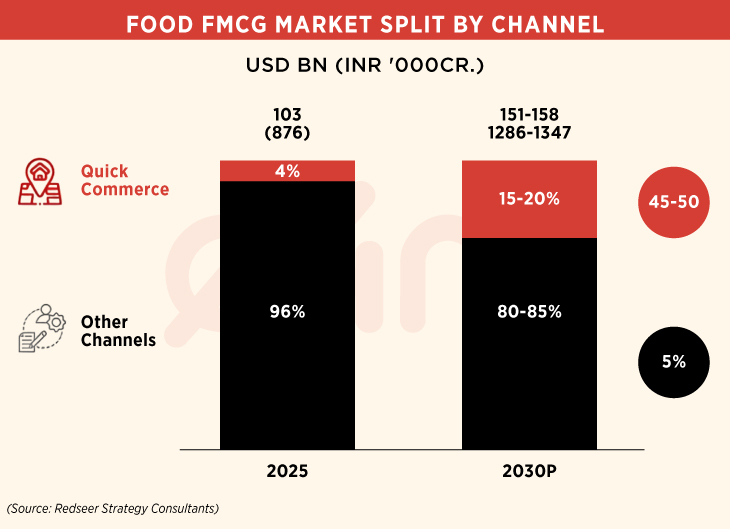
India’s $100 billion-plus packaged food and beverages (F&B) market is projected to expand to over $150 billion by 2030, and within this evolving landscape, quick commerce is emerging as a disproportionate growth driver. According to a recent Redseer research, the channel is expected to scale from roughly $4 billion today to over $25 billion in GMV by the end of the decade, signalling a sharp acceleration in both adoption and usage.
Despite this momentum, quick commerce still accounts for only around 4% of India’s food FMCG market as of 2025, with the remaining 96% dominated by traditional and modern trade. However, according to Redseer, this share is projected to rise rapidly to 15–20% by 2030, marking a 4–5X expansion within a few years. According to industry estimates and Redseer’s analysis, this growth is being fuelled by the rapid expansion of dark store networks, increasing order frequencies, and basket diversification.
This rapid scale up not just signals a distribution shift, however, it signals a deeper change in how consumers are discovering and consuming packaged foods.
For legacy FMCG players like Marico, quick commerce is already beginning to influence both innovation cycles and category playbooks. The company noted that the channel is enabling faster feedback loops and shorter trend cycles, while also opening up demand for niche, premium, and occasion-led products. “The growth of quick commerce and the influx of new-age D2C brands have raised the pace of innovation across the industry,” a Marico spokesperson told e4m, adding that the company is increasingly aligning its pipelines to emerging, platform-led trends.
The impact is visible in business metrics as well. Quick commerce contributed around 3% to Marico’s India business in FY25, with strong traction coming from everyday essentials, impulse purchases, snacking, and premium lifestyle categories.
For D2C brands, however, this shift is even more structural. Vidur Kataria, Co-founder of MasterChow, describes quick commerce as less of a channel evolution and more of a consumer mindset reset. “Quick commerce hitting 20% of packaged F&B isn’t just a channel shift, it’s a behaviour shift. Convenience is now a necessity, with consumers expecting bold and high-quality flavours instantly,” he said.
Echoing this shift in consumer behaviour, Dhruv Kohli, Founder of Boba Bhai, a D2C bubble tea brand, pointed out that quick commerce is driving more impulse-led consumption. “Quick commerce scaling to this level signals a clear shift towards impulse-led consumption. At Boba Bhai, we are already seeing discovery and ordering move closer to real-time decisions,” he said, adding that the brand is evolving its flavours to stay relevant for a younger audience and focusing on speed, consistency, and visibility across platforms.
This has direct implications for product design. Categories that deliver instant gratification like easy-to-use, flavour-first, and quick-to-prepare, are outperforming, aligning with the promise of near-instant delivery.
As consumption patterns shift, so too is the marketing playbook.
According to Shradha Agarwal, Co-founder and Global CEO of Grapes Worldwide, the rise of quick commerce reflects a fundamental change in how consumers make decisions. “People are deciding much quicker, usually with a clear need, so brands have to be visible and easy to pick in that moment,” she said.
This compression of the decision-making window is prompting a reallocation of marketing budgets, with brands prioritising channels that drive immediate action over those focused solely on long-term awareness. Agarwal added there is now greater emphasis on platform presence, discoverability, and partnerships, as opposed to traditional mass-led visibility.
Adding to this, Vejay Anand, Senior Advisor at marketing and advisory firm Prequate, points out that quick commerce is effectively redefining the competitive arena. As the channel scales toward a 20% share, consumption is becoming “immediacy-led and intent-rich,” where decisions are made in seconds and discovery is increasingly algorithm-driven.
Anand further noted that the rise of quick commerce is also accelerating the importance of retail media ecosystems. “These platforms are evolving into closed-loop environments, where search visibility, sponsored placements, and in-app media are tightly integrated with transactions. This is pushing brands to invest more heavily in conversion-proximate touchpoints, where the path from discovery to purchase is nearly instantaneous. The traditional marketing funnel is now collapsing into a single, continuous journey within the platform itself.
From a supply-side perspective, this shift is also reshaping how categories like fresh and dairy operate. Ranjith Mukundan, CEO and Co-Founder of Stellapps dairy platform mooMark, noted that quick commerce is compressing the gap between production and consumption. “Quick commerce compresses the distance between production and consumption, which is exactly where fresh dairy wins. Brands that promise freshness and deliver it within minutes are where we are positioning our manufacturing capabilities and our brand partners,” he said.
These shifts point to a broader transformation in the packaged F&B landscape. Quick commerce is fast emerging as a high-frequency consumption layer, reshaping everything from product formats and innovation cycles to media investments and distribution strategies, rather than remaining just an additional channel.
If quick commerce accounts for 15–20% of India’s packaged food and beverages market over the next few years, it will mark a decisive shift from scale-led distribution to precision-led demand capture. For brands, this means rethinking playbooks across the board, building agile innovation pipelines, designing formats suited for impulse and immediacy, and reallocating spends toward platform-led visibility and conversion.
As industry voices point out, the battle is no longer just for shelf space, but for algorithmic prominence and in-app discovery, where decisions are made in seconds.
Read more news about Digital Media, Internet Advertising, Marketing News, Television Media, Radio Media
For more updates, be socially connected with us onInstagram, LinkedIn, Twitter, Facebook, YouTube & Google News