Full funnel, cross-channel in practice: Rewiring consumer journey at e4m RetailEX summit
Moderated by Adeeb, Head of Agency Business, India at Criteo, the panel had Sujata Dwibedy, Sairam Ranganathan, Driv Vohra, and Swati Rao
 by
by
Published: Apr 20, 2026 1:29 PM | 7 min read
 Follow Us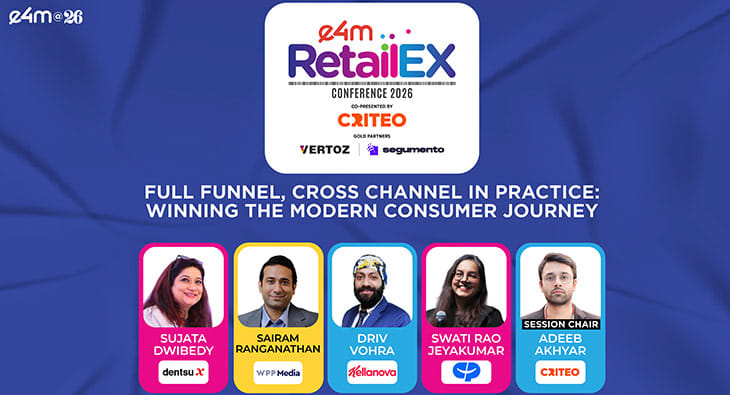

The opening panel at the e4m RetailEX Conference 2026 set the tone for a day centered on one central truth: the consumer journey is no longer linear, and marketing can no longer afford to be either. Moderated by Adeeb, Head of Agency Business, India at Criteo, the session brought together a diverse mix of agency leaders and brand marketers: Sujata Dwibedy (CEO, dentsu X), Sairam Ranganathan (Head of Commerce, WPP Media), Driv Vohra (Head of Digital Marketing, Kellanova), and Swati Rao (Director Marketing, Colgate-Palmolive) to unpack what “full-funnel, cross-channel” really looks like in practice.
From the very outset, Adeeb framed the problem succinctly. India’s commerce ecosystem is evolving at breakneck speed. Consumers today move seamlessly across platforms: discovering on social media, validating through reviews, and purchasing via marketplaces or quick commerce apps, often within hours. Yet, marketing structures and measurement frameworks remain fragmented, split across silos like on-site vs. off-site, brand vs. performance, and retailer vs. open internet.
The conversation that followed was less about acknowledging this gap and more about how the industry is attempting to close it.
The Fragmented Reality of Consumer Behavior
Driv Vohra was quick to point out that while consumer journeys have evolved, marketing systems haven’t kept pace. “Consumers are moving between social for discovery, reviews outside the platform, and then going on-platform to take the final decision. But planning still happens in silos,” he said.
He highlighted a crucial blind spot in today’s data ecosystem. Platforms like Google and Meta are exceptionally strong at capturing intent and interest signals. But they lack the most definitive signal of all: purchase behavior. “There is one signal that’s completely missing: what you’ve bought and what you’re going to buy. That’s where retail media becomes critical.”
For Vohra, integrating this “buy signal” is not about replacing existing planning frameworks but enhancing them. It allows brands to move beyond just targeting interest or intent and instead focus on actual category buyers: unlocking growth through penetration rather than just share.
From Platform-First to Audience-First
Swati Rao offered a more optimistic view, suggesting that some brands have already begun bridging the gap. At Colgate-Palmolive, she explained, the shift has been from platform-first to audience-first planning.
“Planning has moved to meeting audiences where they are, at the moments that matter,” she said. This means identifying high-value cohorts, such as category purchasers or lookalikes, and targeting them consistently across the ecosystem, rather than tailoring strategies separately for each platform.
This shift, however, is not just tactical; it’s organizational. Teams need to align around shared goals, rather than operate in channel-specific silos. “The journey is far more connected than it used to be,” Rao noted, emphasizing that structural change within organizations is as important as strategic change.
The Agency Lens: Connected Systems, Not Channels
From an agency perspective, both Sairam Ranganathan and Sujata Dwibedy acknowledged that while the industry has made progress, true unification remains elusive.
Ranganathan pointed out that agencies have long understood the importance of a connected journey. However, the lack of a unified measurement framework continues to be a major hurdle. “Consumers are nonlinear. They can discover on Pinterest, validate on YouTube, and purchase elsewhere. But there is no single study or system that connects these ecosystems seamlessly.”
Dwibedy contextualized this evolution over a longer timeline. A decade ago, the industry grappled with integrating TV and digital. Today, that question feels almost redundant because of the massive shift toward digital consumption. Similarly, she argued, the current debate around on-platform vs. off-platform will soon become irrelevant.
Instead, she reframed the challenge around two core questions: What is the growth objective? And where is the source of growth for the audience?
She broke down audiences into three broad categories: category non-buyers, category buyers, and brand buyers, and emphasized that every marketing effort must address some combination of these groups. With the rise of digital and retail media, marketers now have the tools to target these segments with unprecedented precision.
The Persistent Challenge of Measurement
Despite advancements in planning and targeting, measurement remains the industry’s Achilles’ heel. Even as brands adopt full-funnel strategies, they often revert to last-click metrics like ROAS (Return on Ad Spend) to evaluate success.
The panel collectively agreed that this is insufficient. Metrics like incremental sales, new-to-brand customers, and lifetime value offer a far more holistic view of performance, but are harder to measure and standardize.
Vohra emphasized the importance of shifting focus toward “new-to-brand” customers, aligning with Byron Sharp’s principle of prioritizing penetration over share. “New-to-brand is better than ROAS,” he asserted, urging marketers to rethink their success metrics.
Data Signals: The New Currency of Commerce
A significant portion of the discussion centered around the growing importance of data signals, particularly those emerging from retail ecosystems. Transaction-level data, basket composition, and substitution patterns are now accessible in ways they weren’t before.
Rao identified data clean room partnerships as one of the most underutilized opportunities. These enable brands to combine their first-party data with retailer data in a privacy-safe environment, unlocking highly personalized targeting.
She shared Colgate’s “Oral Health Movement” as a case in point. By offering consumers an AI-powered oral health assessment, the brand not only delivers value but also gathers meaningful data. This data can then be used (via partnerships with platforms like Amazon) to recommend relevant products at the point of purchase.
Dwibedy expanded on this by distinguishing between partner-dependent and independent data clean rooms, advocating for the latter to ensure greater transparency and scalability. However, she also cautioned against treating first-party data as a “shiny new object.” The real value lies in having a clear purpose and value exchange for the consumer.
Back to Basics: Signals That Still Matter
While much of the conversation focused on advanced data ecosystems, Vohra brought the discussion back to fundamentals. Not every brand, he argued, is ready for sophisticated data partnerships.
“There are enough signals already available that marketers are not fully utilizing,” he said. Simple metrics like “viewed but not purchased” can be powerful indicators for bottom-funnel activation. Similarly, understanding purchase cycles (such as when a consumer is likely to repurchase a product) can significantly improve targeting efficiency.
“These are not new concepts,” he noted, referencing traditional tools like market basket analysis. “But now, we finally can use them effectively.”
AI: Enabler, Not Replacement
The conversation naturally turned to artificial intelligence, a topic that has dominated industry discourse in recent years. However, the panel took a measured view, cutting through the hype.
Dwibedy described AI as an enabler rather than a solution in itself. “It helps us multiply what we already know,” she said, highlighting its role in automation, insight generation, and data analysis.
Ranganathan introduced a useful distinction between “foundational AI” and “transformational AI.” The former focuses on efficiency: optimizing media buys, analyzing data, and improving targeting. The latter has the potential to fundamentally change how marketing functions operate, from strategy to creative development.
Yet, both agreed on one key point: human intelligence remains indispensable. The future lies not in replacing humans with machines, but in creating a synergy between the two.
Toward a More Scientific, Consumer-Centric Future
As the session drew to a close, one theme stood out: the shift from fragmented, channel-based marketing to a more integrated, data-driven, and consumer-centric approach is well underway, but far from complete.
The tools exist. The data is available. The intent is clear. What remains is the hard work of integration: breaking down silos, aligning teams, redefining metrics, and building systems that reflect how consumers actually behave.
In many ways, the industry is at an inflection point. The question is no longer whether full-funnel, cross-channel marketing is necessary. It is whether organizations can evolve quickly enough to execute it effectively.
Read more news about Marketing News, Advertising News, PR and Corporate Communication News, Digital News, People Movement News
For more updates, be socially connected with us onInstagram, LinkedIn, Twitter, Facebook, YouTube & Google News