Search had keywords. Social had audiences. Can ChatGPT sell context?
Marketers and agency executives say conversational intent is potentially richer than conventional signals but the real hurdle is not intent but attribution
 by
by
Published: Aug 28, 2026 8:47 AM | 4 min read
 Follow Us

- Marketers believe that while conversational intent from ChatGPT Ads in India could provide richer insights than traditional advertising methods, it does not automatically translate to higher value for advertisers.
- Current advertising strategies in India emphasize proof of effectiveness over potential, with a focus on attribution being crucial for determining the value of conversational advertising.
- The challenge lies in demonstrating that conversational intent can reliably convert into transactions, as ChatGPT users are not inherently more valuable than users on other platforms.
- Advertisers face additional hurdles, such as the lack of access to user data and the need to compete with AI-generated responses, which may undermine the effectiveness of their ads.
If the first question around ChatGPT Ads in India is whether conversational intent makes an Indian user more valuable, the answer from marketers is broadly consistent.
Potentially. But not automatically.
“Search gave advertisers keywords. Social gave them audiences. AI could give advertisers context,” says marketing and digital advertising leader Nikhil Kumar.
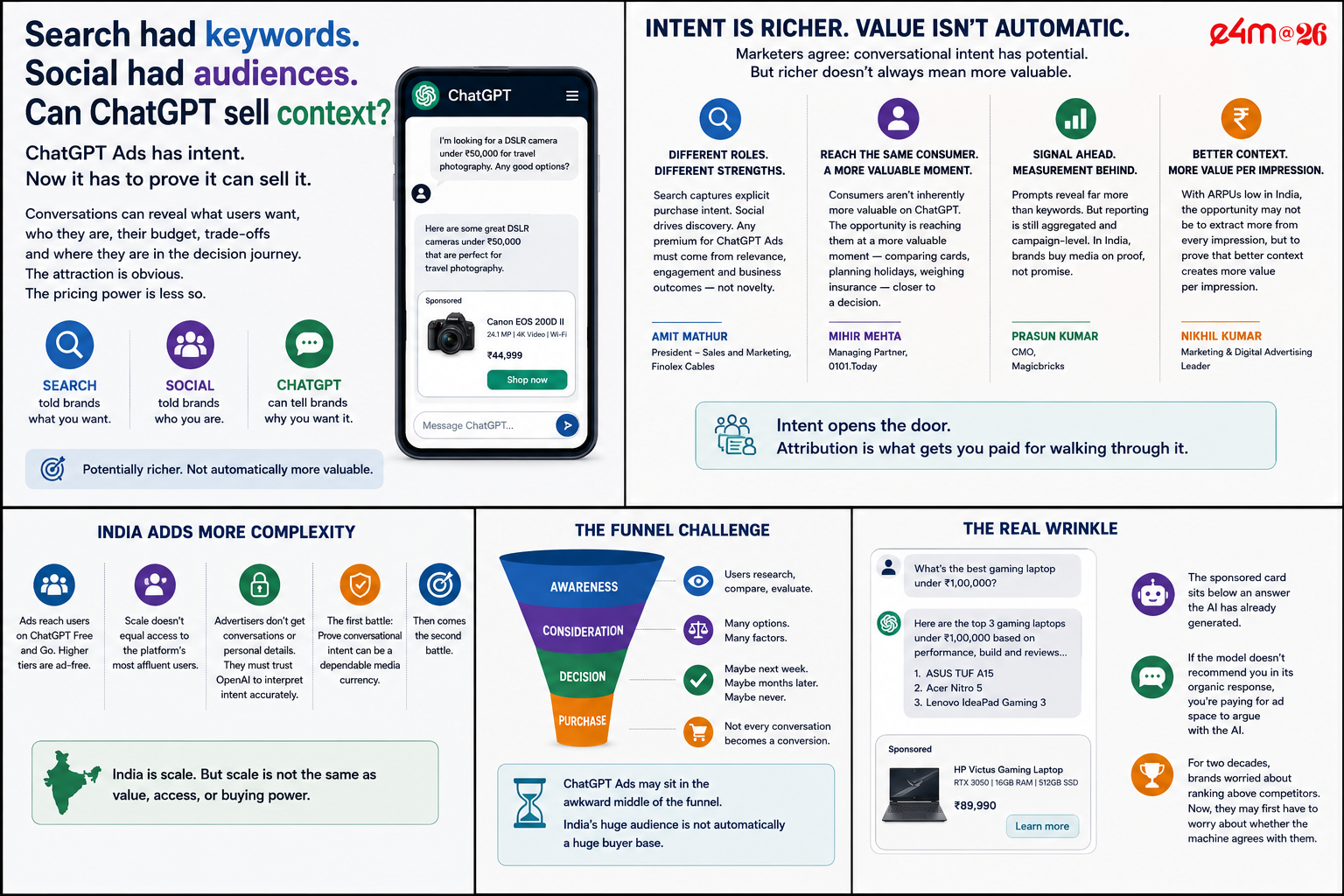
That is, broadly, the proposition. A search can tell a brand what somebody wants. A social profile can tell it who they are likely to be. A conversation can potentially do both, while also revealing budget, use case, trade-offs and where the user sits in the decision journey.
The attraction is obvious. The pricing power is less so.
Can India give OpenAI ad revenue? Read here
Across marketers and agency executives exchange4media spoke to, there was little disagreement that conversational intent is potentially richer than conventional signals. What they were much less willing to concede was that richer automatically means more valuable.
Amit Mathur, President – Sales and Marketing, Finolex Cables, points out that search, social and conversational platforms still play different roles. Search already captures explicit purchase intent, while social remains strong at discovery and consideration. Any premium for ChatGPT Ads, in his view, has to come from stronger relevance, engagement and incremental business outcomes rather than from the novelty of the environment itself.
AI agent may soon shop and pay
Mihir Mehta, Managing Partner, 0101.Today, arrives at a similar conclusion from a different direction. The consumer does not necessarily become more valuable simply because they are using ChatGPT. “The opportunity is in reaching the same consumer at a potentially more valuable moment — while comparing cards against spending habits, planning a holiday against a defined budget, or weighing insurance options closer to a decision.”
That distinction matters in India, where scale is enormous but media buying remains relentlessly efficiency-driven.
The real hurdle is therefore not intent. It is attribution.
Prasun Kumar, CMO, Magicbricks, argues that a conversational prompt can reveal far more than a handful of keywords. But with reporting still largely aggregated and campaign-level, the signal currently sits ahead of the measurement infrastructure needed to price it confidently. “In India, brands buy media on proof, not promise,” he says.
Until conversational advertising can be tied more directly to actual conversions, he expects brands to use it first in high-consideration categories such as insurance, real estate and education rather than immediately pay search-beating premiums for it. “Intent opens the door; attribution is what gets you paid for walking through it.”
Nikhil Kumar makes a related point, noting, “In a market where ARPUs remain low, the opportunity may not be to extract more money from every impression, but to prove that better context creates more value per impression.”
AI and the advertiser. Read more here
There is another complication.
Ali Zaidi, Senior VP – Media, Tonic Worldwide, cautions against treating the ChatGPT user themselves as inherently more valuable. What may be valuable are specific moments within a conversation.
That matters because search has spent two decades proving its ability to turn expressed intent into transactions, while social has proved its ability to create demand at scale. Conversational advertising still has to demonstrate where it sits between those two poles.
India complicates that equation further. Ads currently reach users on ChatGPT Free and Go while higher-paid tiers remain ad-free. Scale, therefore, does not automatically translate into access to the platform’s most affluent users. Advertisers also do not receive the underlying conversations or personal details, meaning much of the value proposition depends on trusting OpenAI to interpret intent accurately on their behalf.
Which means the first battle may simply be proving that conversational intent can become a dependable media currency at all.
And then there is the second battle.
Prashant Puri, Co-Founder and CEO, AdLift, points out that much of ChatGPT’s commercial activity may sit in the awkward middle of the funnel. A user researching a laptop, university course or holiday might buy next week, months later, or never. India’s enormous ChatGPT audience is not automatically an enormous buyer base.
More interestingly, the ad is entering the conversation after the AI has already answered.
“The sponsored card sits below an answer that the AI has already generated,” Puri says. “If the model does not recommend you in its organic response, you are essentially paying for ad space to argue with the AI.”
And that may be the real wrinkle. For two decades, brands worried about whether they ranked above their competitors.
In conversational advertising, they may first have to worry about whether the machine agrees with them.
Read more news about Digital Media, Internet Advertising, Marketing News, Television Media, Radio Media
For more updates, be socially connected with us onInstagram, LinkedIn, Twitter, Facebook, YouTube & Google News