Marketing Strategy in the AI Age: The collapse of strategy and execution in the age of AI
Deepali Naair, Global Head of Brand, Mktg & Corp Comms, Biocon, speaks with Shripad Kulkarni on GenAI, collapse of the strategy-execution divide — & why the principles of mktg have never mattered more
 by
by
Published: Apr 28, 2026 7:58 AM | 5 min read
 Follow Us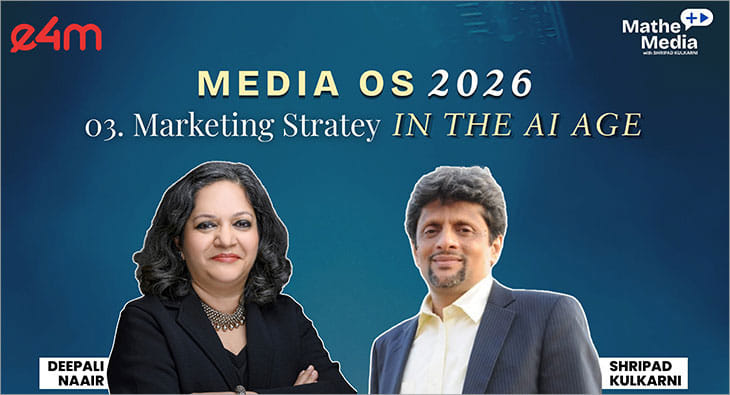

- Deepali Naair highlights that Generative AI (GenAI) fundamentally alters marketing by integrating into the creative process, redefining brand strategy rather than merely enhancing existing efficiencies.
- She warns of the risks associated with AI-generated outputs that may appear credible but lack a solid human data foundation, emphasizing the responsibility of marketers to understand their AI models.
- The traditional separation between strategy and execution in marketing is collapsing, as AI enables faster execution, prompting a shift in how marketing organizations are structured and necessitating that young marketers learn strategic inputs early.
- Naair stresses the importance of direct consumer engagement, cautioning that reliance on technology without understanding consumer behavior can undermine effective marketing, as true insights come from personal interactions.
What GenAI Actually Changed
Deepali Naair is precise about where the current wave is different from everything that came before. Earlier AI — programmatic advertising, media evaluation, planning tools — added efficiency to processes that already existed. It made the machine faster.
GenAI has done something structurally different.
"What has happened with Gen AI is that it has gotten into the creative aspects of marketing and branding — adding speed as well as creation and iteration of creative assets”. It's impacting everything in brand strategy. So it is not a conversation about AI in marketing. It is a conversation about how marketing itself is being redefined.”
This is not a faster version of what was already being done. It reaches into the creative process itself — into brand strategy, into the decisions that used to require a room full of strategists and a week of workshops.
Be Responsible About the Base
But with that reach comes a risk that Deepali has seen up close. An international agency group — she will not name it — built consumer cohort models for research purposes. Fast, sophisticated, impressive-looking. The models and cohorts were not based on any human data at all.
"For all you know, AI could be hallucinating — and I can sit here doing that on my ChatGPT page, professional version. Marketers need to become more responsible about what is that base when you're using the AI model and for what kind of purpose."
The output looked like research. It was not research. It was pattern-matching on pre-trained data, presented with the confidence of fact. The responsibility, she argues, lies with the marketer — not the tool. You have to know what your AI model is built on. You have to ask the question before you trust the answer. The risk is not bad output. The risk is credible-looking output that is fundamentally untrue.
The Principles Stay. The Process Doesn't.
The reframe Deepali offers is the most useful strategic insight in the conversation. The brains behind the appeal — the consumer understanding, the brand truth, the strategic instinct that tells you what your audience actually needs to hear — have not changed. What has changed is the machinery around them.
"Some of the principles are kind of the same, but the process of doing it is entirely different."
She makes this concrete. Twenty years ago at HSBC Mutual Fund, the aspiration was to serve every investor at their exact investment level — 50,000 rupees per month here, 2,000 rupees there. Theoretically right, practically impossible. Today, that aspiration is executable. Fifty pieces of creative, fifty consumer cohorts, served through media with precision that would have been science fiction a decade ago. The intent was always there. Now so is the infrastructure.
Strategy and Execution Are Collapsing
The corporate structure Deepali has worked within for thirty years is shifting beneath her. Strategy at the top, execution at the bottom — that model is being disrupted not by reorganisation but by capability.
"The people who are doing strategy will be able to execute very fast themselves. So there will be a very high execution throughout the corporate organisation. This doesn’t just change roles. It changes how marketing organisation is designed.”
Her message to younger marketers is pointed: do not wait to learn strategy. The execution advantage that used to buy time for early-career learning is compressing fast. Learn the strategic inputs now. The jobs that AI will create are ones that nobody has yet named — but the ones it will displace are precisely the ones built on execution alone.
The Proof Is Already Here
The scale of this shift is visible not just inside marketing departments. It is visible in who has started paying attention to them.
“We’ve never had the big consulting companies focus on marketing in brands so much as they have in the last few years — because they’re trying to figure out what the LLMs are doing and LLMs are very largely impacting the marketing ecosystem.”
At Biocon, Deepali is already building differently. Hiring for creative plus project management. Fewer traditional agency interactions, more new-age partners. And at the centre of it — a 22-year-old who managed the entire film production in her previous role at CKA Birla Group. Everything.
"The whole year — the film that we got done — it was all managed by a 22-year-old boy. Everything. So that is also something that I see around me that is changing."
We Have Stopped Meeting the Consumer
And yet — underneath all of it — Deepali returns to the one conviction that thirty years in marketing has not shifted.
"The thing I find missing in young marketers and the development of technology is that we have stopped meeting the consumer."
She says this not as nostalgia. She says it as a strategic warning. The insights that come from sitting with a consumer — watching how they interact with their phone, their machine, their environment — are irreplaceable. They are the raw material that every AI model, every cohort analysis, every creative workflow depends on. Lose the source, and you lose the thing that makes all the downstream tools meaningful.
"I hope that AI doesn't just make us sit in the room and just do all our marketing from that."
The principles stay. The process doesn't. The marketers who understand the difference — who know what AI can do and what only a human sitting with a consumer can do — are the ones who will still be standing when the next wave arrives. No model can replace what you observe when you sit with a consumer. AI will change how we do marketing. It will not change what good marketing is.
Deepali Naair is a contributor to the Media OS 2026 Report, examining how Indian advertising is being rebuilt from the ground up. This piece has been curated by Shripad Kulkarni based on the conversation for the MatheMedia Podcast Series.
Read more news about Marketing News, Advertising News, PR and Corporate Communication News, Digital News, People Movement News
For more updates, be socially connected with us onInstagram, LinkedIn, Twitter, Facebook, YouTube & Google News