As microdramas take off, brands move from placement to participation
From JK Super Cement to Meesho and RuPay to Tinder and P&G, brands are moving beyond product placement, betting on serialised storytelling to build deeper engagement with mobile-first audiences
 by
by
Published: Aug 27, 2026 9:30 AM | 7 min read
 Follow Us

- Branded entertainment in India is shifting towards microdramas, where advertisers collaborate at the script stage to shape content, as seen in JK Super Cement's "Tera Ghar Mera Ghar" and RuPay's "Sarva Groom Sampanna."
- The microdrama market in India is projected to grow significantly, reaching $4.5 billion by 2030, with increasing participation from brands looking to engage younger audiences through meaningful storytelling.
- Platforms like Kuku TV and ShareChat are gaining popularity, with microdramas accounting for a notable share of viewer engagement, as they offer a compelling alternative to traditional advertising methods.
- Despite the growth and interest, the effectiveness of microdramas in translating viewer attention into brand impact remains to be fully established, emphasizing the need for engaging and well-crafted content.
For years, branded entertainment in India has largely followed a familiar formula: create the content first, then find a way to put the brand into it. Microdramas are beginning to reverse that equation, with advertisers entering at the script stage and helping shape the premise, characters and distribution.
JK Super Cement has created a 53-episode drama, Tera Ghar Mera Ghar, around the emotional journey of building a home. Created with JUJU Films and set in Kanpur, the series follows a young couple preparing for their first child while navigating financial pressures, family tensions and aspirations. It premiered on August 21 on ZEE5’s Bullet microdrama app and is also available across ShareChat, Moj, and JK Cement India’s Facebook and YouTube pages.
“For generations, cement communication has focused on what a product delivers—strength, durability, and quality. But for an Individual home builder, a home is much more than a structure; it is where aspirations take shape, relationships grow, and life’s most important moments unfold. At JK Super Cement, we believe that understanding this emotional journey is as important as understanding the product itself,” says Pushp Raj Singh, Group President – Sales & Marketing, JK Cement Ltd.
RuPay has taken a similar route with Sarva Groom Sampanna, the first story under its Tiny Talkies original microdrama IP, created with tgthr.Originals. The nine-episode romantic family drama follows 27-year-old Arya through the Indian ritual of “groom hunting”.
“RuPay is woven into the plot rather than inserted as conventional advertising. That distinction was deliberate,” says Aalap Desai, Chief Creative Officer and Co-Founder, tgthr., and Series Director, Sarva Groom Sampanna.
“In India, striking the right balance between a good show and the brand not feeling like it was randomly inserted has been a unicorn most brands have been looking for but haven't found. That’s where our latest release for RuPay sits. It is great, watchable content written around the brief and the product. As a result, it fits like a glove,” he adds.
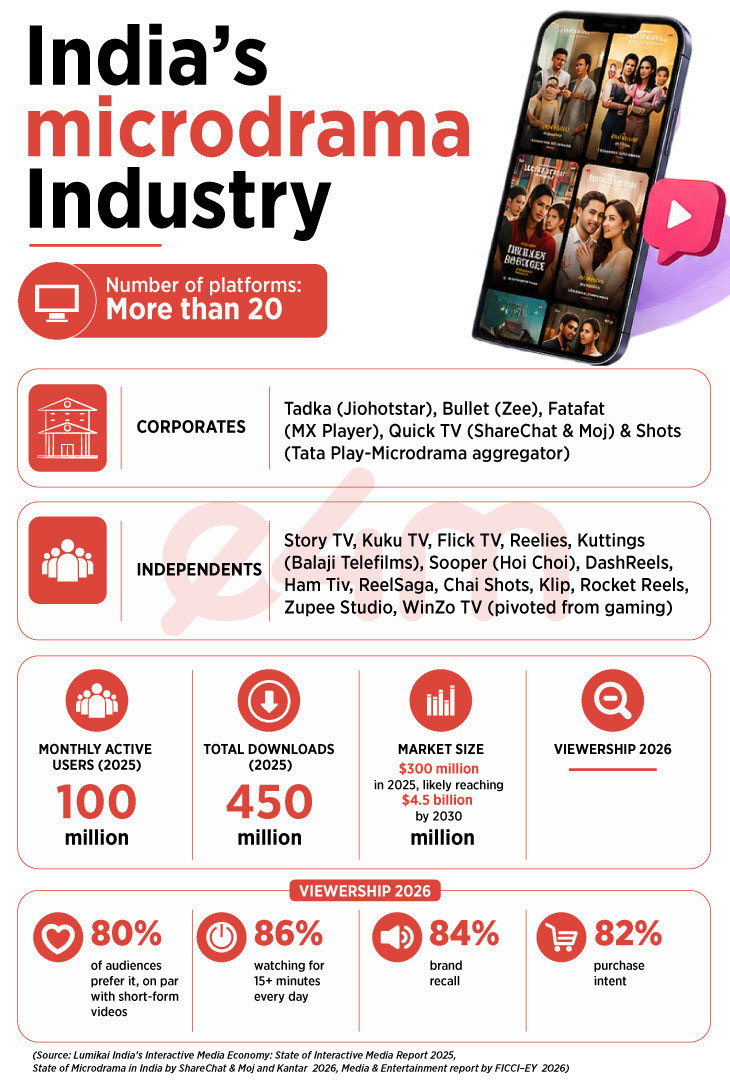
The shift comes as India’s microdrama market crosses $300 million, with 450 million downloads and 100 million monthly active users in 2025, according to Lumikai’s State of India Interactive Media Report 2025. The segment is projected to reach $4.5 billion by 2030.
Also Read: Microdramas move up the value chain as top studios bet on vertical storytelling
How microdramas are rewriting content economics, cost structures
Kuku’s IPO could put microdramas on India’s public-market map
Brands are buying participation, not just placement
Kuku TV’s Sabse Bada Dramebaaz illustrates another model. The 50-episode acting reality microdrama, co-presented with Meesho and powered by Tinder, combines a talent hunt with vertical storytelling. Episodes run for around two minutes, while nationwide auditions attracted more than 2,000 entries, with audience voting helping select contestants.
Meesho’s role connects to its Creator Club, while Tinder is positioned around connection and opportunity. “At Tinder, our mission is to create meaningful connections for every single person worldwide, and that begins with creating opportunities for people to express themselves and discover new possibilities. Sabse Bada Dramebaaz celebrates that spirit, with young people putting themselves out there and taking a chance on something they believe in,” Daniel Kim, SVP, Tinder Asia, Match Group said.
Tinder had earlier partnered with Kuku TV on Right Match, indicating that brands are beginning to view microdrama as a repeatable content environment rather than a one-off campaign.
Data moves upstream
The shift is also visible in the US, where Procter & Gamble and Albertsons Media Collective created Rico’s Tacos, a scripted microdrama with platform Minivela. Shopper intelligence was used before the content was made, helping shape the series rather than simply determine who would see it.
The Southern California-set series follows a family building a taco business and is distributed through Albertsons’ YouTube, social and in-store channels. P&G brands including Bounty, Head & Shoulders and Vicks feature in the project.
For advertisers, that represents a larger shift: data is beginning to influence what gets made, not just who gets targeted.
Indian advertisers are watching
Indian agencies and clients are also beginning to explore the space.
“Client interest in microdrama is currently in pockets, especially when they want to target younger and Gen Z consumers,” says Navin Khemka, President of Client Solutions, WPP Media South Asia. “It’s an early trend. There is a long way to go, a lot of investments, and a lot of large networks are making this, given whatever trends that we’ve seen globally also.”
The wider ecosystem is scaling. Mohalla Tech, parent of ShareChat, Moj and QuickTV, has partnered with Double Tap Films, Pratilipi’s microdrama studio, to distribute 75+ stories. Z has acquired Bullet, while JioHotstar, MX Player and ShareChat have launched micro-content platforms. YRF, Applause and EPIC Studios have also entered partnerships with emerging platforms, while former Publicis executive Oindrilla Roy has co-founded AndOr Content to produce branded microdramas.
Roy says: “The skip button tells us something fundamental: people have taken control of what gets their attention. Advertising can no longer assume it will be watched simply because it has been placed in front of someone. At the same time, short, episodic, mobile-first content is becoming a significant part of how people consume entertainment. That creates a sizable new opportunity for brands: to move from buying interruptions to building content people actively choose to watch.”
“If the skip button is the enemy, micro content gives brands a very interesting way around it,” Roy emphasises.
The audience numbers are adding to the momentum. Kuku TV, Story TV and Quick TV have entered India’s top five most-downloaded video streaming apps, ahead of Zee5, SonyLIV and Netflix, according to FICCI-EY. Sensor Tower data accessed by e4m shows Kuku TV and Story TV recorded over 400,000 global downloads each in the past month, while JioHotstar crossed one million. Kuku TV generated roughly $50,000 in revenue in February 2026, followed by Story TV at $40,000.
A Kantar & ShareChat study found microdramas account for 14% of viewing among consumers who watch content for more than two hours a day, equal to long-form content. 80% of consumers prefer microdramas, compared with 81% for short-form video and 63% for long-form content, while 54% return to the same story on the same day.
The format still has to prove itself
The growth, however, brings a familiar advertising-industry question: does attention translate into brand impact?
In the US, brands including P&G, Maybelline, Dr Pepper, Marc Jacobs and Crocs are experimenting with the format. “We’re seeing a shift in consumption habits of our consumers where they are looking for content that feels like entertainment. Microdramas are just that, which is why we’re leaning into this space,” says Carly Gomez, CMO, Crocs.
But a microdrama cannot simply be a 30-second advertisement stretched across multiple episodes. Its currency is the cliffhanger—every episode has to earn the next swipe.
As Khemka puts it: “Microdrama success will depend on how intriguing and how interesting you are able to make the content. The way you are able to cut the content, because it’s also in the vertical format, the way you are able to hook the audience into the next episode — that will be critical.”
That may determine the category’s next phase: whether microdramas remain another branded-content format or evolve into scalable entertainment IP that brands, platforms and studios can build together.
Read more news about Digital Media, Internet Advertising, Marketing News, Television Media, Radio Media
For more updates, be socially connected with us onInstagram, LinkedIn, Twitter, Facebook, YouTube & Google News