Digital format allocation by verticals: How India’s ad money has shifted
Digital media continues to be India’s top advertising channel, supported by enabling policy frameworks and infrastructure
 by
by
Published: Feb 3, 2026 6:35 PM | 5 min read
 Follow Us

The Indian digital media industry has decisively moved from experimentation to execution. According to the dentsu–e4m Digital Advertising Report 2026, after growing 19% in 2024, the market closed 2025 at ₹71,621 crore, firmly establishing digital as the centre of gravity for brand investment. Its rapid expansion reflects both the scale of India’s connected population and the increasing sophistication of digital commerce and content ecosystems.
Digital media continues to be India’s top advertising channel, supported by enabling policy frameworks and infrastructure. These structural tailwinds are projected to sustain an 18.6% growth rate through 2026, taking digital media spends to ₹84,977 crore by year-end. The surge is being driven by mobile-first consumption, short-form video, creator-led commerce and AI-powered adtech that is improving targeting, optimisation and attribution.
As per the 2026 report, digital media is expected to grow at a CAGR of 17% to reach ₹98,034 crore by 2027, contributing nearly 70% of total Indian advertising spends and marking a definitive shift to a digital-first communication economy.
What is increasingly evident, however, is that this growth is not uniform. As digital becomes the default medium, industry verticals are deploying budgets very differently across formats.
Read On: dentsu-e4m report: Indian advertising industry to grow at CAGR of 7.4% by 2027
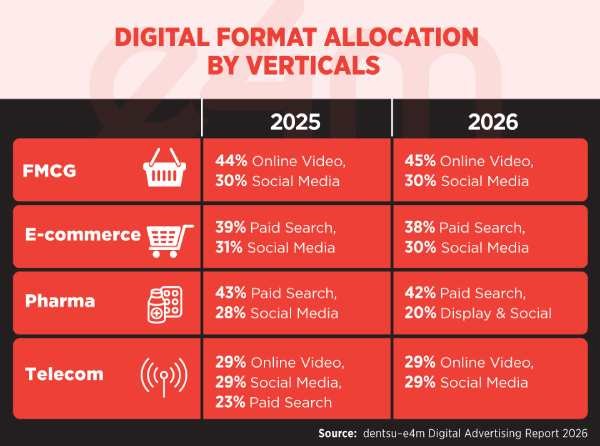
The dentsu–e4m 2026 outlook makes this divergence explicit. FMCG advertisers are increasingly skewed towards online video to drive reach and storytelling at scale. E-commerce players are doubling down on paid search and social media to capture high-intent demand while sustaining discovery. Pharmaceutical brands, meanwhile, are prioritising paid search and display within digital, reflecting the category’s reliance on precision, compliance and intent-led engagement. These format choices underline a clear shift from broad digital adoption to vertical-specific optimisation.
Digital Format Allocation Within Verticals
This year's report reveals that FMCG allocates 45% of its digital media spends to online video and 30% to social media. This reinforces video’s role as the primary driver of mass reach, regional penetration and visual storytelling across high-frequency consumption categories, while social platforms complement this with personalisation, community influence and rapid optimisation.
E-commerce, in contrast, directs 38% of its digital budgets to paid search and 30% to social media in 2026. This mix reflects the sector’s dependence on capturing high-intent shoppers at the bottom of the funnel, while leveraging social media and influencer-led ecosystems for product discovery and demand stimulation.
The pharmaceutical sector remains the most search-heavy category within digital. With 42% of its digital spends allocated to paid search in 2026, pharma advertisers rely on accuracy and intent-driven queries to reach consumers within stringent regulatory and compliance frameworks. Display and social formats play supporting roles, largely focussed on awareness-building and retargeting.
Telecom brands continue to maintain a balanced digital mix. In 2026, the sector allocates 29% each to social media and online video, enabling high-impact storytelling alongside continuous engagement for plans, bundles and service updates in an intensely competitive market.
A comparison with the past two years shows that while the overall digital format split has remained broadly stable, the intent behind allocation has sharpened significantly.
In the 2025 dentsu–e4m report, telecom had already allocated 66% of its overall media budget to digital, with 29% each split between online video and social media, and 23% to paid search. E-commerce devoted 65% of its media budgets to digital, with paid search accounting for 39% and social media 31% of digital spends. Pharma spent 54% of its overall media budgets on digital in 2025, with 43% allocated to paid search—an allocation pattern that has largely carried forward into 2026.
Going further back to 2024, FMCG emerged as the single largest contributor to digital media spends, accounting for 36% of the digital advertising market. E-commerce followed with a 19% share, while BFSI, pharma and automotive rounded out the top contributors. While these sectors were still scaling their digital investments, the emphasis then was on presence and reach rather than precision-led format optimisation.
Read On: FMCG leads ad spends with 30% share; e-commerce records fastest growth: dentsu-e4m report
Digital Advertising Spends Across Formats: YoY View
At an aggregate level, the 2026 dentsu–e4m report shows social media commanding the largest share of digital ad spends at 29% (₹21,057 crore), driven by high user engagement, creator-led ecosystems and the expanding role of social commerce.
Online video follows closely with a 28% share (₹20,004 crore), supported by the explosive growth of short-form content, OTT platforms and mobile-first video consumption.
Paid search contributes 23% (₹16,581 crore), reflecting its continued importance in intent-led marketing and conversion-driven campaigns, while display banners account for 16%, anchored in retargeting and broad-reach visibility.
This distribution closely mirrors trends observed over the last two years. In 2025, social media accounted for 29% (₹14,480 crore) of digital ad spends, followed by online video at 28% (₹13,756 crore), paid search at 23% and display at 16%. Online video emerged as the fastest-growing digital format, with a projected CAGR of over 23% through 2026, while social media was expected to grow at over 20%.
Going back to 2024, social media contributed 30% (₹11,962 crore) to digital ad spends, with online video at 28% (₹11,363 crore), paid search at 23% and display banners at 16%. Even then, online video and social media were the fastest-growing formats, driven by rising consumption demand and pushing brands to prioritise content quality and relevance.
As digital media moves towards contributing nearly 70% of India’s total advertising spends by 2027, the defining advantage will lie not in how much brands spend on digital, but in how precisely they align formats with consumer intent.
Read more news about Digital Media, Internet Advertising, Marketing News, Television Media, Radio Media
For more updates, be socially connected with us onInstagram, LinkedIn, Twitter, Facebook, YouTube & Google News
