The Advent of Commerce Media: Is the line between ads and commerce disappearing?
As OTT platforms, Q-comm apps, creator ecosystems collapse the distance between content and checkout, a new media category is quietly taking shape, share industry heads
 by
by
Published: Jul 1, 2026 8:41 AM | 10 min read
 Follow Us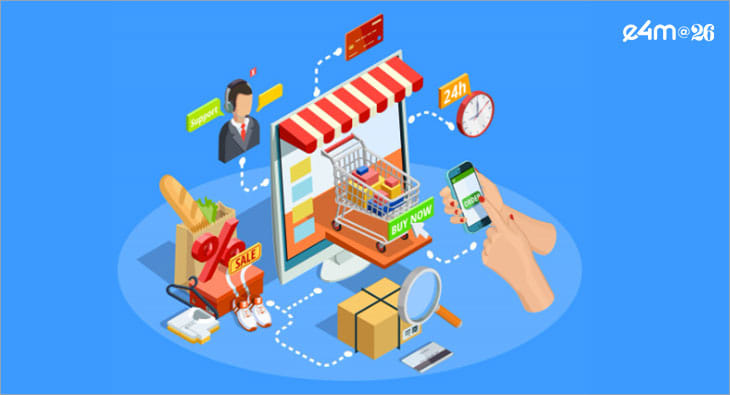

- A structural shift in India's advertising landscape is emerging, characterized by the rise of "commerce media," which integrates advertising and transactions, compressing the time between consumer intent and purchase from days to seconds.
- The Indian advertising market is projected to reach Rs 1,55,105 crore by 2025, with digital advertising accounting for 60%, and commerce-linked formats, particularly in quick commerce and retail media, showing significant growth.
- Platforms like OTT services are increasingly embedding shoppable features, allowing consumers to make purchases seamlessly during content consumption, indicating a shift in how media is planned and executed.
- The evolution of commerce media raises new questions for marketers regarding budget allocation and effectiveness measurement, as it combines audience engagement with direct sales outcomes, potentially redefining traditional advertising metrics and pricing models.
For most of advertising history, a fundamental compact held firm: media owners sold attention, and commerce happened somewhere else. A viewer watched a television commercial and then, days or weeks later, walked into a store. A reader saw a print ad and perhaps visited a website. The gap between inspiration and transaction was wide, deliberate and, for the most part, accepted as the natural order of things. That order is now collapsing.
Across India's digital landscape, a structural shift is under way that is reshaping how brands think about media investment. OTT platforms are embedding shoppable fashion integrations within reality shows. Quick-commerce platforms are converting advertising into near-instant sales. Creator ecosystems are turning recommendations into checkouts. The distance between discovery and purchase, once measured in days, is now being compressed into seconds. What is emerging from this convergence has a name that industry observers are beginning to use with increasing frequency: commerce media.
This is not simply a new format or a tactical upgrade to existing digital advertising. It represents a rethinking of what media is for. If traditional advertising sold attention and digital advertising sold clicks, commerce media sells outcomes. As the data begins to bear this out, marketers, platforms and agencies across the country are being forced to ask a question they have not seriously confronted before: What happens to the entire architecture of media planning when the ad and the transaction become one?
The Numbers Behind the Shift
The scale of what is happening in India's advertising economy makes the emergence of commerce media less a surprise than an inevitability. India's advertising market reached Rs 1,55,105 crore in 2025, with digital already accounting for 60% of that total. Within this digital majority, the fastest-growing segments are not content-led formats, but commerce-linked ones. Quick commerce advertising on platforms like Blinkit, Zepto and Swiggy Instamart scaled from Rs 1,325 crore in 2024 to Rs 4,000 crore in 2025, a 202% jump, with projections pointing to Rs 6,000 crore in 2026.
Retail media ad revenues in India are projected to grow 26.4% in 2025 to approximately Rs 24,280 crore and are expected to cross Rs 30,000 crore by 2026, accounting for nearly 15% of total advertising spend. At that scale, the category is no longer an experiment tucked into performance marketing budgets. It is becoming a strategic priority in its own right.
Meanwhile, the OTT sector is accelerating as a commerce surface. India's OTT market, estimated at around 3.9 billion dollars in 2024, is projected to reach $19.25 billion by 2035, growing at a CAGR of 15.6%, according to a Market Research Future Report. As streaming scales, so does its potential as a transactional environment. The question for platforms is no longer whether they can carry advertising, but whether they can carry commerce.
Shrinking the Distance Between Intent and Transaction
The most consequential aspect of commerce media is not the technology that enables it, but the behavioural shift it exploits. Consumer intent, historically, was perishable. A viewer inspired by a product seen on television had to carry that intent through hours, or days, of friction before a purchase could occur. By the time they reached a store or a website, the impulse had frequently faded. Commerce media works precisely because it captures intent at its peak and converts it before it evaporates.
JioHotstar's Bharath Ram, Chief Product Officer, articulates what this looks like in practice from a platform perspective. "Whether it is Shop the Look enabling viewers to instantly discover and purchase fashion inspired by characters and creators, or our Swiggy integration allowing audiences to order food seamlessly during live matches without leaving the stream, the larger vision remains to reduce friction between intent and action while keeping the content experience at the centre," he says. The results suggest the approach is resonating. "During the ongoing cricket season, the Swiggy integration has seen significant traction with over 37 million users engaging with the feature. This shows how naturally audiences are engaging with commerce-led experiences within streaming environments."
The significance of that number lies not just in its size but in what it represents. Thirty-seven million users ordering food during a live cricket match, without leaving the stream, is not a commerce experiment bolted onto a content experience. It is commerce becoming the content experience. Ram is explicit about the larger ambition: "What makes this especially powerful is that commerce is being integrated into moments where consumer intent already exists naturally. A look worn during a reality show, merchandise linked to a key sporting moment, or contextual offers triggered during a live match become extensions of engagement itself rather than standalone transactions."
This framing precisely distinguishes commerce media from the transactional add-ons that have existed in digital advertising for years. The integration is not interrupting the content. It is emerging from within it.
From Media Planning to Business Planning
For marketers, the implications of this shift run deeper than a new format to test or a new platform to add to the media mix. If commerce media can connect exposure to transaction within a single environment, it fundamentally changes the questions that advertising is being asked to answer.
Nikhil Khatri, VP of Biddable Performance and eMarkets at LS Digital, sees this as a categorical evolution. "The biggest advantage commerce media brings is that it combines audience, intent and transaction within the same ecosystem. Marketers are no longer buying just impressions; they are buying proximity to purchase," he says. This proximity is already reshaping how budgets are being allocated and discussed. "Historically, commerce platforms were funded through trade marketing or performance budgets. Today, we increasingly see commerce media being discussed alongside search, social, video and television during annual planning cycles. That is a clear signal that the channel is evolving."
Meher Patel, Founder of Hector AI, frames the shift in terms of what marketing teams are now being asked to prove. "Marketing teams want to know not only who saw an ad, but also whether it influenced a purchase, brought in a new customer or contributed to business growth. For brands, this means media planning will move closer to business planning." The measurement language is changing. Reach and frequency remain relevant, but they are no longer sufficient as the primary vocabulary of media effectiveness.
A New Category, Not Just a New Format
The deeper debate within the industry is whether what is emerging constitutes a genuinely distinct media channel, or whether it is a more accountable evolution of existing digital formats. The distinction matters because channels attract dedicated budgets, specialized agency capabilities and standardized measurement frameworks. Formats attract experiments.
The evidence increasingly points toward channel status. Rishi Sen, Founder and Chief Brand Architect of The Sixth Sen, draws the boundary with characteristic precision. "Commerce media is not live commerce with a better name. It is a structural shift in digital advertising. For years, brands bought attention in one place and hoped to fulfil the transaction somewhere else. That gap is now collapsing. When content, creator trust, product discovery, payment and delivery begin to sit inside the same experience, advertising starts becoming a sales environment rather than just a message."
Sen validated commerce media as a distinct channel which will be visible in three signals: budget behaviour, organizational behaviour and platform behaviour. "When marketers stop asking 'Should we spend on commerce media?' and start asking 'What role should commerce media play versus search, social, video and retail media?', that is when it will go from being a trend to a channel."
Khatri adds a further indicator: the emergence of what he calls incrementality thinking. "For years, the industry has focused on whether a sale happened. The more important question now is whether media exposure genuinely influenced that sale. As measurement capabilities improve, advertisers will increasingly reward platforms that can demonstrate incremental business impact rather than simply capture existing demand."
The Pricing Model Question
Perhaps the most forward-looking dimension of the commerce media conversation concerns what happens to the commercial models that underpin the advertising industry. The cost-per-thousand-impressions model, or CPM, has served as the dominant pricing mechanism for media inventory for decades because it provides a common currency for buying attention at scale. If media owners can now demonstrate not just attention but commercial outcomes, the question of who captures the value of that outcome becomes unavoidable.
Patel is measured in his view of where this leads. "Hybrid models are far more likely than a complete shift away from CPMs. Reach, frequency and awareness will continue to matter, and CPM remains an effective mechanism for buying those objectives at scale. At the same time, commerce environments are creating opportunities for outcome-linked commercial models because platforms increasingly have visibility into the transaction itself." He flags attribution as the unresolved challenge: "Multiple platforms may often claim credit for the same sale."
Sen takes the argument further, suggesting the real opportunity lies not in replacing one model with another but in building pricing structures that value both functions of advertising. "Commerce media will reward brands that combine entertainment, trust and availability, not brands that simply add a buy button to content. Personally, I am not worried about whether CPMs will survive. The more interesting situation I am looking forward to is how we eventually build pricing models that value both demand creation and demand capture. Because great advertising does not only close a sale. It should make the next sale easier."
Khatri anchors the discussion in what he believes will ultimately determine commercial premium. "The platforms that can demonstrate both brand impact and commercial effectiveness will be best positioned to command premium valuations. Ultimately, the future of commerce media will not be defined by CPMs versus transaction pricing. It will be defined by trust, transparency and the ability to prove measurable contribution to business growth."
India's Own Path
The China comparison is instructive but incomplete. India's e-retail market reached approximately 60 billion dollars in 2024, with over 270 million Indians shopping online, making it the second-largest e-retail market in the world by number of online shoppers. The infrastructure for commerce media exists. The consumer base is mobile-first, creator-influenced and increasingly comfortable with transacting within content environments. But the cultural and structural context is distinctly Indian.
Sen is cautious about the assumption that India will simply replicate China's live commerce playbook. "In India, blindly copying China's marathon live shopping rooms will not get us anywhere because there is still a significant level of distrust in online shopping across many regions. The real opportunity is to build commerce moments around how India actually buys: mobile-first, creator-influenced, convenience-led, price-aware and increasingly impatient." The India opportunity, he argues, may not come from one dominant mega-format. "It may come from many smaller commerce moments stitched together: influencer-led drops, shoppable short video, WhatsApp-led selling, quick-commerce launches, marketplace ads, regional creator commerce and content-led product discovery."
Globally, commerce as a category spanning retail, travel and financial services media networks will account for 15.6% of global ad revenue in 2025, or USD 178.2 billion, surpassing total TV ad revenue for the first time, and is projected to reach USD 268.3 billion by 2030. India's share of that global shift is still being determined. But the direction is not.
The gap between advertising and transaction has been narrowing for years. Commerce media is the point at which that gap closes. Whether the industry is ready to measure, price and plan for that reality is the defining strategic question of the next phase of Indian digital advertising. The platforms, brands and agencies that answer it first will not just be ahead of the market. They will have helped build a new one.
Read more news about Digital Media, Internet Advertising, Marketing News, Television Media, Radio Media
For more updates, be socially connected with us onInstagram, LinkedIn, Twitter, Facebook, YouTube & Google News
