All eyes, but where’s the impact? CTV faces its test
CTV is a strong attention driver, but marketers question its ability to deliver measurable business outcomes as gaps in attribution and execution persist, leaving it between promise and proof
 by
by
Published: Jun 15, 2026 11:27 AM | 8 min read
 Follow Us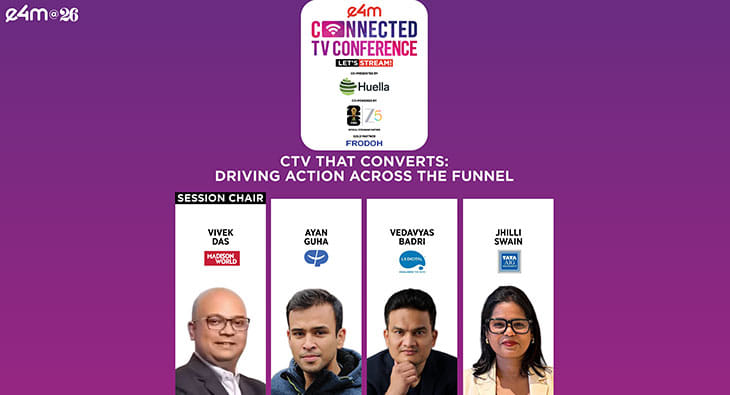

- At the e4m CTV Conference 2026, marketers discussed the accountability of the Connected TV (CTV) ecosystem in driving business growth, highlighting strong ad spend growth and high completion rates.
- Panelists Ayan Guha from Colgate Palmolive and Jhilli Swain from TATA AIG expressed mixed feelings about CTV's effectiveness, with Guha noting high costs and a lack of proof for conversions, while Swain emphasized CTV's efficiency in reaching premium households.
- The discussion revealed a need for improved measurement frameworks and common currency for CTV in India, as current metrics focus on cost per reach rather than effectiveness in driving sales.
- Despite challenges in execution and measurement, CTV's importance in media plans is rising, with industry experts advocating for collective responsibility in addressing the ecosystem's gaps.
CTV has already won the attention game, with big screens, high completion rates, rising spends, and the case for it as a branding medium is well established. At the e4m CTV Conference 2026, marketers came together to question whether the CTV ecosystem is finally ready to be held accountable for driving real business growth.
Moderated by Vivek Das, Chief Digital Officer, Madison India, the session titled "CTV That Converts: Driving Action Across the Funnel" featured insights from Ayan Guha, Marketing Director – Premium Oral Care, Colgate Palmolive, and Jhilli Swain, Associate Vice President Marketing, TATA AIG.
The fundamentals on attention, Das began, already look strong as ad spends on CTV are doubling year-on-year, penetration is expected to grow by at least 20 per cent, and completion rates remain high. He also flagged a common misconception worth interrogating, that CTV caters primarily to a top-tier, NCCS A1 audience. "The fact is that more than 50 per cent of viewers come from towns with a population of less than ten lakh in India," he said, framing the rest of the discussion around whether the currency and attribution systems exist to hold CTV accountable across the rest of the funnel.
Guha opened by admitting to a duality in how he views connected TV. "I love it and I hate it," he said. The case for loving it was that CTV remains the single largest screen in any household, and there is enough data to show that creative effectiveness increases with screen size.
“But, when I look at cost per reach, it's three to four times more expensive than my other touchpoints, and therefore it needs to be at least three to four times more effective. As of today, I have no way to prove that," he said, adding that with quarterly brand outcomes to deliver, media choices for CTV ultimately become a bet.
Shaped by TATA AIG's positioning as a premium product, Swain offered a different lens. For her, CTV addresses the challenge of reaching premium households efficiently. "If I go for linear TV combined with connected TV, I think most of my audience is reached completely, and I don't have to worry about any other platform," she said. Viewing CTV consumers as cord-cutters, she said they are a largely unique audience, with duplication running at only five to seven per cent.
That said, Swain disagreed on the earlier point about CTV's reach extending well beyond metros. "Even if I'm reaching out to those tier-two cities, they are not always my core audience," she said.
Every new television entering the market now comes with smart TV functionality built in, regardless of whether the consumer actively sought out connected viewing, something she felt the industry still needs to account for when reading its audience data.
Moving to the funnel itself, Das talked about advertising's three core jobs, namely capturing attention, building or refreshing memory structures, and generating response. CTV has delivered on the first from an attention and creative-effectiveness standpoint. The question he put to the panel was whether they had real examples of tracing CTV investment downstream to actual conversions.
Guha had one such example from the previous year, though not an entirely happy one. When Amazon Prime Video hadn’t opened for advertising, his funnel ran through MX Player, leading into Amazon DSP and on to conversion on Amazon. "You could argue that we didn't execute particularly well, but genuinely, the incremental cost of constructing that funnel versus the return on ad spend for the end conversion didn't live up to expectations," he said.
The brand subsequently returned to using CTV purely as an extension of linear TV to drive top-of-funnel reach.
Next in the discussion, Swain talked about how CTV's role sits more naturally in the top and middle of the funnel for her. However, she pointed to TATA AIG's recent IPL activity, spanning CTV, on-ground presence, and mobile, as an example of how the medium can still feed into conversion in a long-cycle category like insurance. "For consumers, it adds up to one journey, from CTV to social, and eventually to conversion," she said.
The industry faces an absence of any measurement framework or common currency for CTV in India, compounded by the fact that CTV is sometimes planned by a digital agency and traditional media by a separate one. Das asked Guha whether, in his category, performance channels such as retail media and CTV are being looked at as part of an integrated approach.
Guha replied by describing how Colgate Palmolive's media budgets are structured around the brand outcomes they are meant to drive, namely awareness, consideration, and trial.
Performance marketing sits with the e-commerce team, while in-store deployment, which he also classifies as performance marketing, sits with the modern trade team. Within this structure, CTV sits in the attention-driving layer, as an extension of linear TV. "For a category that's consumed every day, at 99 per cent penetration, I need to keep driving top-of-mind and spontaneous awareness," he explained.
He sees the shift from TV to CTV as a continuum rather than a break in behaviour, with viewers simply gaining more control over what they watch while their underlying behaviour stays the same, making CTV an effective replacement for linear spend.
According to Swain, the combination of linear TV and CTV remains the primary focus, with performance marketing led by a separate team altogether. Her team tracks the broader picture, growth in search volume and website traffic, and then works through whether and how CTV might be contributing to those performance metrics.
Returning to the currency question, Das asked whether the industry needs to move beyond cost per reach towards metrics like cost per reach per sale, or cost per reach per capita consumption, and what that would mean for rebuilding the underlying statistical models.
The shift needs to happen, from cost per reach to cost per effective reach, with efficacy defined through volume ROI, margin ROI, and net sales ROI, agreed Guha. The catch is that these models typically surface only once every six months.
His workaround has been to build experimental cells into the reach and AOTS stack. As an example, he described taking three states as a test cluster and disproportionately investing in CTV as a second incremental layer of reach and frequency above linear TV.
“Within these cells, we track sales, volumetrics, and brand health on a monthly basis, allowing decisions to be made on a one-month horizon with results assessed over roughly three months,” he said.
Swain's approach runs in parallel, tracking cost per incremental reach for every medium added to the mix, alongside the correlation between business sales, media spend, and top-of-mind awareness. That correlation is where she looks for the breakthrough or impact she is trying to identify.
Shifting to a more technical challenge, Das raised the question of IP-address-based household mapping. A household may consume CTV together, but the journey often continues on an individual's mobile device. He asked the panel how marketers should address this gap, and how they hold agencies and CTV ad-tech providers accountable for closing it.
Swain's answer drew on the nature of her category. For insurance, the core audience tends to skew male. "In our case, I think it's a bit easier, because the core decision-maker's login IDs and IP addresses are largely consistent, so I have to reach out to that one person, and most of the purchase and search activity happens through more or less the same identifiers," she said.
Guha had a negative example for this. His team had worked with The Trade Desk specifically to attempt this kind of mapping, only to find a massive drop-off by the time it came to actual purchase, since the login ID and IP address often belonged to different people. Combined with The Trade Desk's additional cost overlay on top of CTV's already higher costs, the exercise was eventually shelved.
On-ground realities during high-stakes events like the IPL reveal further cracks like language mismatches, inconsistent frequency control, or platform-level UX issues. In one instance, an ad meant to run at controlled frequency appeared three times within fifteen minutes. “There's a massive area of tech improvement that needs to happen to deserve the price these platforms are charging,” Guha said. Swain shared the frustration, pointing out that even basic metrics like delivered frequency remain unclear.
Creative sequencing adds another layer of complexity. While full-funnel storytelling across platforms is theoretically possible, execution is not. “It can't be customised to that level of individual context,” Swain said, highlighting the difference between ambition and current capability.
And yet, despite all these challenges, CTV has become important in the media plan with penetration rising sharply. “The choice is no longer whether you want to be on CTV, it's how much to spend behind it,” Guha highlighted.
The final question was who will solve the ecosystem’s biggest gaps. Swain’s answer was collective responsibility. Guha was less optimistic about shared ownership. “Whoever has the most to gain will solve it,” he said, suggesting that the players who crack measurement and full-funnel integration will ultimately define CTV’s next phase.
Read more news about Digital Media, Internet Advertising, Marketing News, Television Media, Radio Media
For more updates, be socially connected with us onInstagram, LinkedIn, Twitter, Facebook, YouTube & Google News