Why CTV’s real power lies in building memory structures
At e4m CTV Conference 2026, marketers argued that CTV's true value lies not in reach numbers, but in its ability to command attention, build trust, and translate into measurable business outcomes
 by
by
Published: Jun 13, 2026 8:34 AM | 10 min read
 Follow Us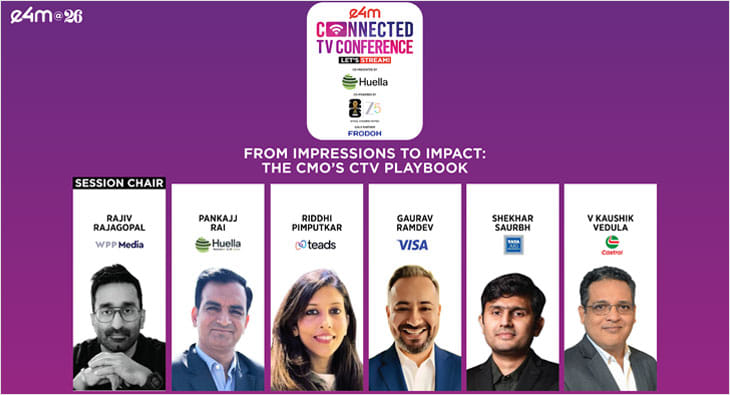

- At the e4m CTV Conference 2026, marketers emphasized that the true value of Connected TV (CTV) lies in its ability to command attention and drive measurable business outcomes, rather than just reach numbers.
- Despite CTV's rapid growth in India, with nearly 60 million households, ad spending has not kept pace, largely due to skepticism about measurement capabilities and the need for differentiation in media choices.
- Panelists discussed the importance of viewing CTV as a premium attention environment that enhances overall media effectiveness through storytelling, rather than merely as another video placement.
- The conversation highlighted the need for marketers to focus on metrics that matter, such as unique household reach, quality engagement, and measurable impact, to justify CTV investments and bridge the gap between brand awareness and performance outcomes.
Connected TV (CTV) may have scaled rapidly, but the industry is still grappling with the question of what is it truly being valued for. Marketers at the e4m CTV Conference 2026 argued that Connected TV's true value lies not in reach numbers, but in its ability to command attention, build trust, and translate into measurable business outcomes.
Chaired by Rajiv Rajagopal, Business Head – Advanced TV, WPP Media, the session titled "From Impressions to Impact: The CMO's CTV Playbook" brought together Pankajj Rai, SVP – Revenue, Huella; Riddhi Pimputkar, Director, Enterprise Solutions – India, Teads; Gaurav Ramdev, Head of Marketing (CMO), Visa; Shekhar Saurabh, Head of Marketing, Tata AIG; and Kaushik Vedula, VP Marketing, Castrol India.
Rajagopal set the context by highlighting the medium’s rapid expansion, noting the rise to nearly 60 million CTV households in India, with more than half of that growth coming from outside metros. Yet, ad spends haven’t kept pace. Why?
For Riddhi Pimputkar, the hesitation stems from a lack of confidence in measurement. “There's scepticism about measurement capabilities not being as evolved. A lot of marketers today don't have the confidence that CTV has the capabilities to measure the impact it's believed to be creating,” she said.
Gaurav Ramdev, however, widened the lens beyond measurement alone. “It's about measurement in terms of impact, because the investments behind a media choice are tied to ROI on that spend. But increasingly, it's also about differentiation. Given the sheer number of media choices available, what differentiation can CTV bring, whether that's incremental reach, distribution, or access to premium households? That still needs to be unravelled,” he said.
That tension between evaluating CTV as just another reach channel and recognising its deeper potential emerged as a recurring theme.
Drawing on nearly a decade of experience selling traditional media, Rai said marketers were still evaluating CTV through an old lens. “The marketer is still evaluating it as another reach platform; is it giving me another 60 million households, or better targeting? Those are the only two ways CTV is being judged. But the medium has far more depth than that, and it needs to be uncovered.”
Vedula added that adoption itself varies by category and audience mix. “Measurement is, of course, the number one challenge, and fixing it would accelerate the medium's growth considerably. But it's also about the demographics of adoption. If you're a mass brand, a chunk of your business still comes from non-adopters, so your investments need to reflect that audience mix too.”
Looking at his own portfolio, which spans multiple price tiers and audience segments, he said there had been clear movement in CTV's representation.
A different pattern was emerging in where incremental ad spend was actually going, according to Saurabh. "If you compare last year's ad spend to this year's, a good chunk of the incremental spend is coming from new-age brands. Smaller players who are very performance-driven and looking purely for conversions," he said.
For more established brands, however, CTV remains a brand-building tool, and he noted that most traditional advertisers from his previous organisation continued to increase their CTV investments significantly, particularly in the SSEA region.
At the same time, he pointed out that some newer, product-led brands such as The Whole Truth were not necessarily drawn to CTV or TV at all, preferring performance and social media campaigns instead, meaning this segment of the ad pie was unlikely to shift towards CTV regardless.
Reframing CTV as a Premium Attention Environment
Shifting the conversation, Rajagopal asked what one thing the industry and marketers needed to understand better about CTV when including it in their media mix.
The fundamental shift needed, Pimputkar replied, was in how marketers perceive the medium itself. “What matters today is the way marketers look at CTV. It's not just another video placement, it's a premium attention environment. When a user switches on their smart TV, they're in a high-attention mindset, actively choosing and discovering content, and spending extended time on a larger screen. This is the moment marketers can engage consumers and capitalise on CTV's storytelling strength,” she said.
Rather than asking how CTV fits into the media mix, she suggested marketers ask how CTV can amplify the effectiveness of the entire mix, using its storytelling layer to build awareness on the big screen while reinforcing that messaging on mobile and digital to drive measurable outcomes.
Ramdev echoed this shift while outlining Visa’s approach. “We're not looking at incremental awareness in the traditional sense, as top-funnel metrics are well established. What we're looking for is middle-funnel metrics, because while our journey of building trust with consumers is a continuum, we want to do it at scale and with precision,” he said.
For him, CTV delivers on three fronts: access to premium households, a superior viewing experience, and the ability to build trust through more engaging formats. “We'll continue to build trust over time, expect CTV to deliver more middle-funnel metrics for tangible long-term results, and use it for access to premium households with a more memorable experience,” he added.
A Category-wise View Beyond Reach
The panel also pushed back against evaluating CTV in isolation. Turning to the automotive aftermarket category, traditionally reliant on mass media and television, Rajagopal asked whether CTV had shown early signs of influencing consideration and purchase behaviour.
Vedula emphasised that outcomes begin upstream. “It starts with the product being built for the consumer's needs. If we carry that understanding forward, the consideration metrics we want to move will see an uptick. But if we use generic communication, those metrics simply won't move,” he said.
Looking at media in isolation was an approach that should have ended much earlier, and CTV's real promise lies in attention rather than just targeting. Vedula also drew a clear distinction between platforms. “Digital gives us targeting, CTV gives us attention. The question is whether we're doing enough to earn that attention, not just from a media standpoint but a creative one too.”
Given that not all video, content, or platforms are equal, what were brands missing when they evaluated CTV through the same lens as digital video?
Rai built on what others said by focusing on what happens after the ad is delivered. “Gaurav spoke about precision targeting, and yes, CTV offers far higher precision than linear or terrestrial television. But we need to look beyond precision too; CTV has a depth that goes beyond targeting alone,” he said, pointing to what happens once an ad lands, whether it drives engagement, website visits, brochure downloads, test drive bookings, or card enquiries.
That depth lies in real-world outcomes, from engagement and website visits to test drive bookings and enquiries, enabled by contextual and dynamic creative delivery.
Defining the Metrics That Matter
Rajagopal brought the conversation back to accountability. “We don't discuss impressions and CPCs in any boardroom, we discuss business outcomes. Can any medium, not just CTV, drive real business outcomes? That's where this medium has to grow,” he said.
Asked to narrow this down to two or three metrics advertisers should track on CTV, Rai offered three. The first, he said, is unique household reach, reaching audiences without over-exposing the same household to the same ad repeatedly.
"The second is quality engagement, going beyond impressions delivered to ensure the viewer is intentfully involved with the creative rather than distracted. And the third is measurable impact, whether that's website uptake, QR code scans, or downloads. These three elements are always critical for me," he said.
The discussion then turned to the financial services sector, with Rajagopal noting the pressure such brands face to justify marketing investment given the trust and transparency their category demands, and asking which metrics mattered most there.
To this, Saurabh replied that brand recall in insurance often masks a lack of category awareness. "People know Tata AIG as a brand, but if you ask them whether Tata AIG offers health insurance, most don't know. Many of us don't even know which brand insures our own vehicles. We simply take a quotation from an agent and move on," he said.
For this reason, reach within the right households, planned at a defined frequency similar to television, remains the foremost metric for him. Nearly 50 per cent of Tata AIG's investments go into CTV, largely because the medium penetrates well among cord-cutters and light TV viewers.
Citing industry estimates, he said that of India's roughly 320 million households, around 240 million have television, of which close to 20 per cent, or 50-60 million, are cord-cutters or light TV viewers, broadly aligning with CTV reach estimates of 40-80 million depending on the source. "From reach to view-through rates to engagement, it's a great medium to track these fundamental metrics," he said.
Moving Towards Incrementality
Looking ahead, Pimputkar placed her bet on a more outcome-driven future. "I would place my bet on incrementality and outcome. That doesn't mean attention and engagement aren't important. They are key indicators of media quality compared to traditional metrics like impressions and completion rates. But CMOs aren't investing in attention for its own sake, they're investing in outcomes," she said.
As measurement evolves, she expects marketers to move from exposure to attention to real business impact, with CTV uniquely positioned to bridge that journey.
A long-standing tension within brand teams came up next, with Rajagopal asking whether CTV had helped bridge the divide between top-funnel brand awareness and bottom-funnel daily engagement.
For Ramdev, the divide was largely artificial to begin with. "This is a question that will persist until attribution is fixed. But traditionally, brand metrics like preference or top-of-mind recall existed for one outcome and that is business performance, because all of it eventually trickles down into consumer behaviour. The distinction between brand and performance is something we marketers have created ourselves; both exist to sell more," he said.
CTV, he explained, adds value by improving memorability, since consumers may not act on an ad immediately but could recall and search for it later. Instead of siloed metrics, he argued for “actionability”, the ability to either build or harness intent over time.
Rajagopal then asked Vedula to weigh in, noting that Castrol appeared to run both premium audience targeting and mass targeting for commercial vehicles on CTV, and asked how the two were differentiated.
Outcomes matter, Vedula said, but called them a lagging indicator that needs leading indicators to back them up. "What was sold with CTV to the marketing fraternity was better attention, at a premium price, so if I can't measure that attention effectively, it remains a nagging problem for me," he said.
In the brand-versus-performance debate, he agreed with Ramdev. "Everything is ultimately performance, whether short term or long term. What CMOs should be mindful of is building a retained message," he said.
Storytelling Versus Efficiency
As formats shrink and attention becomes harder to earn, storytelling itself is being tested.
Vedula highlighted the need for sharper, more relevant communication. “If we take pride in representing the consumer's voice, the challenge becomes how crisply we can tell them we're relevant. If we can't do that, that's on us and our teams to solve,” he said.
Closing the discussion, Rajagopal turned to Rai, given his focus on creative innovation, to ask how creative execution complements this requirement.
For Rai, creative is inseparable from strategy rather than a finishing touch. “Our USP lies in creative. My role is to build around that thought, driving engagement and intent that feeds into consideration,” he said. “Media gets you into the living room, but holding attention within it without losing the viewer is where creative excellence comes in.”
Read more news about Marketing News, Advertising News, PR and Corporate Communication News, Digital News, People Movement News
For more updates, be socially connected with us onInstagram, LinkedIn, Twitter, Facebook, YouTube & Google News