Industry entering a new phase where attention alone is no longer enough: Mayura Nayak
At e4m Connected TV Conference 2026, Huella Co-Founder Mayura Nayak outlined how changing viewing habits, second-screen behaviour and interactive formats are pushing CTV towards measurable engagement
 by
by
Published: Jun 15, 2026 1:39 PM | 5 min read
 Follow Us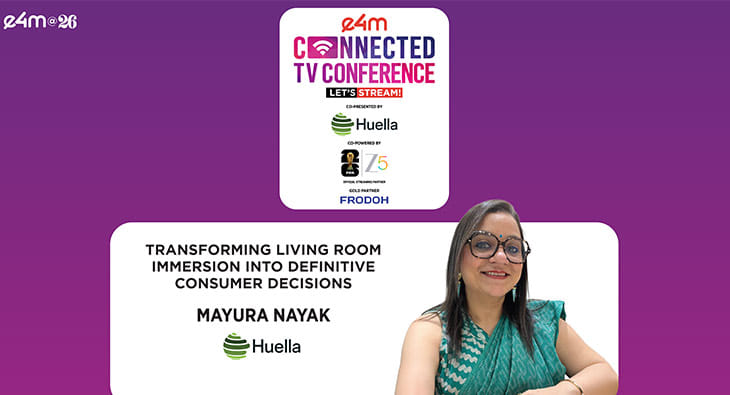

- Mayura Nayak, Co-Founder of Huella, emphasized at the e4m Connected TV Conference that the advertising industry is shifting from merely measuring audience attention to focusing on viewer engagement and intent, particularly in the context of Connected TV (CTV).
- Nayak outlined three eras of television evolution: mass reach, digital advertising with audience targeting, and the current phase of CTV, which prioritizes measurable outcomes and engagement driven by changing consumer behaviors.
- With nearly 86% of internet users multitasking on other devices while watching TV, Nayak highlighted the opportunity for brands to create seamless advertising experiences across screens, leveraging interactive formats and social media integrations.
- The future of CTV advertising will depend on brands' ability to connect creativity, technology, and measurement, shifting the focus from traditional metrics like video completion rates to understanding consumer engagement and the overall impact on purchasing decisions.
Speaking at the fourth edition of the e4m Connected TV Conference, Mayura Nayak, Co-Founder of Huella, argued that the industry was entering a new phase where attention alone is no longer enough.
For years, television advertising was measured by the size of the audience it could reach. Then came the digital era, bringing the promise of precision targeting, audience intelligence and automated buying.
Today, as Connected TV (CTV) becomes a growing focus area for brands and marketers, the conversation is shifting once again. Marketers through CTV must focus on understanding whether viewers engage with content, express intent, and ultimately move closer to a purchase decision.
"The real question here lies in how brands are prepared to start thinking about things beyond attention," Nayak said. "You've got reach, scale and frequency. You know that you can target a user. But are you engaging with the user? Are you driving attention? Are you driving intent?"
According to Nayak, the evolution of television can be viewed through three distinct eras. The first was defined by mass reach, where television served as the dominant medium for communicating with millions of consumers simultaneously.
The second emerged with the rise of digital advertising, introducing audience targeting, data-driven planning and programmatic buying into the media ecosystem. The third era, she suggested, is now taking shape through Connected TV, where the focus is increasingly shifting towards engagement and measurable outcomes.
What makes this transition significant is that it is being driven not only by technology but also by changing consumer behaviour. Viewers today are no longer confined to a single screen. Research cited by Nayak showed that nearly 86 per cent of internet users use another device while watching television content.
While marketers have often viewed this as a challenge, Nayak believes it presents an opportunity. Consumers are simultaneously browsing, comparing products, sharing content and seeking information while watching television. "The user is not distracted. The user is connected to multiple devices," she said. "They're discovering, sharing, resharing and comparing. They've become omnichannel themselves."
This behaviour is prompting brands to rethink how advertising experiences are designed. Rather than treating television and mobile as separate environments, marketers are increasingly looking for ways to create seamless journeys between screens. Interactive formats, social media integrations and mobile-linked experiences are emerging as tools that can help reduce friction and encourage consumer participation.
Beyond technological capabilities, Nayak pointed to another advantage that continues to make television unique in a fragmented media landscape. Unlike most digital experiences, which are highly individualised, Connected TV remains one of the few shared screens in the household.
"Television is the only place where you're watching content in a community, either with your family or friends," she said. "It is a space where conversations can happen. It is a space where considerations can happen. Decisions can be made."
That shared viewing environment has important implications for advertisers. Research highlighted during the session showed that 75 per cent of internet users watch television content with at least one other person. For brands, this creates opportunities to influence not just individual viewers but collective conversations and decision-making within households.
As the medium evolves, however, Nayak argued that measurement frameworks must evolve alongside it. The industry has traditionally relied on metrics such as video completion rates to evaluate campaign effectiveness. Yet these metrics often fail to reveal whether audiences were genuinely engaged.
Citing industry research, she noted that a 95 per cent video completion rate may account for less than 40 per cent of actual human attention. "Is there a way that you can actually track engagement? Yes," she said, adding that consumer participation and interaction offer stronger indicators of intent than passive viewing alone.
The challenge of attribution remains a persistent concern for marketers, particularly as consumers move across platforms before completing a purchase. A viewer may watch an advertisement on television, search for the product days later and eventually buy through another channel. This fragmented journey makes it difficult to assign credit to any single touchpoint.
Nayak suggested that the industry should focus less on claiming attribution for individual channels and more on understanding incrementality, intent and outcomes. Emerging tools such as brand studies and measurement frameworks that track awareness, consideration and sales impact are helping marketers build a clearer picture of television's role within the broader consumer journey.
For Nayak, the future of Connected TV will belong to brands that can successfully connect creativity, technology and measurement. As interactive capabilities become more sophisticated, television advertising has the potential to evolve from a passive awareness medium into a platform that captures intent and drives measurable action.
"The future won't belong to those who buy the loudest 30 seconds," she said. "It will belong to those who build the most frictionless bridge between attention and action."
Her remarks reflected a broader shift taking place across the advertising ecosystem. As Connected TV continues to mature, the industry's focus appears to be moving away from simply counting impressions and completed views towards understanding what viewers do next. In that transition, engagement, intent and business outcomes are increasingly emerging as the metrics that matter most.
Read more news about Marketing News, Advertising News, PR and Corporate Communication News, Digital News, People Movement News
For more updates, be socially connected with us onInstagram, LinkedIn, Twitter, Facebook, YouTube & Google News