Go On. Name the Top 5 Media in India
Puneet Avasthi, Director, Kantar, speaks with Shripad Kulkarni on Media Compass — India’s first unified currency across traditional and digital media — and what it reveals about Indian media landscape
 by
by
Published: May 26, 2026 7:57 AM | 6 min read
 Follow Us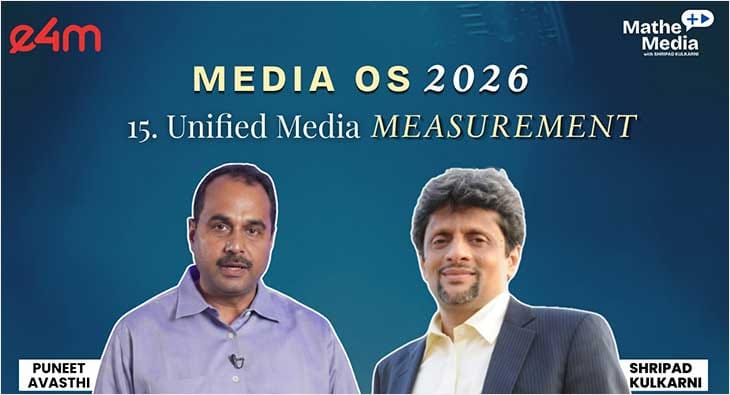

- Puneet Avasthi, architect of Kantar's Media Compass, reveals the top five media channels in India by reach: social media (58%), linear TV (55%), YouTube (51%), gaming (49%), and out-of-home (44%), highlighting a shift in media consumption patterns.
- The data indicates a significant regional disparity, with linear TV reaching 81% of consumers in South India compared to just 39% in Hindi-speaking markets, where platforms like gaming and YouTube are gaining prominence.
- Kantar's Media Compass integrates traditional and digital media metrics through a probabilistic fusion of two studies, aiming to provide a unified view of the Indian media landscape for better advertising decisions.
- The article emphasizes the need for media planners to adapt strategies based on regional differences and emerging platforms, such as connected TV, while recognizing the evolving nature of out-of-home advertising.
The Ecosystem as It Is
Try it. Name the top 5 media in India right now, by reach. Not the ones you plan for. The ones that are actually there, in the consumer's life, measured on a single base across urban and rural India.
Most planners get two or three right. Almost nobody gets all five. And the ones they miss — Gaming, Out of Home — are the ones quietly consuming the media time that many plans don’t account for.
Puneet Avasthi has spent years building the instrument that can answer this question with precision. As the architect of Kantar's Media Compass — India's first unified currency across traditional and digital media — he has a view of the Indian media landscape that very few people have. What that view is showing is both clarifying and, for anyone who has been planning on instinct, uncomfortable.
"Media Compass indicates that there are five lead media options to reach audiences in the country. India’s most dominant media is social media which is No1 at 58% reach, led by WhatsApp which reaches an estimated 51% of Indians. Linear TV is No2 at 55% and is followed by YouTube at 51% and Gaming at 49%. And then the good old Out of Home follows at 44% reach. It is critical for planners to have an answer for assessing the cross-media audience across these 5."
- Puneet Avasthi
Effectively, Linear TV is as of now strong at 55%. Challenged by not just WhatsApp and YouTube, but also by Gaming at 49% - 51%. Out of Home at 44% is still in Top 5. These are not niche channels. They are mainstream media surfaces that Indian planning must consider.
Gaming, Puneet is careful to point out, is not a future trend. It is a present reality.
"Interestingly, Gaming commands fairly significant chunk of media time among Gamers. Additionally, one in two 15\+ yrs aged Indians are y interacting with and spending time with gaming platforms."
One in two. That is not a segment. That is a population.
But the number that should most unsettle a national media planner is not the all-India figure. It is what happens when you break the numbers by geography.
The New Story of South India vs North India
"The South tells a very different story. Linear TV reaches 81% of consumers there — four in five people. Compare that to 39% in HSM and you understand why a single national plan simply cannot work. The South requires its own treatment, and linear television is non-negotiable in that treatment."
And HSM tells its own story — one that should fundamentally change where budgets flow in India's largest advertising market. Linear TV takes a big beating in the Hindi heartland. This includes UP, Bihar, Jharkhand, Uttarakhand, Haryana, HP, MP, Chhattisgarh and Rajasthan.
"In the HSM markets, something quite significant has happened. Gaming, YouTube and WhatsApp, all around 45-46% reach have overtaken Linear TV, which stands at 39% estimated reach. That is a structural shift in the largest advertising market in India, and to my mind, it needs to change how planners are allocating budgets to reach audiences in these markets."
Looked at in another way, what this means is that YouTube, WhatsApp and Gaming are the New National Media. And that Linear TV is still very very Strong in the South. Later, in this story, we also see that Connected TV has taken off in the South, and NCCS A.
The problem was never data. It was inertia.
The question a planner might reasonably ask is: why has India taken this long to have a unified view of its own media landscape?
Puneet's answer is direct.
"The biggest challenge is inertia in addressing this problem of scale and diversity. This requires getting everybody together in enabling a more transparent and ROI driven media decision making process."
And he locates the inertia precisely:
"The biggest challenge to my mind is the fact that different stakeholders in this entire media landscape as such need to come together, to collectively create something that really adds value to advertiser decisions."
Broadcasters measuring their own audiences. Platforms measuring their own reach. Agencies reconciling incompatible numbers across incompatible methodologies. Everyone had a piece of the compass. Nobody had agreed to build it together.
The Compass India Finally Has
What Kantar has built is a probabilistic fusion of two large, syndicated studies — I-Cube, with its deep digital measurement, and TGI, with its traditional media profiling — stitched together using machine learning to create something India has not had before.
"What we've tried to do is to kind of create an integrated view of the consumer fusing two large scale studies. In this, TGI is the Donor to the I-Cube, which is recipient. We've taken from TGI the media choices of people, particularly in the traditional media sphere. A Probabilistic Fusion helps create a single view of the consumer across both traditional and digital. We launched the service in 2025under the brand name Media Compass."
What the Compass Shows Next
CTV is the medium to watch — but with clear eyes about where it actually exists today.
"Connected television is coming of age, but it is heavily concentrated as such — 39% reach in metros, 30% in NCCS A, and 23% in the South, compared to 13% All India. Apart from these segments, the numbers drop sharply. Therefore, CTV is a very powerful tool for the top of the pyramid, but it would be a mistake to treat it as a mass medium just yet.
Linear and CTV, he believes, are moving toward each other. The distinction is blurring, with live streaming, OTT platforms of TV Networks and new formats like FAST Channels.
"We are going to be seeing a very strong growth over the next few years of connected television viewing. Over the next few years, linear and connected TV audiences are likely to start converging with blurring CTV’s current distinctiveness."
The channel planner navigating this convergence will need something the industry has not yet fully built. That is: how the platforms are interacting with each other.
"Channel planners will demand greater clarity on cross-media interactions to figure out the optimal media mix."
And the surfaces themselves are evolving. OOH, for example, with connectivity, IOT is developing into exciting possibilities like immersive experiences!
"OOH, in this world, is not just a billboard. It allows brands to create, if well handled, larger than life experiences for the brand. So, it's important to understand the nature of messaging that will cut through in outdoor environments. And to my mind, it is remains relevant in the media mix for brands, particularly as Indian’s spend more time out of home."
The Compass Is in Hand
The brands and planners who read it correctly — who plan the South differently from HSM, who account for Gaming, who treat CTV as a precision tool at the top of the pyramid rather than a mass medium — are the ones who will find audiences that others are systematically missing.
Go on. The harder question is whether your investments reflect what you now know.
Puneet Avasthi is a contributor to the Media OS 2026 Report, examining how Indian advertising is being rebuilt from the ground up. This piece has been curated by Shripad Kulkarni based on the conversation for the MatheMedia Podcast Series.
Read more news about Marketing News, Advertising News, PR and Corporate Communication News, Digital News, People Movement News
For more updates, be socially connected with us onInstagram, LinkedIn, Twitter, Facebook, YouTube & Google News
