Micro Drama: Can OTT 2.0 become the next big entertainment ecosystem?
Guest Column: Ganapathy Viswanathan, Communication Consultant & Author, says premium micro dramas could redefine OTT, with the next five years deciding if they become a lasting entertainment category
 by
by
Published: Jul 10, 2026 8:01 AM | 5 min read
 Follow Us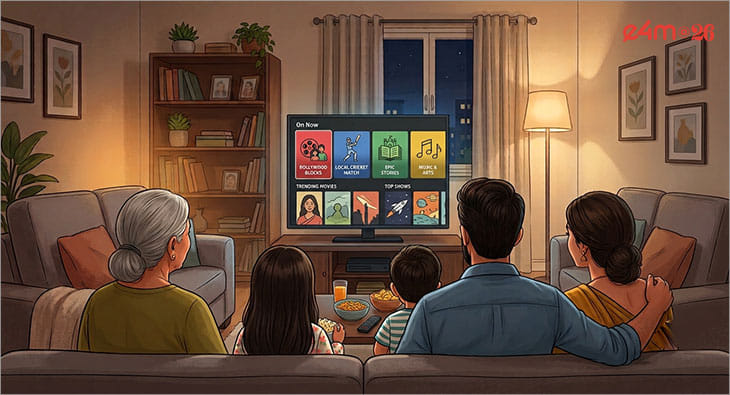

- Premium micro dramas, short professionally produced vertical series, are emerging as a new entertainment format, primarily designed for smartphone consumption, and are gaining popularity in markets like the US, Southeast Asia, and India.
- This format aims to capture audience attention during brief moments of free time, offering emotional engagement rather than requiring long viewing commitments, thus creating a new entertainment economy referred to as OTT 2.0.
- Advertisers see potential in micro dramas for product integration and branded storytelling, as traditional advertising becomes less effective; this format allows brands to become part of the narrative rather than interrupting it.
- The sustainability of micro dramas remains uncertain; while production costs are lower and monetization opportunities exist, long-term success will depend on the quality of storytelling and audience engagement, particularly in mobile-first markets.
Every decade has produced a new entertainment habit.
Television brought families together around a shared screen. Streaming platforms gave audiences the freedom to watch what they wanted, when they wanted. Social media then compressed entertainment into seconds, training billions of people to consume content vertically and on the move.
Today, another shift is quietly taking shape.
Premium micro dramas—or professionally produced vertical series with episodes lasting just a few minutes—are beginning to redefine what entertainment looks like on the smartphone. While the format first exploded in China and is now finding audiences across the US, Southeast Asia and India, the bigger story is not about shorter episodes. It is about a new entertainment economy that could reshape how stories are created, distributed and monetised.
The industry is calling it OTT 2.0.
The obvious question is whether this is a genuine evolution in entertainment or simply the latest digital trend.
The Battle Is No Longer for Screen Time. It Is for Attention
Consumers have never had more entertainment choices. Television, Netflix, Prime Video, YouTube, Instagram, gaming, podcasts and live sports are all competing for the same finite resource—attention.
In that crowded landscape, launching yet another content platform sounds like an impossible proposition.
But history tells us that successful media platforms rarely replace existing ones. They create new viewing habits.
Netflix did not eliminate cinema. YouTube did not replace television. Instagram did not kill Facebook. Each platform succeeded because it owned a different consumer moment.
Micro drama is attempting to do exactly that.
It is designed for the moments that traditional entertainment struggles to occupy—a commute, a coffee break, a lunch hour or the few minutes before going to sleep. Instead of asking for an hour of commitment, it asks for two minutes. The next episode is unlocked not because viewers have spare time, but because they are emotionally invested.
That subtle behavioural shift could prove to be the format's biggest advantage.
From Vertical Video to Premium Storytelling
Vertical video is hardly new. Billions of people already consume content in that format every day.
What is new is the ambition to transform vertical viewing into premium entertainment.
This is not about influencers or viral clips. It is about scripted fiction, cinematic production values and stories designed specifically for the smartphone.
The challenge is that premium vertical storytelling still lacks an established creative playbook. Writers, directors, cinematographers and editors are learning a new grammar where every frame, every dialogue exchange and every episode must deliver immediate emotional impact.
That makes this one of the few moments in entertainment where the rules are still being written.
Why Brands Should Pay Attention
For advertisers, micro dramas could become one of the most interesting storytelling opportunities in years.
Traditional advertising is becoming less effective as audiences skip commercials, block ads or split their attention across multiple screens. Brands increasingly need to become part of entertainment rather than interrupt it.
Micro dramas naturally lend themselves to product integration, branded entertainment and commerce-led storytelling.
Imagine a financial services brand embedded within a family drama, a beauty brand driving the narrative of a romance, or an automobile becoming central to an action thriller. The brand becomes part of the story rather than an interruption to it.
Beyond product placement, the format offers deeper engagement through interactive experiences, direct shopping opportunities and richer audience data than traditional television has ever been able to provide.
For marketers searching for meaningful engagement instead of fleeting impressions, this could become an important new medium.
Can Micro Drama Build a Sustainable Business?
The biggest question surrounding the industry is not audience interest—it is sustainability.
The economics look attractive. Production cycles are shorter, budgets are lower than traditional television and successful stories can be monetised through subscriptions, advertising, micro-payments, licensing and international distribution.
However, rapid growth alone does not guarantee a lasting business.
Every new platform eventually reaches the point where novelty fades. At that stage, only strong intellectual property, premium storytelling and consistent quality keep audiences returning.
The future leaders will not necessarily be those producing the largest number of shows. They will be the companies building recognisable brands, memorable characters and stories that audiences genuinely care about.
In other words, the winners will think less like social media companies and more like entertainment studios.
The Road Ahead
The next five years will determine whether premium micro dramas become a permanent entertainment category or remain a passing trend.
If platforms continue to invest in high-quality creators, embrace regional languages, experiment with AI-assisted production, develop stronger monetisation models and build communities around their content, the opportunity is enormous.
The format is particularly well suited to markets like India, where mobile-first consumption, affordable data and a young digital population create fertile ground for new viewing habits.
Eventually, the biggest platforms may evolve beyond content libraries into complete ecosystems—bringing together creators, writers, producers, advertisers, commerce and technology on a single platform.
That is when micro drama will stop being a format and start becoming an industry.
More Than a Trend
Every generation creates its own storytelling language.
Television spoke to families. Streaming spoke to individuals. Social media spoke to creators.
Premium vertical storytelling speaks to a generation that lives on its smartphone but still craves emotionally engaging stories.
Whether micro drama ultimately becomes the next Netflix-sized success remains to be seen. But one thing is already clear: it is forcing the entertainment industry to rethink how stories are made, how audiences engage and how brands become part of the narrative.
And perhaps that is the real story.
The future of entertainment may not be defined by longer episodes or bigger screens. It may well be shaped by the smallest screen we carry every day—and the stories that fit perfectly within it.
Read more news about Digital Media, Internet Advertising, Marketing News, Television Media, Radio Media
For more updates, be socially connected with us onInstagram, LinkedIn, Twitter, Facebook, YouTube & Google News
