When quick commerce turned AI infrastructure into a marketing statement
Inside and around the recent India AI Summit, dark stores, AI-powered delivery hubs, automated routing systems, and live fulfilment setups were installed and run in real time
 by
by
Published: Feb 26, 2026 8:43 AM | 6 min read
 Follow Us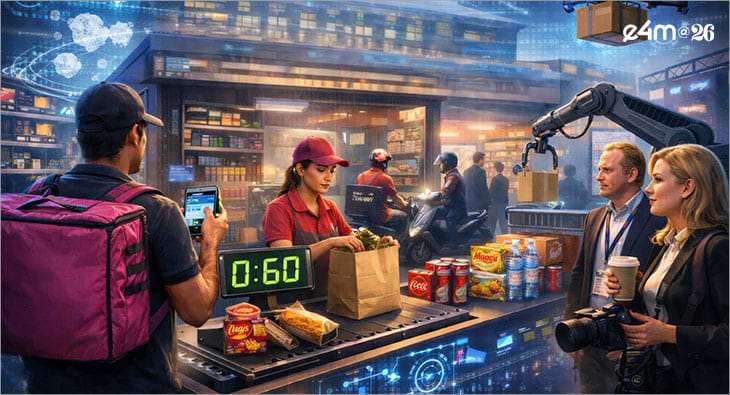

At large global events and tech summits, brand presence usually follows a predictable format—LED-heavy booths, keynote presentations, splashy announcements, and carefully curated demos. Infrastructure, the complex backend that actually powers products and services, rarely becomes the centrepiece. It remains behind warehouse walls and in data centres, invisible to the consumer-facing spectacle.
But at the India AI Impact Summit 2026, quick commerce companies went several steps further.
They didn’t just sponsor the event. They operationalised it.
Inside and around the summit, dark stores, AI-powered delivery hubs, automated routing systems, and live fulfilment setups were installed and run in real time. Orders were placed by attendees. Inventory was allocated dynamically. Delivery partners were routed through machine-learning engines. Lunch-hour surges were managed algorithmically. What is typically backend infrastructure was turned into a live, working showcase.
As the exclusive quick commerce player at the Summit, Zepto installed a compact Delivery Hub on-site, roughly one-third the size of its standard 4,000+ sq. ft. dark store but designed for high-speed fulfilment. The hub was stocked with over 10,000 SKUs curated specifically for summit attendees. Far from being a symbolic showcase, it processed live demand under real conditions, averaging nearly 1,700 orders a day by mid-week, with lunch emerging as the peak rush hour.
A Zepto spokesperson told exchange4media that while there was initial uncertainty on Day One about how the on-ground model would function, the response quickly exceeded expectations, with over 1,000 orders processed on the first day itself. The spokesperson noted that the team had curated inventory thoughtfully for the Summit audience, including essentials even for content creators, “from daily snacks to practical items like replacement footwear in case shoes broke during the long event hours,” they said.
Beyond the consumer-facing convenience, Zepto used the stage to foreground the AI and ML systems powering its operations. The company highlighted that more than half of its order volumes were processed through highly automated distribution centres using cross-docking systems, ASRS, linear sorters, conveyors and pick-to-light mechanisms. Its Warehouse Management System leverages machine learning for SKU placement, picker routing and task allocation, reducing average packing time to nearly 60 seconds. AI-driven demand forecasting, robotic warehouse automation and intelligent last-mile routing were presented not as future ambitions but as active engines enabling minute-level delivery. Even Zepto GPT, its agentic AI layer extended to partner brands, was positioned as part of this larger ecosystem of intelligence.
Similarly, Swiggy transformed the summit experience into what its leadership described as an AI-driven, zero-queue model. Instead of relying on traditional food stalls, Swiggy deployed eight dedicated kiosks across exhibition halls and synchronised a fleet of 100 delivery partners through its AI engine to manage hyper-local deliveries within the venue. Attendees ordered from a curated list of restaurants via the app, while AI predicted preparation and delivery timelines with high precision and notified users when their meals were ready for pickup. The outcome was a frictionless experience that allowed participants to avoid long queues and maximise their time at sessions and networking events.
What made these installations significant was not just their operational efficiency but their symbolic intent. Quick commerce brands chose to demonstrate capability over campaigns.
This is where the larger strategic shift begins to emerge.
For years, the category’s marketing playbook revolved around discounts, celebrity endorsements, witty social media, and the promise of “10-minute delivery.” Speed was the headline, and the backend was incidental. At the Summit, however, speed was no longer the message; intelligence was. The infrastructure itself became the communication.
According to Madhav Kasturia, Founder & CEO, Zippee, by staging a working dark store & AI-enabled fulfilment stack in public, they were signalling capability.
“It’s the difference between saying you’re fast & proving you own the system that makes speed inevitable. This reveals a deeper marketing evolution. E-commerce platforms are moving from storytelling to system-showing. The brand narrative is no longer built around campaigns; it’s built around infrastructure depth, AI orchestration, inventory intelligence & last-mile density,” Kasturia commented.
Kautilya Pandey, SVP and Head of Growth & Marketing at Shiprocket, observed that quick commerce players replaced storytelling with system-building. By constructing live dark stores and fulfilment hubs on the summit floor and processing real orders in real time, they repositioned themselves from being perceived as speed-driven consumer apps to AI-powered logistics infrastructure companies.
Pandey added that the intent was clear: to reposition quick commerce from being seen as a speed-driven consumer play to being recognised as deep, AI-powered logistics infrastructure.
Shradha Agarwal, Co-founder and Global CEO of Grapes Worldwide, pointed out that running operations openly in front of a live audience changes how trust is built. Instead of asking consumers or stakeholders to believe in claims, brands allowed performance to speak for itself. In today’s environment, she suggested, smooth execution and visible efficiency shape perception as powerfully as advertising narratives. At a global innovation platform, operating at scale becomes a branding exercise in itself.
This reveals that the category’s marketing strategy is becoming more grounded and results-led. Instead of relying solely on messaging, brands are allowing their operations to become the message. By showcasing real infrastructure in action, they signal that they can deliver on their promises—building credibility faster than any campaign line could. It also reflects a broader shift in how brands differentiate themselves today: strong systems, seamless execution, and visible efficiency increasingly shape public perception.
Marketing strategist Vejay Anand stated, “By embedding AI-powered logistics infrastructure within the venue, quick commerce companies were effectively signalling to policymakers and global partners that they are not just delivery apps—they are digital infrastructure players. For many foreign delegates encountering India’s quick commerce model for the first time, the functioning dark store served as proof of concept rather than promotion.”
As AI becomes the dominant narrative across sectors, quick commerce appears to be entering a new marketing phase, one that extends beyond acquisition metrics and app installs toward long-term positioning as intelligent, scalable infrastructure.
These developments come at a time when the quick commerce space itself is entering a high-growth, high-visibility phase within India’s advertising economy. According to recent Pitch Madison Advertising Report 2026, quick commerce advertising is projected to jump 50% in 2026, from ₹4,000 crore to ₹6,000 crore, increasing its share of total ADEX from 2.58% to 3.44%.
Under the expanded ADEX view, digital formats already account for about 60% of India’s ad market, with quick commerce emerging as one of the fastest-growing digital engines alongside retail media and MSME digital spends.
In that context, the infrastructure showcase at the India AI Impact Summit was not merely experiential marketing. It reflected a category that is scaling rapidly, attracting larger advertising investments, and seeking a more durable identity beyond speed and discounts.
Read more news about Marketing News, Advertising News, PR and Corporate Communication News, Digital News, People Movement News
For more updates, be socially connected with us onInstagram, LinkedIn, Twitter, Facebook, YouTube & Google News