When did purpose become negotiable?
Guest Column: Yesudas S Pillai, Entrepreneur, Investor, and a Curious observer, questions whether brands are losing sight of purpose in the pursuit of scale, and asks when purpose became negotiable
 by
by
Published: Sep 10, 2026 1:08 PM | 5 min read
 Follow Us

- The author reflects on a promotional experience with Raw Pressery's ABC drink, questioning the authenticity of products that contain minimal amounts of their key ingredients.
- A personal anecdote highlights the tension between maintaining product integrity and the pressures of large companies to prioritize bulk production over authenticity.
- The piece critiques the marketing strategies of some companies, emphasizing the need for genuine consumer understanding and trust rather than focusing solely on short-term sales.
- The author advocates for a balance between purpose and scale in business, suggesting that true innovation and success come from steadfast adherence to core values rather than compromising for immediate gains.
I was looking at buying beetroot this morning when this promotion from Raw Pressery showed up.
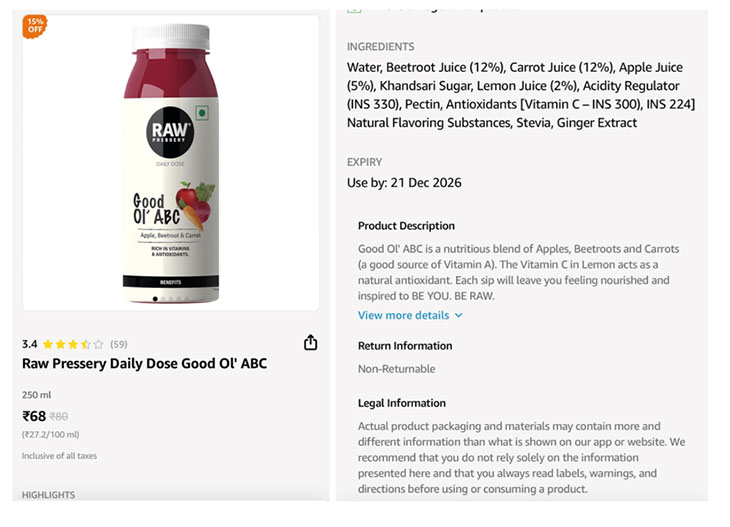
I thought it was a pretty good example of contextual placement. I was looking for beetroot and here comes an ABC drink, Apple, Beetroot and Carrot. I looked at the label.
The ingredients say water, beetroot juice 12%, carrot juice 12%, apple juice 5%, followed by sugar, lemon juice, additives, natural flavouring, stevia, ginger extract and so on.
The three ingredients that give the product its identity as an ABC drink add up less than 25% of the contents (the 12% beetroot also includes water)
The product may be compliant. But my question is whether what is legally compliant always feels right to the consumer.
It reminded me of a recent incident. A large FMCG company approached a friend of mine who ran an authentic organic tomato ketchup business, V J Organic Farms. They liked what he was making and wanted to produce it for them. He agreed, but with one condition. He wanted to use limited quantity using genuinely organically grown tomatoes, from sources he knew and trusted.
What was the fascinating response from the company, since they wanted bulk quantity? Why not mix the regular tomatoes with the organic ones and label it as organic? My friend told me he refused it. But how many others would?
I had once consulted with an organic brand, 24 Mantra, purely because I believed in the people behind it and, more importantly, in the purpose with which they had built it. It has since been acquired by ITC, may be because the founders couldn’t sustain it or financial ambitions overtook purpose. I don’t know. But, I genuinely hope ITC continue with the same guardrails around what made the brand authentic.
Sometimes I ask myself, do I think like this because of the generation I belong to? We were fortunate to have lived through the journey from almost nothing, to a little, to having an abundance of almost everything. Many of us grew up believing that some companies simply wouldn’t cheat us. Tata. Amul, Godrej, and a few others. However, looking at some of the developments within some large companies today, I do wonder if I can still hold on to that belief. I may be wrong. Let time tell.
What I really I struggle to understand is why scale and purpose cannot meet at an intersection?
Why organisations don’t give their non-conformists enough room to have a voice and grow; people who can also make the leadership think differently by asking even the uncomfortable questions?
Why at least some CEOs and CMOs don’t occasionally call their own helplines and experience the frictions their customers go through?
Why some cannot start believing that marketing begins only when the product is sold, with understanding the consumers, being grateful to them and earning their trust so that they give the brand a larger share of their wallet rather than ending marketing with the sale and immediately moving on to the next buyer through bottomless performance marketing?
Why some CMOs don’t spend enough time asking their agencies one simple question, why? before approving another strategy that makes the dashboard glow.
Why I sometimes cringe watching an advertisement in a movie theatre and wonder how it passed the sensibility check of everyone who approved it, especially when people sitting around me are laughing at it?
Why some CEOs, some brands and some start-ups don’t simply say, We will not take shortcuts to shore up our bottom line.
And why some investors don’t have the patience to believe that if you stay on the right purpose long enough, mass markets can eventually follow.
We have all seen the diffusion of innovation happen. We have all seen small ideas become mainstream.
What we lack is not the knowledge of how it happens, but the patience to stay the course long enough for it to happen. I am always reminded of the story Simon Sinek told us about Samuel Pierpont Langley and the Wright brothers. Langley had money, muscle, resources, reputation and institutional backing. The Wright brothers had none of that. But history remembers the brothers who kept experimenting, kept failing, kept learning and eventually flew.
I don’t think the difference is who has more resources. It is who refuses to compromise on what they believe in.
I left the agency business at the peak of my career because I had a vision-alignment issue. I had fantastic offers even after that. And when I saw my bank balance deplete, it was not an easy decision. But I had to ask myself a simple question: Why did I leave in the first place?
So I asked the agencies that made me offers, “Can I be given the space to build the business in the way I believe is right for them and their clients in the long run?” I knew what the answer would be. Make the quarterly results look good, through whatever shortcuts are necessary.
I walked away. But in the last decade, what I have managed to do and, more importantly, what I have managed to learn, I sometimes tell my friends, is something no institution in the world could ever have taught me. Had I continued, I would probably have remained a frog in the agency well, never knowing how big the world outside really was.
Purpose doesn’t lose to scale. We just don’t give purpose enough time to scale. This to me is the real question, When did purpose become negotiable?
Read more news about Marketing News, Advertising News, PR and Corporate Communication News, Digital News, People Movement News
For more updates, be socially connected with us onInstagram, LinkedIn, Twitter, Facebook, YouTube & Google News