Pitch CMO Summit 2026: When brand meets performance, the funnel becomes a loop
At the Pitch CMO Summit 2026, marketers argued that the split between brand and performance lives in budget lines and org charts, not in the consumer's head
 by
by
Published: Sep 7, 2026 1:33 PM | 11 min read
 Follow Us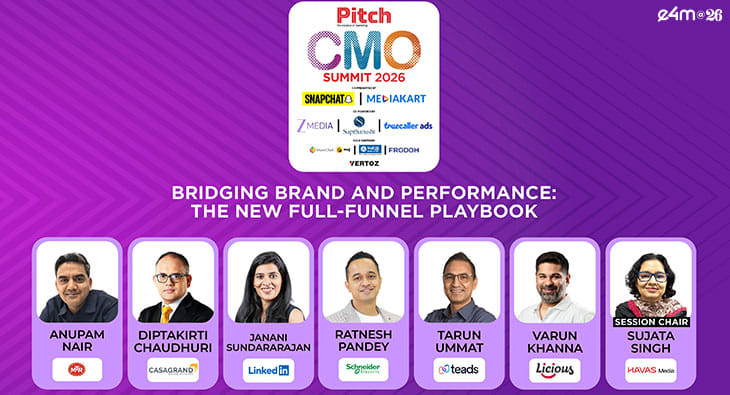

- The Pitch CMO Summit 2026 highlighted the blurring lines between brand building and performance marketing, emphasizing that consumers do not differentiate between the two as they navigate various marketing channels.
- Panelists discussed the need for marketers to create a seamless consumer journey across multiple platforms, recognizing that consumer interactions are no longer linear and may involve multiple touchpoints before a purchase.
- The conversation underscored the importance of balancing short-term performance metrics with long-term brand health, as well as the necessity for integrated planning that maintains a consistent emotional connection across different media formats.
- Marketers acknowledged the challenges of measuring brand investment and the evolving nature of consumer decision-making, advocating for a focus on brand authenticity and the use of attention-based metrics to assess advertising effectiveness.
The old separation between brand building and performance marketing is becoming difficult to sustain. Consumers move between social media, search, marketplaces, physical stores and other environments without necessarily knowing, or caring, which part of a company's marketing organisation is responsible for what they see.
That was the starting point for a discussion on “Bridging Brand and Performance: The New Full-Funnel Playbook” at the Pitch CMO Summit 2026. The session, chaired by Sujata Singh, President - South, Havas Media India, brought together Anupam Nair, Chief Marketing and Growth Officer, MTR Foods; Diptakirti Chaudhuri, Chief Marketing Officer, Casagrand; Janani Sundararajan, Head of Portfolio, LinkedIn Marketing Solutions; Ratnesh Pandey, Vice President – Marketing, Schneider Electric India; Tarun Ummat, MD, Teads India; and Varun Khanna, SVP – Marketing, Licious.
For Nair, the distinction between brand and performance exists within marketing teams, but not in the mind of the consumer. “The consumer is not seeing, ‘Oh, this is performance marketing or this is brand building.’ The consumer is seeing your brand,” he said.
That makes the marketers responsible for making the consumer journey seamless, regardless of where it begins. A consumer might see an advertisement on social media, try the product at a modern trade store and then decide to order it online because it is cheaper or more convenient. The journey can cross several channels before a purchase is completed.
“Funnels are no longer linear and using the term funnel itself needs to be relooked at because it's not a funnel where everything enters right from the top. A consumer is now entering at various stages,” Nair said.
The changing journey also affects how marketers decide where to put their money. While the availability of more consumer data makes performance metrics easier to track, Nair cautioned against allowing the measurable parts of marketing to overshadow brand health.
“There is a temptation to build more at the bottom of the funnel. You have to hold yourself back because eventually you will be answerable for both,” he said. Conversion, clicks, views and repeat purchases need to be considered alongside brand health. If the latter is eroding, short-term performance cannot sustain the business indefinitely.
Khanna picked up the point about vocabulary. "Maybe it's not a funnel anymore, maybe it's a loop, where the consumer comes into the flywheel depending on the consumer's choice. It could be a social content piece, or an ad with a discount mention, or a larger consideration campaign."
For Licious, the loop varies sharply by geography. A consumer in Whitefield, Bengaluru, may already know the brand well enough for a campaign to focus closer to conversion. In Chennai, where consumers have long bought fish from traditional shops, the challenge can be to build awareness and consideration first.
“Micro geographies behave differently,” Khanna said. Digital-first marketing, he added, allows the company to measure the journey more closely and experiment with different approaches.
Singh asked whether brands were just harvesting demand that already existed.
Khanna acknowledged the tension between solving for the current month or quarter and building for the next one or two years. Performance tends to command a larger share of budgets when the immediate target is the priority, but metrics such as lifetime value over customer acquisition cost can reveal the longer-term difference between an organically convinced customer and one acquired primarily through a discount.
“Consumers who arrive organically are stickier,” Khanna answered, “while a discount buys one Saturday evening. If the intent is low, then it's just an acquisition and you will lose the game. If retention is poor, even if you acquire a lot of consumers, that's not a healthy business or brand at all."
The length of the consumer journey becomes even more pronounced in categories such as real estate. Chaudhuri noted that consideration for homes, automobiles and education can stretch for years or even decades.
At a motorcycle company he worked for, the assumption was 25 or 30 years. "A kid decides at five or six years old that he or she wants to ride this particular sports bike, and they usually realise that dream when they're 20, 25."
So, predicting exactly when a consumer will enter the market becomes less important than knowing where a brand is already strong and where it still needs to build.
“A simple rule of thumb for us is that we try to harvest where we are strong and invest where we are not or where we are trying to build,” Chaudhuri said.
Casagrand, for instance, can rely more on its physical presence and community engagement in markets where it has operated for decades, while newer markets require greater investment in awareness and local associations. In Chennai, he pointed to the company's buildings themselves as a powerful form of proof.
“The best advertisement for us is not what we create in the marketing team, but those beautiful, imposing buildings that are all over the place with big logos and built almost for eternity,” he said.
However, for a high-consideration purchase, visibility alone does not establish trust. Chaudhuri argued that marketing has to be supported by the entire organisation, from sales and customer relationships to production, product and engineering. “Everybody is a part of that value chain.”
The same problem appears differently in B2B, where much of the buying process can happen before a marketer ever sees a lead. Pandey highlighted that decision-making often begins in peer discussions and communities, making it necessary for a B2B brand to establish relevance within its category well before a formal buying process starts.
As a result, he believes in owning the category, and to stop treating search position as the finish line. "It's no more about being number one on the search ranking. There are two decision makers that we're talking to these days. One is a human and the other is an AI. And the second decision maker is actually making a lot of decisions for the first. I feel that's the invisible funnel."
Sundararajan hears the same complaint from most marketers she works with. "They do research, they validate the brand, there are communities, content creators, and influencers they lean on, even before they come to your website or even become a lead for you."
"All brands are actually struggling because there's an invisible journey that's happening, but they don't know what the journey is."
This results in the pressure to bring together brand and performance. While marketers may agree on paper that the two need to work together, budgets and teams are still frequently divided between awareness and leads. Sundararajan said that focusing only on cost per click or similar metrics can miss whether the brand is becoming one that consumers actually think about, talk about and trust.
For B2B in particular, she said, the buying group itself has become more complex. “The winning brand is not the best brand anymore. It is a brand which the buying group is comfortable with. They find that there's a trust that they can move, so it is safe, and someone that the entire group is ready to say yes to.”
Agencies and marketers, Singh noted, still brief the two as separate assignments. Ummat’s fix is integrated planning. If the consumer does not distinguish between brand and performance, the media plan cannot afford to either.
“Marketers need to think from the lens of the consumer,” he said. “When a brand plans a campaign, there needs to be integrated planning.”
A creative may need to be tailored for Meta, LinkedIn, television or an outdoor format, but the emotional connection with the brand should remain consistent. “The emotional connect that the consumer is trying to make with the brand should not change irrespective of the media format or the creative format.”
Asked about recall, Nair refused the split again. "What I want to be recalled for is what I stand for." Beyond trust, he said, the one thing that separates brands is authenticity. "Consumers see through you. With the pace at which things are evolving, your only clutch is authenticity."
Singh then put a scenario to the panel. Both teams walk into the CFO's office, and the CFO offers one growth marketing budget instead of two. How do you know brand spend is making performance cheaper?
Nair said it depends on how good the original idea was. "If my investment into the brand is based on the right consumer insight, if it is something that is ownable, eventually my subsequent marketing investments will start showing efficiency."
Holding that line against a newly funded rival is hard, and he did not claim a clean record. "Am I guilty of having overstepped into performance marketing? Yes, I have. I don't think there is anybody here who will say that I know the pristine way to run it and I have done it." Marketers can learn the balance through experience alone.
Khanna offered one way of making that connection more visible. When a strong consumer insight informs the brand message, the same insight can then be carried into performance advertising and social content. He cited Licious's work around regional food preferences as an example of why a broad campaign cannot simply be replicated unchanged across markets.
"When you're talking to a Tamilian about Vanjaram fish that's coming from Kasimedu, your insight has to be deeply powerful. It can't be like a chicken campaign in pan-India."
The seam disappears as that lands. "When somebody's seen 20, 30 perf ads, they're seeing the same message, the same insight, the same cultural nuance. They don't know which team in marketing or in the company is showing them the ad. They just see it as one unified message."
The same can happen with influencer content when it is subsequently used in performance campaigns. What began as social content can become part of the broader marketing loop, allowing teams to see what works and invest further.
For Chaudhuri, the challenge of measurement is acute when the purchase may take months or years. “Leads and sales can be tracked immediately, but brand investment requires a different set of signals.” Casagrand looks at organic interest, including people walking into project sites, organic leads and search behaviour around projects and the corporate brand.
The objective is to build enough confidence in the process to justify investments whose returns may not be immediately visible. "Many times it is not so much the number that a CFO is seeing, but the trust that he's putting in the process. As an organisation, are you meeting enough customers, gleaning enough information, and distilling it into the right insight?"
He compared the nerve it takes to a new driver on a slope. "You're never sure when you will release the brake and when you will press the accelerator."
In B2B, Pandey's preferred measures move away from the immediate lead. He identified consideration and preference as critical markers of whether a brand is progressing towards a future purchase.
“We've got to disseminate knowledge, tell people how we're relevant for them,” he said. “This consideration and preference are very important for our analysis.”
The discussion ultimately came back to what advertising itself is being measured for. Ummat argued that reach and viewability do not necessarily tell marketers whether an advertisement has actually been noticed. An ad can be technically visible without receiving any attention.
One study compared a video ad on YouTube with the same ad on a connected TV home screen for LG. "Most of the attention on that YouTube video was on the skip button, because let's face it, everybody just wants to watch that piece of content."
“So look at attention as a metric,” he said, pointing to work using predictive AI and machine learning to analyse creative and identify ways to improve attention. He also highlighted the importance of the environment in which an advertisement appears, especially as the volume of AI-generated content grows.
He believes that rusted editorial environments can help address that concern, while the industry moves from conventional CPM-based measurement towards attention-based measures such as APM, or attention per mille. The metric may cost more but it is intended to measure attentive impressions rather than impressions alone.
The full-funnel debate, then, is less about choosing one side than about ensuring that the different parts of marketing are working towards the same consumer experience.
Read more news about Marketing News, Advertising News, PR and Corporate Communication News, Digital News, People Movement News
For more updates, be socially connected with us onInstagram, LinkedIn, Twitter, Facebook, YouTube & Google News