AI & The Future of Creativity: The four-person agency
Akshay Gurnani, Founder, The Cofoundry and Co-founder, Schbang, tells Shripad Kulkarni how AI is collapsing the cost of creativity, & why the most powerful unit in mktg today is a nimble team of four
 by
by
Published: Apr 25, 2026 8:02 AM | 6 min read
 Follow Us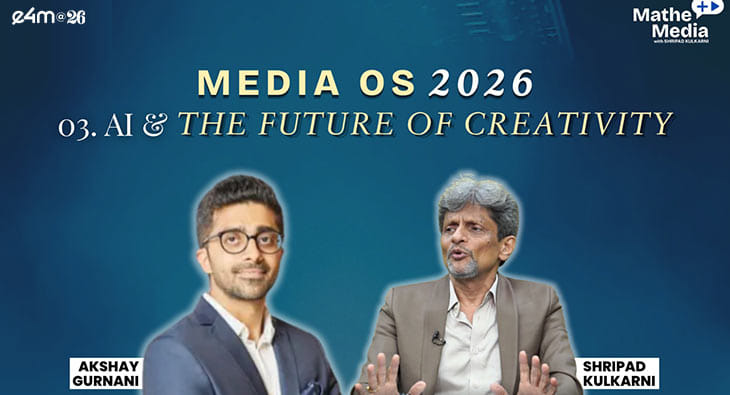

- Akshay Gurnani, hiring for a senior copywriter position, was struck by a candidate's resume highlighting proficiency in AI tools like ChatGPT and Perplexity, sparking a discussion on the implications of AI in the creative industry.
- Gurnani emphasizes the democratization of creativity due to AI, enabling cost-effective production and faster insights, fundamentally altering traditional roles in advertising and media planning.
- The traditional marketing funnel is becoming obsolete as consumer behavior shifts towards immediate access to products, with AI-driven personalization transforming how brands engage with consumers.
- Gurnani observes a trend of startups outpacing established companies, as younger entrepreneurs leverage AI tools to quickly launch products, leading brands to seek smaller, agile teams for in-house marketing efforts.
The Resume That Stopped Him Cold
Akshay Gurnani was hiring for a copywriter. Senior position. The candidate's resume arrived, and the first line — before experience, before portfolio, before any demonstration of craft — read: "Proficient in ChatGPT and Perplexity."
He put it on LinkedIn. Seventy-five, eighty people wrote in with their perspectives.
"A Copywriter, proficient in ChatGPT and Perplexity. Is that a good thing or a bad thing? I don't know. I don't know."
He means the question genuinely — not as rhetorical throat-clearing, but as the most honest summary of the moment the industry finds itself in. The responses on his LinkedIn feed were conflicted. Even after being in the industry for 15 years, he did not have a clean answer either. What he had instead was a framework for thinking about what comes next — built from the ground up from what he is seeing happen to brands, agencies, and 22-year-old entrepreneurs quietly eating everyone's lunch.
Creativity Without Borders
The starting point is creativity itself, and what AI has done to it. Democratisation is Akshay's word — and he uses it to describe something precise: the act of creating something good is now accessible to almost anyone, inside and outside an agency.
He is producing a film for a client. Four minutes long. Eighteen cut-downs. Six languages. The bumpers, the 20-seconders, the 10-seconders — all of it.
"If I had to actually produce this film with real people, real locations, easily a 4 crore film. But today I'm making that in maybe 35 lakh."
The delta is not a rounding error. It is a structural shift in what is economically possible for a brand — and what is no longer a differentiator for a large agency with a large production apparatus. The same shift has hit research. The old focus group — expensive, slow, geographically constrained — has been replaced.
"The AI tools have become like a focus group with millions of respondents. We're able to get insights a lot, lot quicker."
Ideation starting points that used to take weeks now arrive in hours. The creative director's job is no longer just generating ideas. It is curating what comes back.
The Funnel Is Dead. The Moment Is Everything.
The deeper disruption is not in how creative gets made. It is in how consumers behave — and what that has done to the architecture that media planning was built on.
"The funnels in the traditional sense are broken. Funnels are redundant altogether now because people are just transcending the funnel the way they want it — because they're getting things at exactly the moment they want it."
Akshay uses Meta as his personal shopper. He says a keyword onto his phone and starts seeing ads for those products — five options, including brands he did not know existed. Discovery, consideration, and purchase have collapsed into a single moment. QuickComm has taken this further.
"QuickComm is a complete data game. It's literally just a data mine of literally everyone's purchase behaviour — it exactly knows my frequency, exactly knows my behaviour, it knows exactly when I'm going to make that next purchase."
The push notification that appears on a consumer's phone in Shivaji Park at 7pm — mapping the monsoon to chai, to pakoda, to the exact product they last purchased — is no longer written by a human. The copy, the image, the send time: all generated and deployed by AI. CTRs have moved from 3–4% to multiples of that.
Every Website Can Be Netflix
The logical end point of personalisation at this scale is a question Akshay poses simply: can every website become a Netflix? Genre, history, behaviour, moment — all feeding a system that meets each consumer exactly where they are. Hyper-personalisation is not a future state. It is happening now, in the brands that have chosen to build for it. MarTech stacks sending personalised WhatsApp messages, personalised emails, chatbots activated at the exact post-sale moment — all triggered by what a consumer has been doing on a web interface in the last 48 hours.
Startups Are Eating the Incumbents
Which brings Akshay to what he finds genuinely alarming — not for agencies, but for the large incumbents who have not yet understood who their real competition is. For the first time, the MNCs he speaks to are watching not the other top three. They are watching 22-year-olds with Shopify stores.
The younger startups — built around a specific skin type, a specific ingredient, a specific weather pattern — go from idea to product to influencer to performance marketing in three weeks. The incumbent takes six, eight, ten months to launch the same product. Akshay knows exactly where these founders come from. They are the people who are leaving the agencies, not for another agency, not for a brand — but for themselves. Their mother's home-baked cakes, now on WooCommerce with local pin-code marketing. A hyper-local skincare line built on consumer wokeness about what goes on and in the body. The tools are identical to what a large agency uses. The overhead is a fraction.
The Four-Person Team
This is what has driven the most significant shift Akshay is seeing in his own business — the in-housing conversation.
"The number one ask I get from brand managers is: help us in-house the team. We don't need a 25-member team, we don't need a 15-member team. We just need four good people — who could write prompts well, do basics of Canva, write the right copy, generate the right consumer insight."
Morning idea, published by afternoon. The BAU content cycle has collapsed from seven or eight days to two and a half hours. And the direction of travel is clear.
"I see smaller teams, very very nimble small teams — small satellite teams sitting in different parts of the country, not needing physical spaces."
The economics of marketing are being restructured from the ground up. A four-person team, distributed, AI-equipped, can produce what required fifteen people and a physical office two years ago. The only thing standing in the way, Akshay believes, is inertia — the assumption that you need a large team, a large agency, a large budget. Getting your hands dirty with the tools is the only way through it. The copywriter who listed ChatGPT and Perplexity on her resume may have understood this before most of the industry did.
Read more news about Marketing News, Advertising News, PR and Corporate Communication News, Digital News, People Movement News
For more updates, be socially connected with us onInstagram, LinkedIn, Twitter, Facebook, YouTube & Google News