Vivek Gupta concludes INS presidency after tenure marked by key print initiatives
The Sanmarg Group CMD’s 2025–26 term saw a 26% revision in government advertising rates, the launch of the ‘Ink Doesn’t Lie’ campaign and policy interventions on AI, copyright and newsprint
 by
by
Published: Sep 7, 2026 12:08 PM | 5 min read
 Follow Us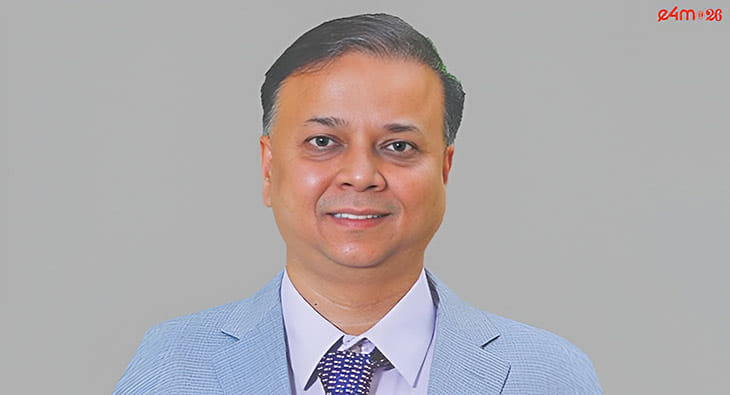

- Vivek Gupta has completed his term as President of the Indian Newspaper Society (INS), focusing on policy advocacy and enhancing the credibility of print media during his tenure.
- A significant achievement was the government's 26% increase in advertisement rates for print media, following nearly four years of advocacy by INS, aimed at addressing economic pressures on publishers.
- Gupta launched the "Ink Doesn’t Lie" campaign to reinforce print's credibility amid rising misinformation and AI-generated content, emphasizing the accountability of the printed word.
- His presidency also addressed issues such as newsprint costs, the impact of generative AI on copyright, and the revenue share captured by global technology platforms, while maintaining that print media remains relevant and resilient.
Vivek Gupta, Chairman and Managing Director of Sanmarg Group, has concluded his term as President of the Indian Newspaper Society (INS), bringing to a close a year marked by policy advocacy, industry engagement and a renewed effort to reinforce print’s credibility among readers and advertisers.
Gupta, who was elected President for 2025–26 at the Society’s 86th Annual General Meeting, succeeded M V Shreyams Kumar of Mathrubhumi. He delivered his concluding presidential address at the 87th AGM of INS.
Among the most significant policy developments during his tenure was the government’s decision to increase advertisement rates for print media by 26%, based on the recommendations of the Ninth Rate Structure Committee.
The revision, announced by the Ministry of Information and Broadcasting in November 2025, followed nearly four years of representations and engagement by INS and other newspaper associations. The government increased the black-and-white advertisement rate for dailies with a circulation of one lakh copies from Rs 47.40 to Rs 59.68 per sq cm. It also approved premium rates for colour advertisements and preferential positioning.
Describing the decision as an acknowledgement of the economic pressures confronting publishers, Gupta said the rate revision needed to be backed by adequate government advertising allocations.
“Higher rates must be accompanied by adequate advertising allocation. The government advertising budget for print should adequately reflect the revised rates and the continuing importance of print’s reach,” he said.
Another prominent initiative during Gupta’s presidency was the launch of INS’s nationwide “Ink Doesn’t Lie” campaign. Rolled out across member publications in July 2026, the campaign sought to reinforce print’s credibility at a time when misinformation, manipulated content and AI-generated material are making it harder for audiences to distinguish fact from fabrication.
Gupta said the campaign was not simply an exercise in promoting print but an attempt to remind readers, advertisers and policymakers of the editorial responsibility behind the printed word.
“In an age of misinformation and synthetic content, the printed word stands for accountability. Ink doesn’t lie because behind the printed word stands responsibility and accountability,” he said.
The campaign formed part of a broader, year-round INS initiative to highlight print’s effectiveness, reliability, brand safety and value as an advertising platform.
Gupta’s tenure also coincided with an important policy debate over generative AI and copyright. According to the Society’s annual report, INS submitted a detailed representation to the Department for Promotion of Industry and Internal Trade in February 2026 in response to its working paper on generative AI and copyright.
The Society advocated a legal framework that would encourage technological innovation while protecting the intellectual property rights of publishers and original content creators. It also submitted recommendations to the Ministry of Information and Broadcasting in December 2025 on copyright infringement and stronger anti-piracy mechanisms.
While recognising that AI could improve translation, transcription, data analysis and publishing workflows, Gupta maintained that technology could not replace reporting, editorial judgement and accountability.
Newsprint costs remained another major focus, though the matter continues to be unresolved. During the year, INS persisted with its demand for the withdrawal of the 5% customs duty on imported newsprint. It also highlighted concerns over domestic production constraints, quality gaps and the limited availability of specialised newsprint grades.
“For the print media industry, newsprint is not simply another industrial raw material. It is one of the most essential inputs,” Gupta said, renewing the Society’s appeal to the government to withdraw the duty.
On the digital front, Gupta raised concerns over the share of revenue captured by global technology platforms from content originally produced by news organisations. The INS complaint against Google before the Competition Commission of India predates Gupta’s presidency, but the Society continued to monitor the investigation during his term. The INS Annual Report 2025–26 states that the outcome of the investigation is awaited.
“Technology companies can aggregate and distribute information. Social media platforms can amplify information. But journalism is created by publications,” Gupta said, calling upon readers to access news directly through publishers’ websites and digital platforms.
Under his presidency, INS also organised interactive sessions with publications and advertising agencies in Kolkata, Delhi, Mumbai and Pune. The Society’s Executive Committee met seven times during the financial year, while its Advertising Committee held six meetings. INS membership stood at 801 publications as of March 31, 2026.
In his address, Gupta cited ABC data for July–December 2025 showing circulation among member publications at approximately 2.91 crore copies, reflecting like-for-like growth of around 2%. He used the numbers to argue that print continued to demonstrate resilience despite changing consumption patterns.
Concluding his tenure, Gupta urged publishers not to underestimate the strength of what they had built.
“We have faced economic pressures and cut-throat competition. And yet, we are still here. More importantly, we are relevant,” he said.
“The future of Indian print media is not behind us. It is still ahead of us. Let us move towards that future together and stay united.”
Read more news about People Movement, Internet Advertising, Marketing, Digital Media, PR and Corporate Communication
For more updates, be socially connected with us onInstagram, LinkedIn, Twitter, Facebook, YouTube & Google News
Tags
Print media
Vivek Gupta
Vivek news
print media credibility
Ink Doesn t Lie campaign
INS presidency
Sanmarg Group
Vivek Gupta INS presidency
Indian Newspaper Society leadership
print media initiatives
INS ad rate increase
Sanmarg Group chairman
generative AI copyright policy
newsprint customs duty
print media industry challenges