BharatGPT Founder’s Warning: Do not believe everything AI companies promise
In a conversation with Brij Pahwa, Editorial Lead at BW Businessworld and exchange4media Group and Editor of MartechAI.com, Sabharwal said India could define its own measure of AI leadership.
 by
by
Published: Sep 9, 2026 6:26 PM | 8 min read
 Follow Us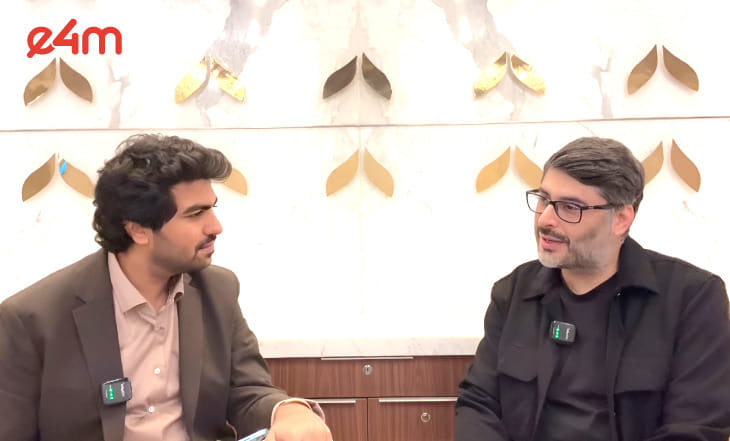

- Ankush Sabharwal, CEO of CoRover.ai and BharatGPT, emphasizes India's AI potential lies in developing practical systems for businesses rather than competing to create a large language model like ChatGPT.
- He highlights India's advantages, including a young, tech-savvy population and a history of rapid digital infrastructure adoption, which position the country for swift AI integration.
- Sabharwal advocates for a focus on specialized AI models tailored to specific industries, suggesting that personal language models could empower individuals to control their own data.
- He expresses skepticism about the current state of AI and the pursuit of artificial general intelligence, urging a shift in societal views on employment and the value of work in an AI-driven future.
This is article was originally published on www.MartechAI.com
India’s artificial intelligence conversation is often reduced to one question: when will the country build its own ChatGPT or DeepSeek?
Ankush Sabharwal, founder and CEO of CoRover.ai and BharatGPT, does not appear interested in competing on that scoreboard.
“I’m not in race anyways,” he said when asked whether BharatGPT could become India’s first indigenous large language model. For Sabharwal, India’s AI opportunity lies elsewhere, in building practical systems for businesses and citizens, developing smaller specialised models and enabling widespread adoption.
“I clearly see we can define our own terms of leaderboard and whatever terms leaderboard we create, we’ll be the leader,” he said.
According to Sabharwal, India has two significant advantages. The first is its young, technologically aware population, which can contribute to the development of platforms, products and solutions for India and global markets. The second is the country’s established record of adopting digital infrastructure at scale.
He pointed to Aadhaar and UPI as examples of systems that have already prepared Indians to adopt new technologies quickly.
“We are already ready to use any AI solution and means we would be the fastest and the largest AI adopters in the world,” he said.
Sabharwal’s argument is that India should not measure its progress only by the size of a model or by whether it has produced a globally recognised frontier LLM. Existing global models, he said, have demonstrated that the technology works. The next challenge is to make it useful in everyday life and business.
“We should not have FOMO,” he said, urging companies and individuals to identify real problems where AI can be deployed. “Help solve the basic functions of individuals and businesses.”
That approach is rooted in the journey of CoRover.ai, which Sabharwal traces back to 2016. With a background in computer science and formal training in AI, he saw the rapid spread of smartphones, affordable data and social media creating a new problem for businesses.
As millions of people began interacting with companies online, customer support systems would have to manage a growing volume of queries. Sabharwal believed AI could help companies understand users and automate customer support.
The company’s business model was built around outcomes rather than simply selling technology.
“We said, no, we are the technology provider, we would help solve that problem. So you pay us only when you make money. You pay us only when you save money. You pay us only when your customers are happy,” he said.
That philosophy also explains why BharatGPT has focused primarily on businesses and institutions instead of launching as a direct-to-consumer chatbot. CoRover’s platform describes BharatGPT as an enterprise AI platform supporting multilingual text, voice and video agents across sectors including banking, insurance, healthcare, travel and government.
When asked why the company had not pursued a B2C model despite the growing interest in sovereign and Indian-built AI, Sabharwal responded bluntly: “Why to do?”
His reasoning is that established companies already understand their sectors, customers and business problems. Partnering with them allows BharatGPT to improve existing services instead of spending heavily on marketing, consumer education and habit creation.
He has not ruled out a direct-to-consumer offering. However, he said such a move would require significant spending and behavioural change. For now, he believes there are enough immediate enterprise problems to solve.
“Maybe we do that later, we have lot of things in our play to solve for consumers indirectly,” he said.
That indirect consumer impact can already be seen in areas such as travel, insurance and government services, where AI systems are integrated into platforms that citizens already use.
Sabharwal’s preference for practical deployment extends to the architecture of AI itself. He is sceptical of the idea that the future will be dominated by one giant model containing all the world’s knowledge.
“I’ve not come across one brain which has all the knowledge in the world,” he said.
Instead, he believes in a distributed ecosystem of smaller, specialised models.
“So, I believe in more tiny models. We’re creating niche SLMs,” he said, adding that the long-term ambition could involve “millions of models.”
He also described a future in which individuals could have their own personal language models. In that system, a person’s data and knowledge would remain under their control instead of becoming the property of a central AI intermediary.
“Your own personal language model,” he said. “So, why LLM becomes the owner of the data?”
Sabharwal argued that AI companies should function more like custodians or database management systems, rather than becoming the owners of information created by users.
“Your data, you’re creating this content, you own it,” he said. “You share it with others. You monetise or not, it’s your choice. But not the intermediary’s choice.”
The question of who owns and benefits from AI-generated value also led to the issue of creator compensation. Sabharwal said creators should first have the choice to allow their work to be used. They should then be able to decide whether to make it available for free or seek payment.
“If you’re ready to give the data, then either free, or you want to be paid,” he said. If creators choose compensation, he argued that they should receive a share of the value generated from the use of their work.
“At least, there should be attribution to it,” he added.
The issue remains legally unsettled. In its July 24, 2026 judgment on ANI’s interim application against OpenAI, the Delhi High Court held at the prima facie stage that OpenAI’s use of ANI content for training could fall within the fair-dealing exception, while the broader copyright dispute remained separate from that interim decision. Delhi High Court judgment
On the impact of AI on jobs, Sabharwal offered a philosophical response rather than a conventional reassurance. He began by asking why people work in the first place.
“Someone is paying us because we are doing, we are adding some value,” he said.
He acknowledged that jobs would be displaced, but argued that society may eventually have to rethink its relationship with employment, money and wealth accumulation. If AI were to perform every task, he said, the question would no longer be limited to whether people had jobs, but why jobs and money were needed at all.
At one point, when he was told that AI could not conduct the kind of interview taking place, he immediately disagreed.
“No, no, it can. Let us consider it can,” he said.
Sabharwal is equally sceptical of claims that current AI systems are close to artificial general intelligence. He said today’s systems remain dependent on written data and do not yet capture the full range of human experience, context and evolving wisdom.
“We are very very far away from the AGI,” he said.
His answer again returned to personal models. Human beings possess knowledge that is not formally written down, including instincts, lived experience, emotional context and unfiltered reactions. A personal AI model, he suggested, could eventually reflect a person more accurately than a general-purpose system trained primarily on published material.
Sabharwal also linked his vision to what he described as Prime Minister Narendra Modi’s emphasis on human-centric, inclusive and accessible AI. He said India should aim to build systems that are not merely polite or efficient, but wise.
“I always believe maybe the world is trying to provide AI which is polite,” he said. “With the right visionary leadership of Honorable Prime Minister, we should build AI which is wise.”
For BharatGPT, the immediate plan remains focused on solving problems for citizens through businesses and institutions. Sabharwal said users may already be interacting with BharatGPT-powered systems while accessing services such as travel and insurance, even if they do not see the BharatGPT name.
His message to people navigating the AI wave was simple.
“Don’t worry about the chaos, hype. There is always hype, there is always a reality. What is your reality, find it,” he said.
Rather than remaining passive users, he urged individuals and companies to identify one problem and find one way to apply AI.
“Let us become the land of AI creators,” he said.
Outside work, Sabharwal said his hobbies now change according to what his son is learning. He has moved from golf to painting, keyboard and guitar, picking up new activities alongside his child.
That willingness to keep learning may be central to his larger argument about India’s AI future. The country may not need to win a race to build the biggest model. It may need to build the widest ecosystem of useful ones.
Read more news about Marketing News, Advertising News, PR and Corporate Communication News, Digital News, People Movement News
For more updates, be socially connected with us onInstagram, LinkedIn, Twitter, Facebook, YouTube & Google News