Gowthaman Ragothaman bets on rebuilding marketing infrastructure with Saptharushi
Gowthaman Ragothaman, Founder and CEO of Saptharushi, on building ‘The Audience Company’, an attempt with neutral infrastructure and more
 by
by
Published: Sep 2, 2026 9:02 AM | 8 min read
 Follow Us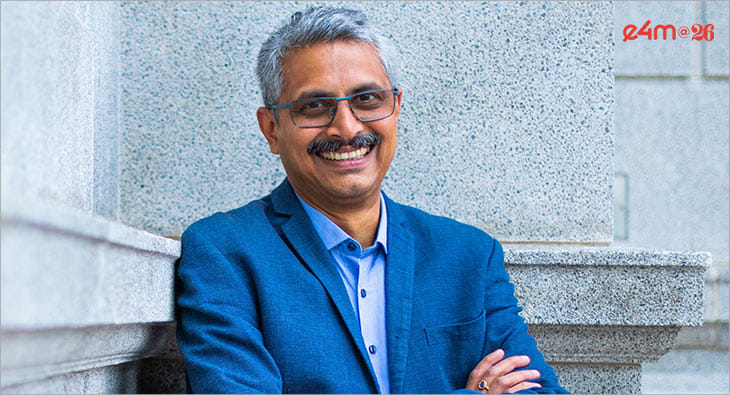

- Gowthaman Ragothaman, founder and CEO of Saptharushi, aims to create a neutral infrastructure for audience intelligence in advertising, emphasizing that brands should retain control over their audience data amidst evolving AI, privacy, and commerce landscapes.
- Saptharushi's approach avoids entering the ad-serving business, acting as a data fiduciary, or centrally managing customer data, focusing instead on independence and decentralization.
- The company combines privacy-enhancing technologies like differential privacy, federated learning, and distributed ledger technology to facilitate audience engagement without compromising data control.
- Ragothaman envisions a future where advertising, marketing, and commerce converge, advocating for a "Return on Audience" framework that empowers consumers and decouples data from inventory, potentially disrupting traditional data arbitrage models.
After three decades across media, Mindshare and WPP, Gowthaman Ragothaman is building Saptharushi around a simple conviction: as AI, privacy and commerce reshape advertising, brands should not have to surrender control of their audiences to participate in the digital economy
Sometimes, knowing what not to build is as important as knowing what to build.
For Gowthaman Ragothaman, founder and CEO of Saptharushi, that clarity came after more than three decades inside the advertising industry and five years spent trying to solve some of programmatic advertising’s most persistent problems.
When Ragothaman and his team moved from Aqilliz to Saptharushi, they made three decisions. They would not enter the ad-serving business, which they believed would become increasingly commoditised. They would not become a data fiduciary, because doing so could compromise their neutrality. And they would not centrally manage customer data, keeping themselves out of the business of data arbitrage.
“Sometimes clarity on what not to do is what makes what to do obvious,” Ragothaman says.
What emerged from those choices was Saptharushi, a company Ragothaman now describes simply as “The Audience Company”, an attempt to build neutral infrastructure through which advertisers, publishers and other enterprises can use, enrich and activate audience intelligence without surrendering control over the underlying data.
The proposition is the latest reinvention in a career that has spanned virtually every major transformation of modern media.
Before becoming an entrepreneur, Ragothaman spent decades across agencies and media businesses, including long tenures at Mindshare and WPP. From that vantage point, he watched digital advertising move steadily towards addressability. Recommendation engines and personalisation made audiences increasingly central to advertising, but the shift also created a more complicated question: who should control the data that makes addressability possible?
Privacy regulation, he argues, has made that question impossible for the industry to ignore.
GDPR became the most prominent global reference point, while other markets began constructing their own regulatory regimes. India has moved forward with the Digital Personal Data Protection framework, while the US continues to operate through a patchwork of state privacy laws rather than a single comprehensive federal regime.
For Ragothaman, the consequence is that advertising infrastructure can no longer assume that a technology architecture developed in one market can simply be exported everywhere else.
“The principles of advertising and marketing are universal. The way audience data is deployed cannot be,” he says.
What the industry faces, in his telling, is therefore not merely a product problem but an infrastructure problem — one that requires systems capable of accommodating sovereignty, consent and local regulation while allowing brands to continue using audience intelligence at scale.
Learning what the market would pay for
That thesis did not arrive fully formed.
Aqilliz, which preceded Saptharushi, emerged during the industry’s scramble to prepare for Google’s proposed deprecation of third-party cookies. It was built around trust, transparency and compliance, with distributed-ledger technology playing a central role.
The difficulty was not persuading advertisers that those things mattered.
“When we went to market with our first set of solutions, nobody said no to us,” Ragothaman recalls. “Why would anyone say no to trust, transparency and compliance? But nobody could put a price on it either.”
Advertisers were unwilling to pay a premium simply for those principles, he says, and Aqilliz struggled to gain traction despite identifying what he describes as a 15% unknown delta in the programmatic supply chain.
For a founder, it was a useful distinction: an industry can agree that a problem exists without yet being prepared to pay someone to solve it.
By the time Aqilliz evolved into Saptharushi, however, the context had changed. Privacy regulation had advanced across markets, India’s DPDP regime had raised awareness locally, and the industry had already passed through successive waves of enthusiasm around blockchain, tokenisation and NFTs. AI was becoming the next transformational technology.
Rather than follow each new cycle, Ragothaman says the team narrowed its focus around independence, neutrality and decentralised control of audience data.
That philosophy now sits underneath Saptharushi’s technology architecture.
Blockchain after the blockchain hype
Ragothaman is also making a deliberately contrarian bet.
Much of advertising has moved on from the blockchain enthusiasm of the late 2010s. He believes the industry may have abandoned the technology just as another technological shift makes its underlying premise more relevant.
His argument is that the original value of blockchain was not speculative tokens but trust: creating a common record that multiple participants can rely on without handing authority to a central intermediary.
The rise of generative AI, he believes, only intensifies that requirement.
“Intelligence itself is now being centralised — a handful of companies, running proprietary models, domiciled in one country,” he says. Enterprises feeding those systems, he argues, are contributing to intelligence that they neither own nor can fully inspect.
Hence one of his more provocative formulations: “AI without blockchain is a runaway train wreck.”
Saptharushi’s answer is to combine three privacy-enhancing technologies.
Differential privacy is intended to reduce individual tracking. Federated learning allows intelligence to be developed where data already resides rather than requiring organisations to pool that data centrally. A distributed ledger, meanwhile, provides a common record of how information has been processed.
Ragothaman argues that the three become significantly more useful together.
Federated learning by itself still requires participants to trust whoever coordinates the system. Adding a distributed ledger, in Saptharushi’s model, allows participants to verify processing and consent against a record that is common to the network rather than controlled by one participant.
It also allows Ragothaman to reclaim another much-abused word from the blockchain boom: tokens.
Within Saptharushi’s model, he describes them not as speculative assets but as mechanisms for attributing contribution and settling value across a network without a central owner.
“Blockchain is not the brake on the train,” he says. “It is the track.”
An audience marketplace without surrendering the audience
The larger commercial opportunity, though, is less about blockchain than about fragmentation.
Brands once dealt principally with a handful of large digital platforms. Today the number of potential data, commerce, media and technology partners has multiplied.
“To how many companies is a brand going to hand over its data?” Ragothaman asks.
Saptharushi’s answer is a Sovereign Audience Marketplace, designed to let enterprises connect with ecosystem partners and curate audiences while the underlying customer data remains under their control.
The company says its enterprise adoption so far has largely come from advertisers for whom first-party customer information is particularly valuable. The same architecture can also be used by publishers, allowing an enterprise to operate in different contexts as both advertiser and media owner.
Ragothaman sees three forces accelerating that opportunity.
Advertising signals are becoming less reliable, while privacy and consent requirements make static audience segments harder to sustain. Publishers continue to struggle with commoditised inventory and low CPMs, creating pressure to demonstrate the quality and outcomes associated with premium audiences. And businesses are operating separate technology systems across advertising, marketing and increasingly commerce.
Saptharushi is betting that those systems will ultimately converge.
The company is already taking its publisher proposition to market under the aegis of the Digital News Publishers Association, while positioning its broader technology as infrastructure that can connect advertising activation, CRM and other marketing applications rather than functioning as another standalone clean room.
From return on investment to ‘Return on Audience’
That explains why Ragothaman resists defining Saptharushi simply as a data clean-room company.
Its broader framework is built around what it calls Resolve, Reach and Reward.
Resolve is about helping enterprises bring fragmented first-party signals together and make them usable. Reach focuses on using real-time signals to curate higher-quality audiences. Reward is intended to give enterprises a mechanism to retain audiences and ultimately allow consumers greater agency over the value generated from their attention and data.
Together, Ragothaman describes the objective as improving an organisation’s “Return on Audience”.
And his five-year vision extends well beyond advertising technology.
He expects the boundaries separating AdTech and MarTech to erode, with commerce increasingly joining the same infrastructure. At the consumer end, he envisages permissioned wallets through which individuals can exercise greater control over their own information.
But perhaps the most consequential part of that vision concerns who no longer needs to sit in the middle.
“The single most valuable thing this industry can do is decouple data from inventory,” Ragothaman says.
If Saptharushi’s thesis proves correct, he argues, the part of today’s value chain most vulnerable to that change will be the arbitrage layer — businesses whose value rests primarily on holding somebody else’s data between participants and charging for access to it.
After decades spent watching successive eras of advertising emerge from inside the industry, Ragothaman is now wagering that the next one will be defined less by who can accumulate the most data than by who can create intelligence without needing to own it.
Read more news about Digital Media, Internet Advertising, Marketing News, Television Media, Radio Media
For more updates, be socially connected with us onInstagram, LinkedIn, Twitter, Facebook, YouTube & Google News