The data is connected. Is the organisation?
Companies have spent years unifying data. Marketers across industries say they should now focus on unifying the people, processes and incentives that surround it
 by
by
Published: Jul 28, 2026 11:00 AM | 8 min read
 Follow Us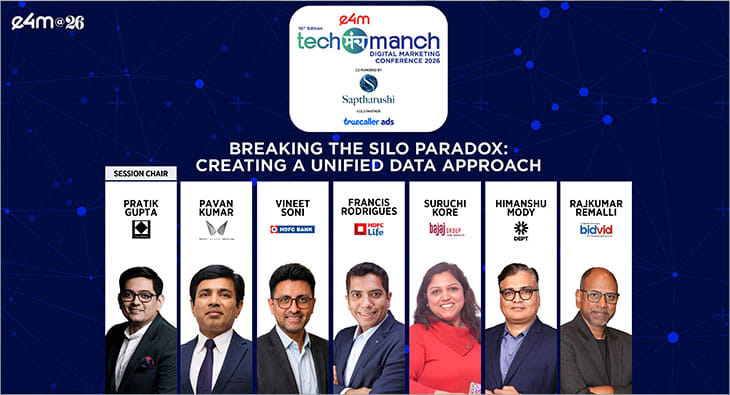

- The e4m TechManch 2026 session, "Breaking the Silo Paradox," focused on how organizations are evolving from data consolidation to actionable insights across functions, with insights from various marketing and technology leaders.
- Panelists highlighted the importance of breaking down internal silos, with examples from Mahindra & Mahindra and HDFC Bank, emphasizing the need for unified data platforms to enhance customer experience and operational efficiency.
- Challenges discussed included the limitations of traditional attribution models, the divide between assisted and unassisted customer journeys, and the necessity for alignment among teams to effectively utilize data.
- The role of AI in enhancing customer personalization and breaking down organizational structures was emphasized, alongside the need for cross-functional ownership and leadership commitment to unify data and improve customer experiences.
Five years ago, marketers faced the challenge of bringing data together. Today, it's getting entire organisations to act on it.
That was the central theme of a session titled "Breaking the Silo Paradox: Creating a Unified Data Approach”, at e4m TechManch 2026, where marketing and technology leaders examined how brands are moving beyond data consolidation to making insights usable across functions.
Moderated by Pratik Gupta, Co-founder and Director, Zoo Media, the session featured Pavan Kumar, SVP & Head – Sales, CX, Mahindra & Mahindra; Vineet Soni, DVP – Growth Marketing & MarTech, HDFC Bank; Francis Rodrigues, SVP Digital Marketing, HDFC Life; Suruchi Kore, Head of Media and Corporate Communication, Bajaj Group; Himanshu Mody, Partner & Head, DEPT; and Rajkumar Remalli, Founder & Director, BidVid.
Setting the tone, Gupta observed, "Five years ago, this conversation would have been all about data and putting all the data together. What we are concerned about today is whether organisations have solved for internal human interventions and internal stakeholder journeys well enough to put unified data to work across functions."
For Mahindra & Mahindra, that change begins with changing customer behaviour.
"Today's buyer is a self-directed buyer, and he or she has already made a choice before they come to our showrooms or visit our websites. All they need is validation of whether their choice is right," Kumar said. As customers interact with the brand across websites, WhatsApp and dealerships, Mahindra captures those touchpoints in a single platform shared across teams, including dealer partners.
Beyond lead information, the platform also stores ownership history, allowing sales teams to personalise conversations using AI. Marketing uses it to understand customer profiles, quality teams track product experience, and product teams use the same insights to prioritise future features. "In the last three, four years, especially post-COVID, we have broken the silos, and this is an evolving process," Kumar said.
Gupta then turned to HDFC Bank, asking what stood in the way of unifying customer journeys across products and channels.
Soni identified two persistent challenges. One was the growing irrelevance of traditional attribution models and the second being the divide between assisted and unassisted customer journeys. Within BFSI, he said, these remain some of the biggest organisational silos.
To bridge that gap, HDFC Bank introduced its "Express Way" system, where customers entering any branch log in through a QR code regardless of the channel that brought them there. "Nobody cares about attribution any more," Soni said, arguing that customer experience has become the shared objective. MarTech now informs decisions well beyond marketing, helping leadership identify operational issues such as app or net banking problems. "Technology is automatically breaking the silos. And that's exactly what AI will do as well."
The challenge looks different in life insurance, where customer relationships can stretch across decades.
"We try to. That's the honest answer," Rodrigues said when asked whether HDFC Life had solved its data silos. The industry's biggest gap, he argued, lies between the point of sale and the "moment of truth", when customers eventually experience the product's value. While AI has improved sales through propensity modelling, next-best-offer algorithms and churn prediction, he believes the larger challenge remains ensuring that promises made today are fulfilled years later. "That, I think, is the key silo to be broken."
For Kore, technology alone isn't enough. Drawing on her experience across Bajaj Group's businesses, she argued that every new strategy must remain rooted in the brand's identity.
"Whenever a new business strategy is made, it somehow needs to tie back to your original brand identity," she said. While most departments now have access to the same data, she argued they often fail to use it collectively. Employees are an organisation's most important stakeholders. "If they don't believe in what we are going to sell to consumers, it's never going to translate to the outside stakeholder."
Asked what fails first when silos emerge, Mody's answer was alignment.
"Alignment breaks first, and everything else crashes along with it."
Drawing on enterprise implementation experience, he described a common disconnect between the teams that buy technology, those that implement it and those expected to use it. Without involving end users early, organisations end up postponing essential features to a hypothetical "next phase". "Alignment has to start even before the first line of code is written."
Remalli traced the problem back to accumulation of data.
"It's not very complicated - different channels are collecting data from different places, and the one single place to accumulate all of it is missing."
He argued that siloed data is ultimately a human problem. Every function protects its own information, and without leadership bringing it together, fragmentation persists.
The discussion then returned to Mahindra, where Gupta asked how emotion fits into an increasingly data-driven buying journey.
For Kumar, emotion itself helps connect departments. Customer feedback from showrooms, workshops and even in-car voice commands is routed through a unified AI-powered platform to quality, product planning and customer experience teams. Connected-car data is also used to predict faults before they occur.
"So we are touching the emotional space of the customer, which builds interest, trust, resilience towards the brand, and growing affinity," he said.
He added that buyers of Mahindra's electric vehicles often arrive with more technical knowledge than sales consultants can process unaided, making AI an increasingly important support tool. "AI is not just breaking the silos - it's breaking the structures within the organisation, because the data is available for everybody to consume."
Contrary to this, in insurance much of the customer experience extends beyond the organisation itself through agents and intermediaries.
While product design and sales quality have improved, Rodrigues said, the harder challenge is managing emotion around long-term investment performance and ensuring families know policies exist when claims need to be made. HDFC Life now collects nominee and beneficiary details upfront, alongside what he called a "little book of legacy", to make that process easier.
"While being cognisant of the emotion in place... this at least ensures you can give a great experience on the things you can control."
As the discussion drew to a close, Gupta asked the panel what single KPI, if removed or reimagined, would do the most to break organisational silos.
Soni returned to the attribution problem, arguing that it remains one of the biggest barriers to customer experience. He also pointed to a broader change in marketing leadership.
"The CMO's job is changing. In today's world, it's no longer just about running brand campaigns or marketing, it's about focusing on the business aspect," he said, adding that value creation, rather than departmental metrics, would increasingly define the role.
Kore agreed that organisations need business-level KPIs aligned with the company's overall vision instead of function-specific goals.
"Marketing wants brand availability or visibility, sales has different targets, corporate communications has different targets. The business team will have to set that KPI for every organisation."
Rather than removing a KPI, Mody proposed adding one, a measure of how well an organisation understands its customers across every interaction. A unified customer profile, he argued, should connect every touchpoint so customers never feel like strangers as they move between channels.
"Not just knowing the demographics or the profile of a customer, but every touchpoint and what it means for them, and using that to make the customer experience better. This is what brands need to define as unification."
For Remalli, the solution came back to leadership.
"KPI hatana nahi hai, KPI banana hai (It's not about removing a KPI, it's about creating one)," he said, arguing that data unification should be a CEO-level responsibility.
The discussion then turned to AI and where it was already making a measurable impact.
At HDFC Life, Rodrigues pointed to AI-driven call auditing. By transcribing and analysing contact centre conversations, the company now provides agents with targeted coaching while feeding customer insights directly into bottom-funnel marketing.
"That same loop can close both ends, because now the conversations and the creatives are feeding into the same place."
Soni cautioned against viewing AI as a standalone solution. Without a strong MarTech foundation connecting channels, AI would simply create new silos.
"Unless that middle layer is sorted, AI will also run in silos, and your silo problem will continue to exist even five years down the line."
Kore shared an example from Bajaj Hindustan Sugar, where dedicated WhatsApp channels connect roughly five lakh sugarcane farmers across fourteen mills with cane managers throughout the crop cycle. "This is a channel that has really given them a path-breaking way to reach out to an organisation they are dependent on."
For Kumar, AI's biggest contribution lies in hyper-personalisation. As AI becomes widely accessible, organisations will need cross-functional ownership rather than a single team driving transformation.
"It will depend on the industry... What will work across sectors is a cross-functional approach, because people have to understand the emotional part of real-time customer expectations."
"AI can play a significant role in breaking these structures, but there is no single owner. It's a joint responsibility."
Mody gave the example of a recent HDFC Life project, where a customer experience function was established from day one to span the entire value chain, with marketing and IT supporting that mandate.
"It doesn't happen easily in most organisations... But wherever a clean slate exists, having a customer experience department defined across the entire value chain makes a huge difference."
The result, he added, was a move from ninth to third in market share.
Gupta ended the session with three observations. One that different industries remain at different stages of data maturity. Second, organisations are moving beyond hyper-personalisation towards "hyper-continuity", where customers expect seamless experiences across every touchpoint. Third, as AI advances, the challenge will be balancing increasingly sophisticated technology with equally rising expectations for simple, frictionless experiences.
Read more news about Marketing News, Advertising News, PR and Corporate Communication News, Digital News, People Movement News
For more updates, be socially connected with us onInstagram, LinkedIn, Twitter, Facebook, YouTube & Google News