DOOH grows up from missed glances to measurable impact
At e4m OOH Conference 2026, industry leaders explored how DOOH and pDOOH are evolving from visibility plays into accountable, performance-driven media
 by
by
Published: Apr 23, 2026 12:34 PM | 9 min read
 Follow Us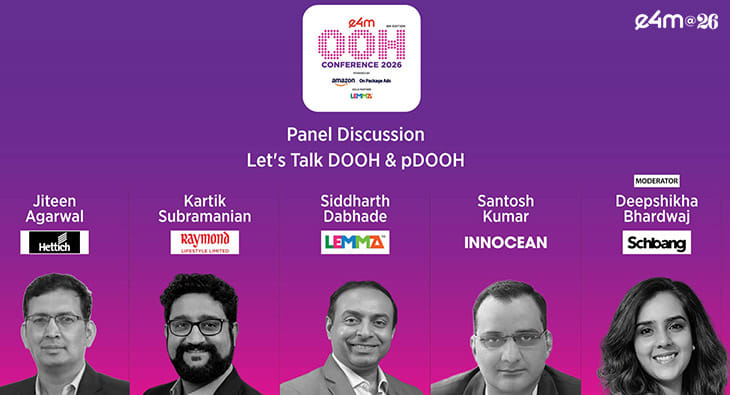

- At the e4m OOH Conference 2026, marketers explored the impact of Digital Out-of-Home (DOOH) and programmatic DOOH (pDOOH) on advertising strategies, emphasizing data-driven storytelling and real-time audience targeting.
- Panelists, including representatives from Raymond and Hettich, discussed the evolution of DOOH from a necessity to a valuable marketing channel, highlighting its advantages in proximity advertising and creative storytelling.
- The conversation also addressed challenges in measurement and attribution, with calls for improved tracking systems and verification processes to enhance the effectiveness of DOOH campaigns.
- Experts noted that the future of pDOOH is tied to advancements in technology and AI, which will enable more efficient audience targeting and dynamic creative capabilities, ultimately reshaping the advertising landscape.
At the e4m OOH Conference 2026, marketers discussed how Digital Out-of-Home (DOOH) and programmatic DOOH (pDOOH) are redefining the rules of engagement through data, storytelling, and real-time targeting.
A session titled “Let’s Talk DOOH & pDOOH” and moderated by Deepshikha Bhardwaj, National Lead – Media Strategy, Schbang, featured insights from Jiteen Agarwal, Chief Marketing Officer, Hettich India; Kartik Subramanian, Head – Brand, Raymond Lifestyle Limited; and Siddharth Dabhade, Chief Business Officer, Lemma.
Setting the context, Bhardwaj highlighted how programmatic DOOH sits at a unique intersection. “On one hand, we have the scale of outdoor, and on the other, the precision of digital. We can control the entire narrative and deliver communication at the right moment, to the right audience,” she said, opening the discussion by questioning whether brands adopted DOOH out of innovation or necessity.
Subramanian was candid about Raymond’s entry into the medium. “As a marketing person, it would be nice to say we wanted to do something innovative. But that wasn’t the case.” Instead, he explained, the shift was driven by a business need. “We are a retail-based fashion company, so advertising in close proximity to our stores is very important. We simply didn’t have regular outdoor sites available, and DOOH was the only option left.”
What began as a constraint gradually evolved into a meaningful channel within the media mix. Subramanian noted that in cities like Mumbai, DOOH inventory is often more accessible in key catchment areas than traditional outdoor. Over time, the medium has delivered tangible benefits, even though the initial adoption was far from strategic innovation.
He also pointed to gaps in how brands currently utilise DOOH. “Most brands tend to use it like carousel ads,” he said, emphasising that storytelling remains a challenge. For a brand like Raymond, built on narrative and visual richness, DOOH has opened new creative possibilities.
Elaborating on this, Subramanian explained how the medium brings product detail to life. “The way the garment falls, the drape, the stitch, the embroidery comes alive on DOOH,” he said. In contrast, he admitted dissatisfaction with traditional OOH for fabric-led campaigns.
Agarwal offered a contrasting lens, positioning DOOH not as an experiment, but as a natural extension of digital. “For us, traditional media was more of an experiment. Digital has always been a very serious business,” he said, pointing to the nature of Hettich’s category. “We are about furniture in motion. A static billboard cannot do justice to that.”
For Hettich, DOOH became integral once the ecosystem matured. Improvements in infrastructure, tracking, and monitoring made the medium viable for integrated campaigns.
Agarwal underscored the importance of storytelling, particularly for a category that requires demonstration. “It’s not about putting a static ad and assuming the consumer will understand. You need to tell a story in 10–15 seconds so that the consumer can grasp what you’re trying to say,” Agarwal noted.
While DOOH may not command a dominant share of budgets, he said brands deploy it selectively to deliver a specific leg of communication, particularly in high dwell-time environments such as airports, where storytelling can be more effective.
Shifting the conversation to programmatic DOOH, Dabhade broke down the concept using a digital-first lens. “Programmatic DOOH has come from the digital world. Earlier, if you wanted to buy a print ad, you had to call every newspaper. Then with digital, that process became platform-led,” he explained.
Drawing an analogy, he described programmatic as “a stock market for advertising,” where buyers and sellers transact inventory through platforms, creating efficiency and transparency.
He elaborated that this model now extends to out-of-home inventory as well, allowing advertisers to buy DOOH through interfaces similar to those used for digital media. This shift brings accountability into a medium traditionally seen as difficult to measure.
“One of the biggest benefits is control and transparency. If you’re running a campaign across 1,000 screens, you know exactly how many are live. If 50 screens have issues, you don’t pay for them,” he said, adding that advertisers now receive daily tracking and reporting.
Dabhade also highlighted how data and technology are enhancing DOOH’s role across the funnel. Through geofencing and data partnerships, brands can retarget audiences exposed to DOOH campaigns on mobile devices, moving them from awareness to consideration and conversion stages. This enables brands to not only create impact but also measure outcomes such as leads, app downloads, and revenue.
Contrary to this, Agarwal pointed to operational and measurement challenges that still persist on the ground. A key concern is the lack of real-time visibility. “You don’t have a dashboard to see whether your ads are playing in the designated slots or if there is under-delivery happening,” he noted.
He also discussed the complexity of dealing with multiple vendors, each with their own processes and billing cycles. This fragmentation leads to inefficiencies and unproductive time spent on coordination.
Measurement remains another grey area. While metrics such as impressions or OTS are commonly reported, Agarwal questioned their depth. He stressed the need for stronger attribution models, including brand lift studies and footfall tracking, to understand real business impact.
Additionally, he pointed to the lack of organisation in non-metro markets. “Beyond metros, the ecosystem is very unorganised. You just put your money and hope everything happens,” he said, underlining the need for more structured systems and aggregators to safeguard brand interests.
As the discussion progressed, the panel turned to answer what would it take for brands to meaningfully shift budgets from traditional media into DOOH and programmatic DOOH.
Subramanian, speaking from the perspective of a recent adopter, outlined both current barriers and future opportunities. For a retail brand like Raymond, attribution remains central to all marketing decisions. “Attribution is a very big aspect of whatever we do. It’s imperative for us that we track full funnel communication and especially the last mile,” he noted.
While acknowledging that traditional formats like print and outdoor have historically lacked attribution, Subramanian pointed out that this is beginning to change. With improving tools and capabilities, marketers can now access better heat maps and location-based insights around DOOH placements.
However, the real breakthrough would come when brands can directly connect exposure to outcomes. “If I put up an ad at Bandra, can I track how many people saw it and how many of them entered my store? Even tracking store entry points would be absolutely fabulous,” he said.
He added that measurability today extends beyond attribution to include basic assurances around delivery. The lack of certainty around whether ads are actually playing as planned continues to be a concern. There’s also growing scepticism around proof-of-play in an era shaped by generative AI. While not suggesting malpractice, he noted that the absence of robust verification systems leaves room for doubt.
Another structural challenge, he explained, lies in the way DOOH inventory is bought and consumed. “A lot of DOOH media is bought on slots. You may get 10 seconds in a one-minute loop,” he said, highlighting how this model limits actual visibility in real-world conditions.
In high-traffic, fast-moving environments, the effective opportunity to see (OTS) an ad becomes extremely narrow. “In a moving traffic scenario, you may only have two to five seconds to glance at an ad. That means my opportunity to see that ad is less than 15%,” he explained. This creates a disconnect between investment and impact, especially when compared to other media where visibility is more predictable.
While increasing the share of voice (SOV) can address this issue, it comes at a cost. Higher dominance on a screen significantly increases media spend, which may not align with initial perceptions of DOOH being a cost-efficient medium. Subramanian suggested that over time, the market will either correct through pricing or marketers will recalibrate budgets to accommodate these realities.
Drawing from international markets, he observed that DOOH-first creative thinking is far more evolved in cities like Bangkok and Vietnam. He described these executions as bold, motion-led, and highly attention-grabbing. “If your content isn’t attractive or relevant for the audience passing in front of the screen, then it’s just money wasted,” he said.
Building on this, Dabhade highlighted how programmatic DOOH is unlocking new layers of innovation, particularly through audience-first planning.
Instead of selecting screens in isolation, marketers can now identify and target specific audience cohorts based on data around footfalls and consumer profiles. This aligns DOOH more closely with broader digital planning frameworks, where audience targeting is central.
Dabhade also pointed to dynamic creative capabilities enabled by data integrations. “You can sync creatives with weather, macro trends, or even something like an IPL score, where your creative changes with what’s happening in the match,” he said, citing API integrations as a key enabler.
He added that advances in artificial intelligence are further accelerating this evolution. From planning to execution, AI is enabling more sophisticated campaign management, including automated creative optimisation and full-funnel tracking. As these capabilities mature, Dabhade noted that the ecosystem will become more efficient in terms of pricing, location discovery, and audience targeting.
As the session moved towards a close, the panelists were asked to describe the future of programmatic DOOH in a word or a line.
“It’s inevitable,” Agarwal responded, pointing to the broader shift towards programmatic buying across digital media. As marketers increasingly seek efficiency, precision, and contextual relevance, programmatic DOOH will naturally gain traction, provided the supporting infrastructure continues to evolve.
Subramanian, however, struck a more measured note. “We will need to understand it a lot more. It’s still early days and we are taking baby steps into DOOH,” he said, adding that greater clarity on use cases will drive adoption, particularly among traditional brands.
Dabhade placed the future firmly within a larger technological shift. “Programmatic out-of-home is actually old news now. It’s the AI-led programmatic out-of-home that is going to define the future,” he said.
He described programmatic as a foundational layer within a much larger transformation driven by digitisation and AI, where connected screens, data, and automation will collectively reshape how brands plan, execute, and measure campaigns.
Read more news about Out of Home, Internet Advertising, Marketing, Digital Media, TV Media
For more updates, be socially connected with us onInstagram, LinkedIn, Twitter, Facebook, YouTube & Google News