Consumer durables’ 17% YoY digital ad spend growth: Through the marketers’ lens
According to the dentsu-e4m Digital Advertising Report 2026, consumer durables have raised their digital ad share from 32% in 2024 to 49% in 2025
 by
by
Published: Feb 13, 2026 9:24 AM | 7 min read
 Follow Us

As temperatures rise and the T20 World Cup grips millions of households, sales of air conditioners, fans and large-screen televisions surge across the country. For consumer durable brands, summer and the cricket season are not just climatic and sporting events, they are high-stakes commercial windows. Yet even as these seasonal spikes continue to drive volumes, the way brands capture demand is undergoing a major shift. Digital is no longer a support act - it is fast becoming the centre of gravity in the marketing strategy of consumer durables.
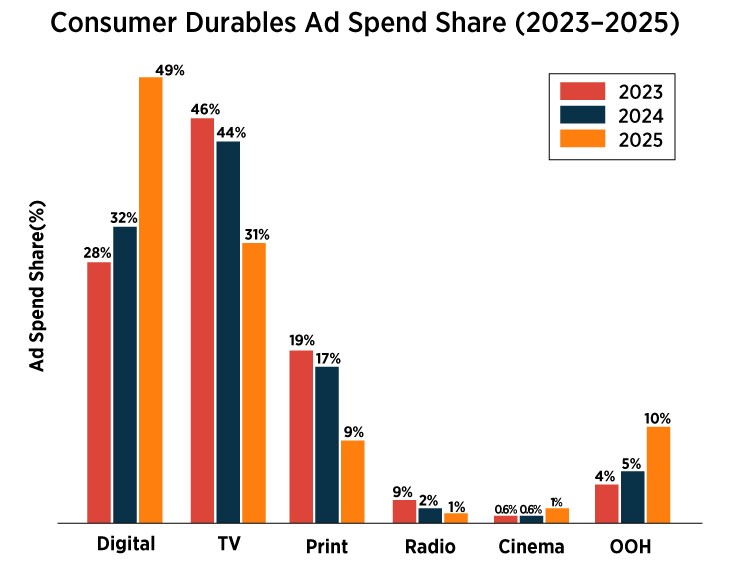
According to the dentsu-e4m Digital Advertising Report 2026, consumer durables have raised their digital ad share from 32 per cent in 2024 to 49 per cent in 2025. That 17 percentage point jump in a single year reflects more than a tactical reallocation. It signals a deeper transformation in how brands respond to consumer behaviour, media consumption and measurable performance.
Explaining why digital now shapes the entire decision ecosystem, influencing both online and offline sales, Nikhil Gupta, Head of Strategy and Marketing at Signify says, “We leverage video led storytelling and emerging digital formats to showcase innovation, educate consumers and drive deeper engagement across both consumer and professional segments. In addition, we focus on e-commerce, quick commerce, influencer marketing and interactive formats to strengthen impact across the digital journey. For 2025, our digital media mix reflects a balanced full funnel approach, with around 40 % directed towards online video and connected TV, 30% towards search and social media, and the remaining 30% towards quick commerce and e-commerce platforms.”
A decade ago, lighting was largely about function. Today, it is about aesthetics, personalisation and architectural expression. Gupta pointed out that the lighting and home upgrade journey typically begins online with consumers exploring décor inspiration, evaluating options and comparing prices before completing the purchase either digitally or in store.
This behaviour becomes even more pronounced during peak purchase periods. The onset of summer pushes air conditioner and fan sales, while the cricket season boosts demand for large screen televisions as families upgrade to enhance viewing experiences. Many of these purchases are tied to life stage moments such as moving into a new home, renovation cycles or seasonal discomfort. Increasingly, the first touchpoint in these journeys is digital.
CTV relevant for consumer durable brands?
The rise of connected TV is blurring the lines between linear and digital. Girish Hingorani, VP Marketing for Cooling and Purification Appliances at Blue Star, believes the shift is inevitable.
“All the TVs now are smart. About 12 to 14 million TVs are sold every year and all of them are smart.” For him CTV is an extension of TV that gives brands digital-like properties. "You can target audiences, you can choose your cohorts, you can decide what frequency you want accurately. So it is nothing but an extension of television with digital properties but finally it is TV,” he said.
For categories like air conditioners and large appliances that rely on brand building during summer bursts, the large screen still matters. “From a brand building perspective I am a very strong proponent of TV and CTV,” Hingorani added. “People are buying bigger and bigger televisions. If they were not watching TV, why are they investing so much in OLEDs and large screens. They want to watch content and they are receptive to ads at that time.”
At the same time, he acknowledged that digital formats on handheld devices face different consumer mindsets. “When you are in a handheld and searching for something specific, if my ad comes, chances are that the consumer is likely to skip it. The consumer is not in the mind space to watch TV scenes. It is like clutter.”
Full funnel accountability
For other brands, digital’s strength lies in its measurability. Ayesha Prasad Narain, AGM Marketing at Kärcher India, argued that while television delivers mass reach, it demands repeated bursts for meaningful brand entrenchment.
“TV is mass media, it has sustained eyeballs, but unless you have consistency in TV bursts across multiple platforms and episodes, you will not get any brand entrenchment,” she said. “Therefore we are looking at digital which is more cost effective, more targeted and gives us the ability to remarket to our consumer cohorts.”
Narain emphasised that digital enables tracking across the entire consumer journey. “The full consumer journey is more measurable with digital. I can actually enable a customer lifetime value via digital. From social media to affiliate, email marketing, WhatsApp and AI journeys, it is the most data driven option that can elongate the lifespan of my brand with a consumer.”
This shift in accountability has strengthened marketer confidence. Signify's Nikhil Gupta noted that advancements in attribution and performance measurement have improved the ability to link digital investments to tangible outcomes such as leads, store enquiries and sales.
“With greater platform maturity, we now deploy a holistic digital mix spanning video, influencer marketing and e-commerce, enabling full funnel impact at scale rather than restricting digital to performance channels alone,” he said.
Digital as lead driver, not support medium
GoBoult, the wearables brand, is even more digital heavy. Co-founder Varun Gupta said the company keeps overall marketing spends at 7 to 8 per cent of revenue, with nearly 95 per cent of the Mustang collaboration campaign focused on digital.
“That is where our core consumer is discovering and transacting,” he said. “We track performance very closely through CTRs, conversions and ROI to ensure efficiency.”
He added that influencer strategy is also evolving. “Earlier, the focus was largely on tech creators, but now we are integrating more lifestyle influencers who can communicate aspiration, design and premium appeal. As the category matures, it is no longer just about specs. It is about how the product fits into a consumer’s lifestyle.”
The IPL and summer season will continue to act as demand accelerators for air conditioners, fans and televisions. New home purchases and renovations will keep triggering upgrades in lighting and appliances. What has changed is the pathway to purchase.
Consumers now toggle between inspiration videos, product reviews, price comparison sites and marketplace listings before stepping into a store or clicking buy. Connected TV is reshaping the way mass properties are consumed. Performance marketing is bridging the gap between intent and availability.
The near double digit jump in digital share over a single year suggests that for consumer durable brands, this is not a temporary experiment. It is a recalibration of the marketing playbook. Television may still anchor marquee moments like the IPL, but digital increasingly sustains engagement before, during and after the burst.
As Gupta summed up, the real shift is not about replacing one medium with another. It is about building a more accountable, intent driven ecosystem where inspiration, consideration and commerce are seamlessly integrated. In a category defined by high consideration and seasonal spikes, that integration may well define the next phase of growth.
The Digital Don
Digital media contributes ₹71,621 crore, commanding a dominant 59 percent share of the Indian advertising industry. And, by the end of 2027, digital is projected to account for 70 percent of total advertising spends, touching ₹98,034 crore and growing at a CAGR of 17 percent, driven by expanding digital infrastructure, deeper integration with commerce platforms and increasingly measurable performance outcomes.
Programmatic buying is further accelerating this transformation. By the end of 2025, programmatic accounted for 42 percent of India’s digital media spends, translating to ₹30,081 crore, marking a 19 percent growth over 2024. It is expected to grow at a CAGR of 18.77 percent to reach ₹42,435 crore by 2027, taking its share to 43 percent of digital spends.
Within this expanding digital universe, consumer durables contribute ₹7,450 crore, accounting for 6 percent of the total advertising industry, and are increasingly recalibrating their media mix to align with the broader digital surge.
Read more news about Marketing News, Advertising News, PR and Corporate Communication News, Digital News, People Movement News
For more updates, be socially connected with us onInstagram, LinkedIn, Twitter, Facebook, YouTube & Google News
