The Newsroom Reset: Why India's media industry is letting its people go?
More than 1,000 media jobs are estimated to have been lost in 2026 as weak economics, AI and restructuring remake Indian newsrooms
 by
by
Published: Aug 10, 2026 9:20 AM | 14 min read
 Follow Us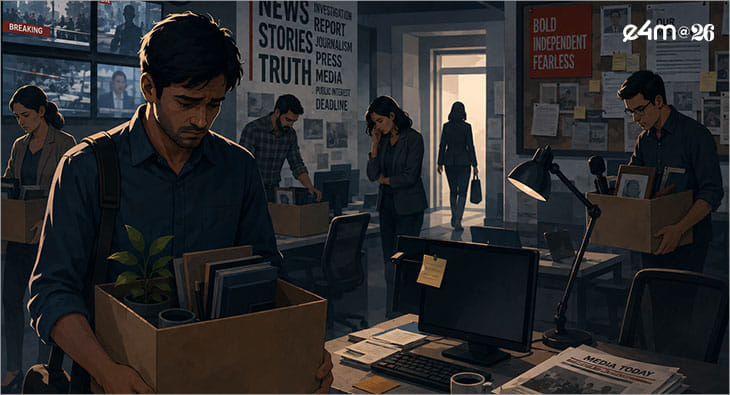

- The Indian media industry is experiencing significant layoffs, with over 1,000 media professionals losing their jobs in 2025 and the trend continuing into 2026, affecting various roles across multiple organizations.
- The layoffs are attributed to a combination of factors, including declining advertising revenues, unpredictable platform algorithms, audience fragmentation, and the impact of artificial intelligence on newsroom workflows.
- Despite growth in the broader media and entertainment sector, news organizations struggle with monetization, as only about 4 million paid digital news subscriptions exist in India, leading to a shift in focus towards digital-first and creator-led journalism.
- The restructuring within newsrooms is prompting a need for adaptability among journalists, with an emphasis on multi-format skills and AI integration, while also raising concerns about the financial viability of journalism education amid stagnant entry-level salaries.
“I know I look shocked... sad... instead of shocked... happy.”
Standing on stage to accept a journalism award, Andy Sachs isn't thinking about the trophy in her hands.
“That's because I just found out a whole table of talented, award-winning journalists from my paper got fired. By text."
Moments later, she delivers the line that lingers long after the applause ends.
"We understand journalism is changing. But it's still devastating when it happens to you... We're... technical term... toast."
It is a scene from The Devil Wears Prada 2. Fiction, yes. But only just.
Across India's news industry, there are no acceptance speeches after the layoffs. There are only calendar invites from HR, hurried phone calls, WhatsApp messages asking employees to resign, and newsrooms quietly shrinking one team at a time.
What Andy Sachs describes on screen has become an increasingly familiar reality in Indian media, where behind every announcement of ‘restructuring’ or ‘cost optimisation’ are careers abruptly interrupted and an industry undergoing one of the biggest transformations in its history.
In 2025, an estimated 1,000 media professionals lost their jobs as restructuring swept through newsrooms across the country. The story has only intensified in 2026.
By August alone, exchange4media's reporting suggests the number has already crossed the 1,000 mark, with months still left in the year. The cuts have spared few. Journalists, producers, video editors, camerapersons, designers, product and technology professionals, sales teams and support staff have all been affected.
Layoffs have cut across seniority levels, from fresh recruits to long-serving editors and business leaders, and have reached organisations that many in the industry once considered among the most stable employers.
These are no longer isolated layoffs. They are the visible symptoms of a deeper transformation that is quietly redefining the business of news.
Over the past 18 months, restructuring has swept through several of India's largest media organisations, affecting television networks, newspaper publishers, digital-first companies and business newsrooms alike. The wave has cut across English, Hindi and regional media, suggesting that the crisis is no longer confined to one platform or one business model.
Why is this happening?
This is no longer a story about one company making cuts or another newsroom tightening its belt. Interviews with more than two dozen current and former media executives, HR leaders, editors and employees suggest the industry has entered a new phase.
The economics of journalism are being rewritten. Advertising remains under pressure, platform algorithms have become increasingly unpredictable, audiences are fragmenting, artificial intelligence is reshaping newsroom workflows and management teams are under relentless pressure to deliver profitability. The result is a fundamental reset in how news organisations are built, staffed and sustained.
The numbers tell the story
While India's broader media and entertainment industry continues to grow, news has increasingly become the outlier.
According to a latest FICCI-EY report, digital subscription revenues jumped 60% in 2025, driven by strong growth in video and music streaming.
Paid video subscriptions climbed to 216 million, while paid music subscriptions grew 37% to 14.4 million.
News, however, continues to struggle to convince audiences to pay. India has only around 4 million paid digital news subscriptions, highlighting the difficult economics of producing journalism in a market where readers have grown accustomed to free news.
Publishers are simultaneously fighting another battle: retaining their audiences.
The same report notes that the reach of online news platforms declined 9% in 2025, with industry stakeholders attributing the fall to AI-generated search summaries and the rapid adoption of AI applications, both of which increasingly answer users' queries without requiring them to visit publisher websites.
For an industry that still depends heavily on advertising, fewer readers mean fewer page views, lower monetisation and mounting pressure to cut costs. The result is a vicious cycle in which shrinking revenues force organisations to become leaner, even as they invest more in technology and AI to remain competitive.
The strain is also evident in listed media companies.
While some have returned to profitability through aggressive cost controls and restructuring, others continue to battle weak advertising markets, pressure on television revenues and slowing digital monetisation. Across earnings calls, management commentary has increasingly centred on operational efficiencies, profitability and cost optimisation rather than expansion.
Even as legacy businesses such as print have delivered signs of stability for some publishers, digital, once seen as the industry's biggest growth engine, is increasingly under strain.
HT Media, for instance, reported that even as its print business registered healthy growth, its digital business continued to face headwinds. Digital operating revenue fell 28% year-on-year to Rs 27 crore in the June quarter, while the segment remained loss-making.
The company attributed the decline to business portfolio streamlining initiatives undertaken during the quarter. The results underscore a broader challenge confronting news publishers today: even as audiences continue to consume news online, converting that consumption into a profitable digital business has become increasingly difficult.
HT Media is not alone in feeling the pressure.
Network18 Media & Investments reported a contrasting picture. While consolidated operating revenue rose 10.3% year-on-year to Rs 516 crore in the June quarter, aided largely by heightened advertising spends during multiple state elections, the company slipped to a consolidated net loss of Rs38.7 crore, compared with a net profit of Rs 148 crore in the corresponding quarter last year.
With the June quarter results of companies such as Jagran Prakashan, DB Corp, TV Today Network and Zee Media still awaited, the full financial picture of India's news industry is yet to emerge.
Okay... but how do companies actually decide whom to fire?
The financial results explain why companies are under pressure. They do not explain how layoffs unfold behind closed doors.
A former senior HR executive at a leading media company, who was directly involved in multiple restructuring exercises, says layoffs are rarely the first response. "It's almost always the last step," the person said.
According to the executive, the trigger was not a single event but the convergence of several pressures.
Advertising slowed, digital publishers were hit by changes in Google's search ecosystem that reduced high-value international traffic, particularly from the US, and monetisation weakened.
"When both traffic and revenue started falling together, companies realised the old growth model was no longer sustainable.The initial response was to try and grow out of the problem. Teams were expanded, new content formats were tested and multiple experiments were launched in the hope that traffic would recover. When that failed, the conversation shifted from growth to survival,” they said.
"Digital transformation stopped being about innovation. It became about cost,” they added.
The first targets, the executive said, were not people but positions.
Hiring was frozen. Vacancies were left unfilled. Replacement hiring was stopped. Every department, every product and every salary line came under scrutiny. Contrary to popular perception, the first cost reviews were often concentrated in technology, product and support functions rather than editorial.
"Five senior technology roles can sometimes save more money than dozens of junior editorial positions,” they said.
Only after those measures failed to bridge the gap did companies begin identifying employees for layoffs. Department heads were given cost-reduction targets rather than headcount targets and asked to decide how to achieve them. Performance ratings were one factor, but they were far from the only one. Product profitability, role redundancy, future business priorities and the overall wage bill were weighed together before final decisions were made.
The restructuring also coincided with the growing use of AI inside newsrooms. Teams were expected to produce more with fewer people as AI tools became part of everyday workflows. Journalists who earlier produced eight stories a day were now expected to produce ten or twelve.
"The expectation wasn't just to reduce costs. It was to increase productivity at the same time,” they added.
Executives familiar with restructuring decisions who spoke to exchange4media on conditions of anonymity, however, argue that these exercises are often viewed too narrowly as cost-cutting.
According to the executive, whose organisation is estimated to have reduced nearly 300 roles across its media businesses over the past two years, the process began long before the first employee was asked to leave.
“The objective is to realign businesses with rapidly changing consumer behaviour, technology and monetisation models while improving operational efficiency and focusing investments on areas with stronger long-term growth potential.”
The source said organisational structures are reviewed periodically to ensure businesses remain sustainable and profitable in an increasingly challenging media environment. They also maintained that where roles are impacted, companies generally follow internal policies and applicable legal requirements, with transition support varying depending on the circumstances.
exchange4media reached out to multiple media organisations that have undertaken restructuring or workforce reductions over the past couple of months.
Most declined to comment on the record, while others chose not to respond.
The human cost
For the employees involved, the layoffs were not balance-sheet decisions but deeply personal moments.
At one English news broadcaster, the process began quietly in the last week of April. Employees were called individually by
HR, and informed that their services were no longer required.
The exercise continued through May, with some exits spilling into June.
In all, an estimated 150 employees, largely from the English news operation, were let go. The channel itself was not shut, but its English television and digital operations were significantly downsized, with a much leaner team left to handle both platforms. Many of those affected had spent four to five years with the organisation. While the separation process and severance package were, according to employees, in line with company policy, the official explanation rarely went beyond broad references to "cost-cutting".
One former employee, however, believed the problems ran deeper. "Cost-cutting was the reason we were told, but I don't think that was the real issue. It reflected larger management failures. Planning, execution and decision-making had all suffered, and eventually employees paid the price.”
A similar pattern has played out elsewhere in the industry. At another leading television news network, around 120 employees across editorial and business functions were asked to leave as part of a restructuring exercise this year, according to multiple people familiar with the matter.
Several employees described abrupt exits, with resignations sought over text messages or through hurried HR conversations.
One employee recalled being in the middle of a meeting when they received a message asking them to immediately download the company's internal HR application and submit their resignation without delay.
Unlike some other organisations, employees said no severance package was offered as part of the separation.
These accounts reflect the abrupt and deeply unsettling nature of many recent exits, where careers built over years came to an end in a matter of minutes.
Layoffs are no longer isolated responses to temporary business pressures. They have become part of a broader restructuring of newsroom economics, affecting organisations across ownership groups, platforms and business models.
The effects extend well beyond those who lost their jobs. Employees who remain describe smaller teams, expanding responsibilities, higher productivity expectations and increasing reliance on AI-assisted workflows. In many newsrooms, restructuring has changed not just who works there, but how journalism itself is produced.
Where is the industry investing? Capital and hiring haven't disappeared. They've moved
Alongside restructuring, several media organisations are quietly rebuilding around digital-first businesses, creator-led journalism, newsletters, podcasts, YouTube and direct-to-consumer products. The objective is no longer simply to publish more stories, but to build loyal audiences, stronger communities and sustainable revenue streams beyond traditional display advertising.
That shift is already visible across the industry. Legacy publishers are investing more aggressively in video and creator-led journalism, while digital-native publishers continue to expand podcasts, newsletters and subscription-led offerings. ThePrint, for instance, in spite of being an independent media outfit, has built one of India's largest digital-first news video operations, with nearly 3 million YouTube subscribers, complementing its text and podcast strategy.
At the same time, publishers are increasingly investing in specialist verticals, audience development, product, data, subscriptions and monetisation teams. Several organisations have also made targeted editorial hires centred on digital storytelling and creator-led formats, signalling that the industry is not shrinking uniformly. Rather, talent and investment are being reallocated towards businesses that can build direct audience relationships instead of relying predominantly on search traffic and traditional advertising.
Is journalism still worth studying?
One of the more uncomfortable questions emerging from the current wave of restructuring is whether the economics of journalism still justify the growing cost of entering the profession.
India's leading journalism schools today charge anywhere from around Rs 2 lakh to more than Rs 10 lakh for postgraduate programmes, depending on the institution and specialisation.
At leading private journalism and media schools, the cost of a degree or postgraduate programme can run into several lakh rupees. Institutions such as the Asian College of Journalism, Symbiosis Institute of Media and Communication, Amity University, Manipal Academy of Higher Education and Christ University represent a significant financial investment for students and their families.
Yet, according to Rajneesh Singh, Managing Partner at SimplyHR Solutions and former Group Head-HR at TV18, entry-level salaries have barely kept pace.
“The worrying part is that the economics of media careers haven't fundamentally changed in nearly two decades. When I joined the industry around 20 years ago, entry-level salaries were in the Rs 20,000-25,000 range. Even today, many reputed media organisations continue to offer similar starting salaries. That tells you the needle has barely moved. As a profession, media remains financially under-rewarded despite the skills and effort it demands,” he said.
Singh believes journalism is increasingly becoming a profession sustained by passion rather than financial rewards. At the same time, he says, experienced professionals are moving into corporate communications, public affairs and independent ventures, while AI and continued cost pressures are likely to make newsrooms leaner in the years ahead. "Journalism isn't disappearing," he said.
"But media organisations will almost certainly employ fewer people than they once did."
He argued that future journalists will need to be adaptable, technologically proficient and willing to work across formats and subject areas rather than build careers around a single niche.
Jarshad NK, editor in chief at YourStory and former Dean, ACJ-Bloomberg, Post-Graduate Diploma in Business and Financial Journalism, took a more nuanced view. He argued that the cost of journalism education is not the problem in itself, provided students receive genuine value in return.
“I think costs are justified if the student gets value. At ACJ-Bloomberg, where I was the Founding Dean, the fees may be high, but students are taught skills that help them land a reasonably high paying job. Journalism is moving towards depth and, unfortunately, most j-schools still focus on breadth. That is a problem,” Jarshad said.
“The other problem is that the schools are out of touch with the media consumption habits of the younger generation. The youth value individual experience higher than institutional opinions. Authenticity matters more than credibility for them. A simple look at the engagement reporters get on social media over the organisations they work for will prove this. J-schools need a way to crack this. Costs are not a problem as long as the placements are good. At ACJ-Bloomberg, we have 100% placements. And that's because the demand for quality business journalists is high,” he added.
Survival of the adaptable
That need for adaptability doesn't end in the classroom. It has become one of the defining expectations inside modern newsrooms, particularly as organisations grapple with smaller teams and changing business models.
A former senior HR executive recalled that one of the biggest challenges during restructuring was resistance to change. "We had people who said, 'I cover health. I can't write lifestyle’. That mindset is no longer sustainable," the executive said.
"The industry has changed, but many professionals haven't changed with it,” they added.
“In today's newsroom, adaptability has become as valuable as expertise. Journalists who can work across beats, formats and AI-assisted workflows are increasingly better placed than those defined by a single specialisation,” they said.
The bigger challenge, however, lies with leadership. For years, many publishers relied heavily on platform-driven traffic rather than building loyal, direct audiences. When algorithms changed, that dependence was brutally exposed.
In The Devil Wears Prada 2, Andy Sachs walks off the stage after accepting her award.
In India's newsrooms, there are no applause lines after the layoffs.
There is only the quiet search for the next assignment, the next contract, the next opportunity. Journalism will survive.
Whether the newsroom, as generations of journalists knew it, survives in the same form is a far more difficult question.
Read more news about Digital Media, Television Media, Out of Home Advertising, Print Media, Latest Advertising India
For more updates, be socially connected with us onInstagram, LinkedIn, Twitter, Facebook, YouTube & Google News