Content and credibility are the backbone of media: Vinod Agnihotri
Vinod Agnihotri, senior journalist and Advisory Editor at Amar Ujala Group, shares insights on media evolution, content shifts, digital competition, the role of AI, and more
 by
by
Published: Apr 6, 2026 3:16 PM | 7 min read
 Follow Us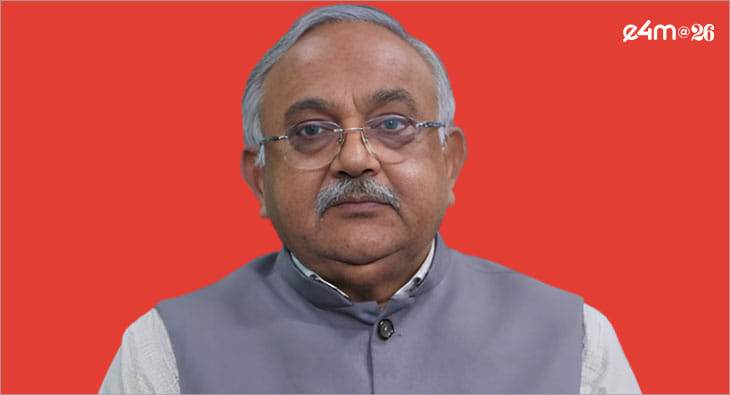

Senior journalist and Advisory Editor at the Amar Ujala Group, Vinod Agnihotri, shared his insights in an exclusive interview. Drawing on over four decades of experience, he spoke at length about the evolving media landscape, changing content trends, the balance between editorial and commercial priorities, digital competition, the role of AI, the future of newspapers, and the core principles of journalism.
Excerpts:
You've spent over four decades in the media industry. What do you consider the biggest change during this time?
Look, change is natural and necessary with time, because if there's no change, stagnation will set in. When I started journalism, digital media didn't exist. Television was the only medium, and it was primarily the era of newspapers and magazines. Back then, major magazines were published, with widespread influence. Newspapers were also published in limited cities and had limited editions. But today, the situation has completely changed—newspapers now have multiple editions, sub-editions, and a new edition is available every 50-70 kilometers. Circulation has increased significantly, and the entire working process has changed.
What changes have taken place at the content level?
When I started journalism, news related to public concerns and politics received the highest priority. The front page featured only those stories that related to society and the country. Sports news often relegated to the last pages, receiving prominence only in major events. But gradually, this began to change. Now, you see that news related to entertainment, crime, and lifestyle also become headlines and often appear on the front page. After economic liberalization in the 1990s, the tone of content began to shift and market influence began to grow, which also changed news priorities.
How has the balance between editorial and advertising changed?
Earlier, there was a time of editorial dominance. If an advertisement came in and there was no space available in the newspaper, the editor had the authority to decide whether to place it or not. Editorial decisions were paramount. But now the situation has changed. Commercial pressure has become immense.
How do you see the race to be 'first' in today's media?
In today's world, the competition to be the first to report news has intensified, and this competition often results in news being broadcast without verification. However, we established a clear policy in our time that unless a reporter verifies the news, it will not be broadcast, even if it is delayed by five minutes. If viewers trust a medium that the news they receive will be authentic, that becomes its greatest strength. Running false news in a hurry may yield short-term benefits, but it only causes long-term losses.
How important is credibility?
Credibility is the greatest strength of any media organization. If you build trust among your viewers and readers that the news you publish will be completely accurate and authentic, it becomes your greatest identity. This trust isn't built in a day or two; it takes time—years. But once it's established, your audience becomes completely invested in you and won't abandon you. Conversely, if you report false news, your credibility gradually erodes. Content and credibility are the true strengths of media.
What is the biggest challenge of digital media?
The biggest challenge in digital media is that sometimes the thumbnail is one thing, and the content inside is another. This may initially attract people, generate views, and increase subscribers. But it doesn't last long. Eventually, viewers begin to realize they're being misled and start to drift away from the platform. Therefore, this is a serious problem and it's crucial to avoid it.
How do you see the entry of AI in media?
Technology is always a tool, and artificial intelligence (AI) is one as well. It makes work easier, provides faster access to information, and streamlines many processes. However, adopting it completely and becoming dependent on it is not right. AI should be used as a support—for example, for editing or obtaining additional information. However, human intervention is necessary, because if AI handles everything, content will become uniform and diversity will be lost.
How has technology changed journalism?
When we first started, news was incredibly difficult to come by. Correspondents from faraway places would send packages by bus, which would arrive at the office several days later. Important news was often noted over the phone. Now, imagine that news that broke on Monday would be published on Thursday. But with the advancement of technology, teleprinters, faxes, modems, computers, and the internet have arrived. Today, information is available instantly through Google, and news is instantly accessible. This has made journalism much faster and easier.
How do you see the future of newspapers?
The biggest challenge facing newspapers is the decline in reading habits. People used to read newspapers very attentively—even several people would read a single newspaper together, and in villages, one person would read it aloud to others. But now, the situation has changed. People simply scan newspapers, not fully read them. The new generation is more interested in viewing than reading, which poses a major challenge for newspapers.
What is your opinion on TV debates and the race for TRP?
TV debates used to be quite noisy and confrontational, but now that has subsided somewhat because viewers weren't liking it and TRPs weren't being achieved. However, the race for TRPs continues, and this pressure often forces channels to show different types of content. Therefore, it's important to control this.
How was your experience of writing your book 'Andolanjeevi'?
I had been planning to write this book for quite some time, but I couldn't find the time. I was able to complete it when I finally had time during the COVID-19 pandemic. This book reflects the period of my journalistic career in which I covered various movements. In particular, the experience of closely observing and understanding the farmers' movement and other mass movements forms the basis of this book.
Are you working on a new book?
Yes, I'm writing a book on journalism, which is largely complete. It includes my experiences, lessons learned while working in various organizations, and practical aspects of journalism. This book will be useful for journalism students and those working in the media, as it is based on real experiences.
How do you view impartiality in journalism?
No one can be completely impartial, as everyone has their own preferences and opinions. However, a journalist must always stand by the truth and facts. Impartiality doesn't mean presenting both sides equally in every situation, but rather calling right as right and wrong as wrong. It is a journalist's duty to present the victim's side and question the powers that be.
What should a journalist keep in mind while reporting?
When reporting, journalists should transcend their personal preferences. If a large gathering is present at an event or rally, it should be presented as it is. There should be no compromise on facts and truth. A journalist's job is to provide accurate information, not to alter it to suit their own perspective.
What is your message for young journalists?
Young journalists should first understand that technology is a tool, not let it dominate them. Additionally, reading is crucial—read as many books as possible, gain a deep understanding of your subject, and maintain regular contact with people. Information can be obtained from Google, but knowledge and understanding come only through reading and experience. Therefore, reading and connecting with people are crucial.
Read more news about Print Media, TV Media, Advertising India, Digital Media, Marketing
For more updates, be socially connected with us onInstagram, LinkedIn, Twitter, Facebook, YouTube & Google News