From Maids to Minutes: How apps are rewriting household help in urban India
Guest Column: Ganapathy Viswanathan, Independent Comm. Consultant & Author, on how apps are changing the way urban India accesses household help, bringing convenience, trust and technology together
 by
by
Published: Oct 1, 2026 9:05 AM | 8 min read
 Follow Us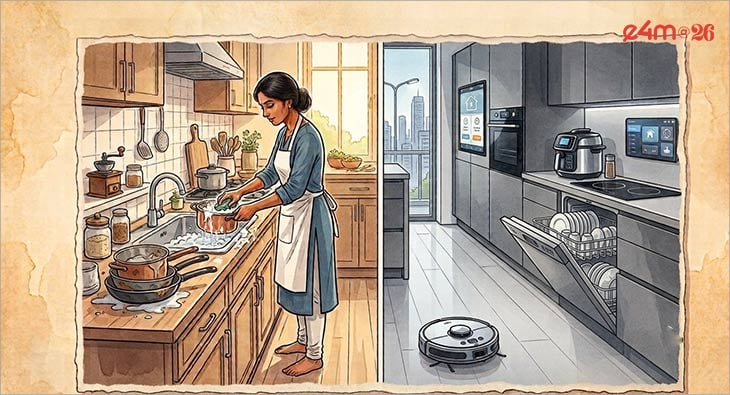

- Traditional domestic help in Indian households is evolving as families increasingly turn to technology for assistance, utilizing robots and appliances for routine chores while exploring on-demand platforms for human help.
- Companies like Snabbit, Pronto, and InstaHelp are capitalizing on the shift towards an on-demand economy, allowing consumers to book household services for specific tasks rather than employing workers on a monthly basis.
- The home-services market in India, estimated at over ₹5 lakh crore, is seeing growth in its online segment, with these platforms handling millions of bookings monthly, although challenges remain in ensuring consistent quality and trust in service delivery.
- The future of household help may involve subscription models and expanded service offerings, but success will depend on balancing affordability for consumers with sustainable earnings for workers, while maintaining trust and reliability in service quality.
When the Maid Became a Problem
For years, our household, like many others, depended on regular domestic help. At one point, we had almost three people coming in, including a cook. It was the traditional arrangement: you found people through references, they came regularly and, over time, became part of the household routine.
A few months ago, however, we found that the quality of service was no longer meeting our expectations and decided to let them go. What happened next was interesting. Instead of immediately looking for replacements, we turned to technology. A robot took care of the floors and a dishwasher took care of the vessels. Two of the most time-consuming household chores had suddenly been taken care of.
Yet technology cannot do everything. There are still jobs around the house that require a human being, particularly when you need an extra pair of hands. That is when we started noticing companies such as Snabbit, Pronto and InstaHelp, which are attempting to bring household help into the on-demand economy.
The Maid Is Becoming a Service
For decades, getting somebody to sweep the floor, wash vessels, do the laundry or help in the kitchen depended largely on neighbourhood networks, word of mouth and personal references. The system worked reasonably well when households had regular domestic workers and expectations were predictable.
Urban India has changed. Dual-income households are increasingly common, nuclear families have fewer people to fall back on and time has become one of the most valuable commodities. Consumers have also become accustomed to getting almost everything on demand. Food, groceries, taxis, medicines and technicians can all be booked through an app. Household help was perhaps waiting for the same transition.
That is the opportunity these platforms are chasing. Instead of employing somebody on a monthly basis, consumers can book help for a specific task and duration. The maid is, in effect, becoming a service.
A Market Waiting to Be Organised
The opportunity is substantial, although the numbers need to be viewed carefully. India's overall home-services market is estimated at more than ₹5 lakh crore, covering cleaning, repairs, appliance servicing, painting, pest control and several other services. The online segment remains a relatively small part of this market, but is expected to grow rapidly over the coming years.
Household help is only one component of this larger market. What makes it particularly interesting is that it has remained overwhelmingly informal. There has been no dominant organised system for finding someone to come home for an hour, wash vessels, clean the kitchen or help with routine household chores.
The new platforms are beginning to change that. By June 2026, Snabbit, InstaHelp and Pronto were together reported to be handling roughly four million bookings a month. Estimates have also put their combined broader monthly active users at around 10 million. These figures should not be interpreted as 10 million people specifically booking household help, but they demonstrate that consumers are increasingly comfortable using digital platforms for services inside their homes.
The Ten-Minute Promise
The attraction is obvious. If the regular domestic worker does not turn up, the household no longer has to spend hours calling friends, neighbours or security guards looking for a replacement. Open the app, select the service, choose a time and somebody arrives.
But convenience comes at a price. These platforms operate on supply and demand, and prices can change according to availability and timing. What looks like a straightforward household service therefore starts behaving like a ride-hailing or food-delivery platform.
For consumers accustomed to paying a predictable monthly amount to domestic workers, dynamic pricing could take some getting used to. Paying more because you need someone at 8 am rather than 2 pm may make commercial sense, but the consumer will ultimately decide how much that convenience is worth.
Trust Is the Real Product
Technology can solve the booking problem. It cannot automatically solve the trust problem.
When a stranger walks into your home, the transaction is very different from ordering a meal or a parcel. You are giving that person access to your personal space and belongings. Background verification, identity checks, training and accountability therefore become critical.
This is perhaps the biggest challenge facing the category. The companies can promise trained and verified professionals, but the consumer's real test is much simpler: Did the person who came today do the job properly? And will the next person do it equally well?
Consistency is difficult when thousands of different individuals provide the service across different homes. One customer's idea of a clean kitchen may be very different from another's. Standardising the experience without making it impersonal will be one of the industry's biggest challenges.
Convenience Is Not Peace of Mind
The real product these platforms are selling is not cleaning. It is peace of mind.
A regular domestic worker gives you continuity. An app gives you availability. They are not necessarily the same thing.
Consumers may appreciate the freedom from negotiating salaries, managing leave and finding replacements. But they may also have to explain the same requirements to a different person each time. What happens if the person arrives late? What happens when the quality is poor? What happens if the consumer wants the same person again?
These seemingly small issues could determine whether the category becomes a habit or remains an occasional convenience.
If a platform can ensure that the same trusted professional returns regularly, it could begin to recreate the relationship that traditional domestic help offered, while retaining the convenience of technology.
The Supply Challenge
For the companies, the challenge is equally formidable. Demand can be generated through advertising and promotions. Supply is much harder.
The right number of trained workers must be available in the right neighbourhood at precisely the right time. Too little supply and the customer cannot get the service. Too much supply and worker utilisation and platform economics come under pressure.
This is why the business is not simply a technology play. It is a people-intensive operation being managed through technology. The worker is also the brand ambassador inside the customer's home. One poor experience can affect the perception of the entire platform.
Can the Model Make Money?
There is clearly investor confidence in the opportunity. Pronto and Snabbit have attracted substantial venture capital, while Urban Company has put its platform behind InstaHelp.
But funding and profitability are two different things.
The real test is whether the economics work after accounting for worker payouts, training, background verification, customer acquisition, technology, incentives and the cost of maintaining sufficient supply.
The platforms cannot depend on discounts forever. Nor can prices rise to a point where consumers conclude that maintaining a regular domestic worker is more economical. The sweet spot will have to be somewhere between affordability for the consumer and sustainable earnings for the worker.
What Comes Next?
The future may not simply be about sending somebody to clean a house in ten minutes. The bigger opportunity could be to become the household's service platform.
Today it may be cleaning, dishwashing and basic household assistance. Tomorrow it could include cooking, laundry, deep cleaning, gardening, car cleaning and other household requirements.
Subscription models could also change the equation. Instead of booking every task separately, households could pay a monthly fee for a certain number of hours of assistance. Technology could remember household preferences and preferred workers, bringing some of the familiarity of traditional domestic help into a digital model.
From Domestic Help to Household Infrastructure
The interesting thing about this new category is that it is not necessarily trying to eliminate domestic workers. It is trying to change the way domestic work is organised.
The robot has already taken over the floor. The dishwasher has taken over the vessels. Apps are now trying to solve the problem of finding human help when it is needed.
But the final test will not be how quickly somebody reaches your doorstep. It will be whether that person delivers the quality you expect, whether you trust the service enough to use it again and whether the company can make the experience dependable without making it prohibitively expensive.
For decades, the household maid was part of the family routine. The new generation of platforms is betting that the future may belong instead to household help as a service.
The real question is whether they can turn convenience into trust, trust into repeat usage and repeat usage into a sustainable business.
Because ultimately, nobody wants just somebody at the doorstep.
They want the job done — and they want to know it will be done properly the next time too.
Read more news about Marketing News, Advertising News, PR and Corporate Communication News, Digital News, People Movement News
For more updates, be socially connected with us onInstagram, LinkedIn, Twitter, Facebook, YouTube & Google News
