Guilty as Bought: Decoding why Indians buy what they buy
Guest Column: Ganapathy Viswanathan, Independent Communication Consultant & Author, shares his thoughts on the book Guilty as Bought by Krishnan Subramanian
 by
by
Published: Aug 26, 2026 10:25 AM | 4 min read
 Follow Us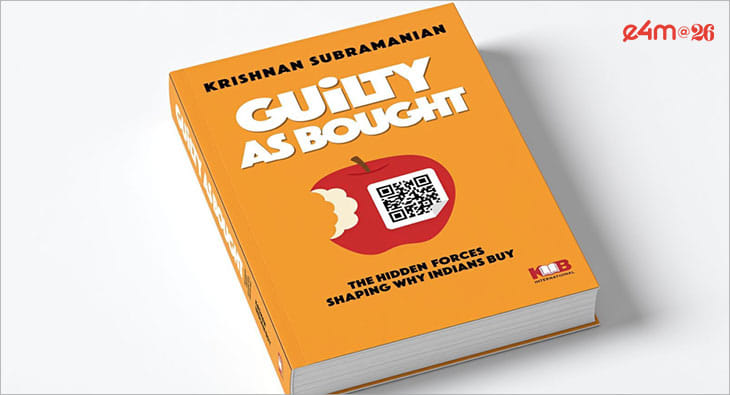

- Subramanian Krishnan, known as Subu, has over 30 years of experience in strategy, planning, advertising, and brand building, and has recently published a book titled "Guilty As Bought: The Hidden Forces Shaping Why Indians Buy."
- The book explores the underlying social, cultural, economic, and generational factors that influence Indian consumer behavior, aiming to answer the question of why Indians make specific purchasing decisions.
- Subu's insights are drawn from his extensive career, which spans various roles and markets, allowing him to analyze the evolving relationship between consumers, brands, and culture in India.
- "Guilty As Bought" seeks to provide a deeper understanding of consumer motivations and the complexities of consumption in modern India, highlighting the persistent influences that shape buying choices amidst changing aspirations and lifestyles.
“Helping. Challengers. Grow. At the intersection of business, brand and culture.”
That is how Subramanian Krishnan describes himself on LinkedIn. Popularly known as Subu, he has spent more than three decades working in the world of strategy, planning, advertising and brand building.
Subu began his career in sales before moving into advertising, where strategy and planning became his forte. Over the years, he has worked across India and international markets, continuously raising the bar for himself as a thinker and as someone who understands what it takes to build brands
Now, after more than three decades of observing businesses, brands and consumers, he has turned his experience and thinking into a book: Guilty As Bought: The Hidden Forces Shaping Why Indians Buy.
The book was launched a few weeks ago and is now available on Amazon. Considering the demands of a busy professional life, bringing a book to life is no small achievement. But Subu's long experience in strategy and planning has given him the perspective and observations needed to undertake such an exercise.
At the heart of the book is a deceptively simple question:
Why do Indians buy what they buy?
The answer, according to Subu, cannot be found merely by looking at today's trends. Consumer behaviour is shaped by decades of subtle changes—social, cultural, economic and generational forces that often operate beneath the surface.
We may think we are making independent choices. But what we eat, wear, watch, drive and buy is influenced by a much larger set of forces. Our upbringing, aspirations, changing lifestyles, social environment, culture and the world around us all play a role.
This is what makes the subject of Guilty As Bought particularly interesting.
The book attempts to decode twelve hidden drivers of consumption, looking at how they have influenced Indian consumers across the past and present and, importantly, what they could mean for the future.
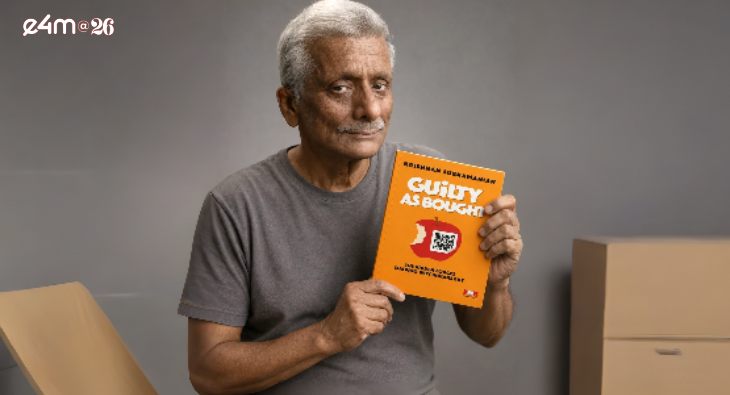
India's consumer story has changed dramatically over the last few decades. The India that existed when Subu began his professional career is very different from the India of today. Aspirations have changed. Families have changed. Media has changed. Technology has changed the way people discover products and make choices. And yet, some of the deeper influences on consumption have remained remarkably persistent.
For someone who has spent decades thinking about brands, these changes provide a fascinating lens through which to look at the Indian consumer.
Guilty As Bought appears to go beyond the conventional question of what consumers buy to ask the more interesting question of why they buy it in the first place.
That distinction matters.
For marketers and brand builders, understanding the consumer is not simply about tracking sales numbers or identifying the latest trend. It is about understanding the motivations and cultural forces behind those numbers. What may look like a sudden change in consumer behaviour could actually be the result of a shift that has been building quietly for years.
And this is where Subbu's professional journey becomes particularly relevant to the book.
From sales to advertising, from planning to strategy, and from working on brands in India and overseas to observing how consumers evolve, his career has given him an opportunity to see the relationship between business, brands and culture from multiple perspectives.
His LinkedIn description—“Helping. Challengers. Grow.”—perhaps sums up that journey rather well. But with Guilty As Bought, he is now turning the lens towards something even more fundamental: the forces that shape consumer choice.
The most intriguing part of the book may therefore be its attempt to look ahead.
It is relatively easy to explain what consumers bought yesterday. The real challenge is to understand what they might want tomorrow.
As India becomes more aspirational, more connected and more diverse, the forces influencing consumption are likely to become even more complex. Understanding those forces could be valuable not only for marketers and brand managers, but for anyone interested in understanding the rapidly changing Indian consumer.
After more than three decades of watching Indian consumers, brands and businesses evolve, Subu has chosen to put some of those observations and insights into a book.
Guilty As Bought: The Hidden Forces Shaping Why Indians Buy invites us to look at an everyday act in a very different way.
Because perhaps the things we buy are telling us far more about ourselves—and the India we live in—than we realise.
Read more news about Digital Media, Television Media, Out of Home Advertising, Print Media, Latest Advertising India
For more updates, be socially connected with us onInstagram, LinkedIn, Twitter, Facebook, YouTube & Google News