Guilty as Bought: What India bought along the way
Veteran adman Prabhakar Mundkur shares his thoughts on the book Guilty as Bought by Krishnan Subramanian
 by
by
Published: Aug 19, 2026 10:49 AM | 3 min read
 Follow Us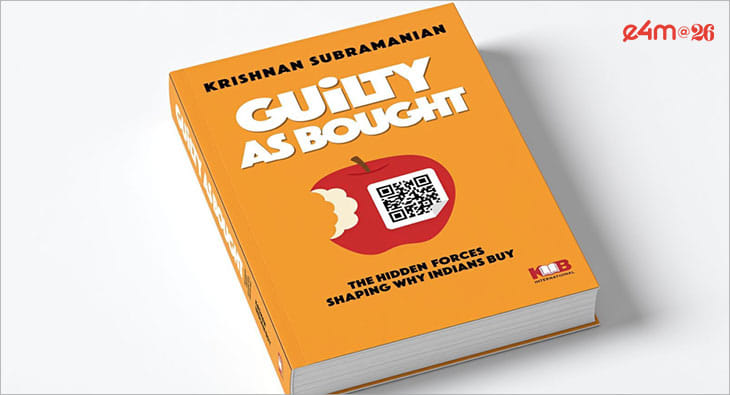

- "Guilty as Bought" by Krishnan Subramanian explores the evolution of Indian consumer behavior, linking it to broader social transformations in India rather than just marketing trends.
- The book highlights how shifts from joint to nuclear families, rising incomes, increased education, and women's workforce participation have influenced consumption patterns and aspirations.
- It raises questions about the relationship between products and social change, suggesting a reciprocal influence where consumer demands and societal shifts continuously shape each other.
- While the book offers cultural insights and anecdotes, it is less focused on scientific analysis, making it an engaging read for those interested in India's marketing landscape and societal changes.
For someone who has spent a lifetime in advertising, Guilty as Bought is an intriguing and occasionally uncomfortable book. It asks a deceptively simple question: why do Indians buy what they buy? But Krishnan Subramanian's answer goes well beyond marketing, brands and consumer psychology. He uses consumption as a window into the extraordinary social transformation of India.
The central insight of the book is that Indians did not simply become more consumerist. India changed, and consumption changed along with it.
The movement from joint families to nuclear families altered what people needed in their homes. Rising incomes changed aspirations. Education created new definitions of success. Women entering the workforce changed household economics. Television, the internet and mobile phones transformed expectations of convenience. Globalisation introduced new foods, fashions, entertainment and lifestyles. What we buy, the book suggests, is often a reflection of much deeper changes in who we are and what we aspire to become.
That makes the book particularly interesting for anyone who has watched Indian advertising evolve over the past few decades. Advertising has always tried to understand the Indian consumer, but the consumer was never a static creature waiting to be understood. The Indian consumer was evolving continuously.
A washing machine, a Maruti 800, a packet of food, a television set or a mobile phone may appear to be simply products. But each can also be seen as evidence of a larger change in society. Convenience, for instance, is not merely about saving time. Once people become accustomed to convenience, their expectations of life change. What was once a luxury becomes normal, and what was once normal begins to feel inconvenient.
This raises an interesting question that the book perhaps invites us to ask more explicitly: do products create social change, or do social changes create the demand for products? Did the washing machine change the role of women, or did changing roles create the demand for the washing machine? Did the automobile create greater individual mobility, or did rising aspirations make personal mobility inevitable?
The answer is probably both. Consumers and markets continuously influence each other.
One of the book's strengths is its breadth. It moves comfortably across family, food, education, entertainment, technology, sport, gender, aspiration and lifestyle. It reminds us that consumption is not confined to shopping malls and supermarkets. We consume experiences, identities, convenience, status and even ideas of success.
There are moments when the book's many observations feel more persuasive as cultural anecdotes than as tightly established cause-and-effect arguments. But that is also part of its charm. It is less a scientific study of the Indian consumer than a fascinating journey through the forces that have shaped the Indian consumer.
And perhaps that is why the title works so well. We may feel guilty about what we buy, but our purchases are rarely just purchases. They are clues to the lives we have lived—and to the lives we increasingly want to live.
For anyone interested in India, marketing, brands or simply understanding how the country has changed, Guilty as Bought is an enjoyable and thought-provoking read.
Read more news about Digital Media, Television Media, Out of Home Advertising, Print Media, Latest Advertising India
For more updates, be socially connected with us onInstagram, LinkedIn, Twitter, Facebook, YouTube & Google News
