How brands became part of Jantar Mantar protest
From food deliveries sent through consumer apps to businesses responding directly to protesters, corporate actions became a talking point alongside the agitation itself
 by
by
Published: Jul 23, 2026 2:11 PM | 2 min read
 Follow Us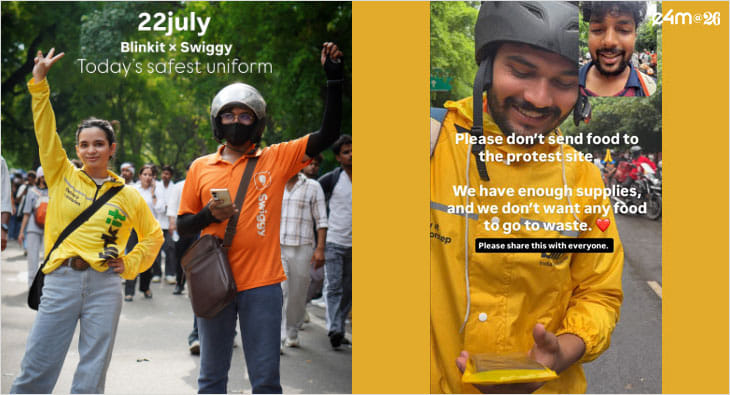

- A student-led protest at Jantar Mantar has seen significant public support, with individuals using food delivery apps like Swiggy and Zomato to send meals and essentials to protesters.
- The influx of food and supplies prompted protest organizers to request supporters to stop sending items, citing that immediate needs had been met and concerns about potential wastage.
- Independent coffee chain Blue Tokai received positive attention for providing facilities to protesters, while Haldiram's faced backlash for allegedly denying access to its outlet during the protest.
- Climate activist Sonam Wangchuk criticized the focus on food at the protest, expressing concern that it detracted from the seriousness of the movement and likened the atmosphere to a picnic.
As the student-led protest at Jantar Mantar intensified this week, several brands unexpectedly found themselves woven into the narrative. From food deliveries sent through consumer apps to businesses responding directly to protesters, corporate actions became a talking point alongside the agitation itself.
Following viral videos of police action and the subsequent public outpouring of support, protesters began receiving food, water and essentials from people across the country. Supporters used platforms such as Swiggy and Zomato to send meals directly to the site, turning delivery apps into channels of solidarity.
View this post on Instagram
Delivery partners were seen arriving with vegetarian thalis, pizzas, burgers and other food items ordered by individuals who wanted to support the students. The gesture quickly gained traction on social media, with many users sharing screenshots of their orders and encouraging others to contribute.
View this post on Instagram
As supplies continued to arrive, protest organisers eventually requested supporters to stop sending food and essentials, stating that immediate requirements had been met. The appeal reflected both the scale of public participation and concerns around potential wastage.
View this post on Instagram
The conversation around brands extended beyond food deliveries. Independent coffee chain Blue Tokai drew praise online after reports and videos suggested that it allowed protesters access to its premises, including washroom facilities and a place to rest amid the demonstrations.
Climate activist Sonam Wangchuk, who undertook an indefinite hunger strike at Jantar Mantar, also spoke about the increasing focus on food at the protest venue during the initial days. Expressing disappointment, he told demonstrators, "Main bhook hartal par hoon aur aap thoos-thoos ke kha rahe ho" (I am on a hunger strike while you are eating heartily).
Wangchuk said the atmosphere was beginning to resemble a picnic rather than a protest. He noted that while he was surviving on salt and water, watching people eat lavishly risked diluting the seriousness and purpose of the movement.
For marketers, the developments highlight how brand perception is increasingly shaped by real-world actions rather than advertising campaigns. In an era of constant social documentation, decisions made at the ground level can quickly become part of a larger public conversation.
Read more news about Digital Media, Internet Advertising, Marketing News, Television Media, Radio Media
For more updates, be socially connected with us onInstagram, LinkedIn, Twitter, Facebook, YouTube & Google News