Why the industry’s biggest AI challenge isn’t technology but trust
At Goafest 2026, leaders from Network18, WPP and Omnicom debated whether the advertising and media industry is genuinely becoming AI-first or simply repackaging old systems with new terminology
 by
by
Published: May 21, 2026 1:08 PM | 6 min read
 Follow Us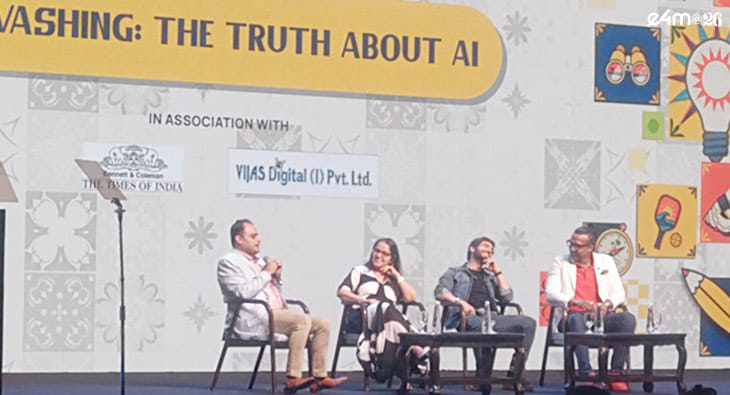

- At Goafest 2026, industry leaders from Network18, WPP, and Affle discussed the authenticity of the advertising industry's shift towards AI, debating whether it represents genuine transformation or mere rebranding of existing practices.
- The panel emphasized the need for media organizations to evolve into intelligence-driven systems that leverage AI for real-time data processing, while maintaining the importance of human editorial judgment in ensuring credibility.
- Concerns were raised about AI-generated content potentially prioritizing efficiency over creativity, with a warning that brands might favor standardized outputs at the expense of emotional storytelling and originality.
- The discussion highlighted the necessity for measurable outcomes in AI applications, with a call for the industry to move from traditional analytics to real-time, AI-led optimization models to ensure effective implementation and accountability.
At Goafest 2026, leaders from Network18, WPP and Affle debated whether the advertising and media industry is genuinely becoming AI-first or simply repackaging old systems with new terminology.
Artificial intelligence may be the most overused phrase in boardrooms today, but at Goafest’s Day 2 panel on AI Washing: The Truth About AI: Why using AI is easy, but becoming AI-first is hard, industry leaders attempted to cut through the noise surrounding the technology’s rapid adoption. What emerged was a sharp and often self-critical conversation around the widening gap between experimentation and actual transformation in advertising, media and marketing.
The discussion brought together Smriti Mehra, Niraj Ruparel and Gulrez Alam, with the session moderated by Shubhranshu Singh.
Singh opened the conversation by contextualising the disruption AI is bringing to media and advertising, arguing that the industry is confronting a shift larger than previous digital transitions. “We have survived an industry with the emotion of 30-second ads. We survived the commoditisation of the banner. Now we're in a situation where even the audience is melting away,” he remarked, referring to the rise of synthetic content, bots and machine-led engagement ecosystems.
For Mehra, AI’s most immediate impact will be on the operational core of news and broadcasting businesses. She argued that media organisations are moving from merely disseminating information to becoming intelligence-driven systems capable of decoding vast amounts of data in real time. According to her, AI will fundamentally alter how newsrooms process information, personalise experiences and scale multilingual content distribution.
“It will make us not just in information reactors and information disseminators to also bringing in layers of intelligence,” Mehra said. “It’s going to become faster. It’s going to become easily there in languages. On personalisation, I think it’s going to become so much more personalised as a service.”
At the same time, she cautioned against the assumption that automation would eliminate the role of editorial judgement. In an era increasingly driven by synthetic media and automated production pipelines, Mehra maintained that credibility would remain a human responsibility. “The human element from news is really never going to go away,” she said, adding that the final editorial decision would continue to require human oversight.
If Mehra focused on institutional transformation, Ruparel approached the discussion from the lens of creative possibility. For the WPP executive, AI’s biggest value lies not in replacing creativity but in dramatically reducing the friction involved in prototyping and experimentation. He described the current moment as one where agencies can rapidly visualise, personalise and test ideas in ways that were previously expensive or technically impossible.
“The best unlock is when you're not doing too much talking on AI, but you go out there and build prototypes,” Ruparel said, stressing that clients increasingly want demonstrable business applications rather than abstract AI narratives.
He cited examples involving telephony-based AI systems designed for consumers without smartphones or internet access, arguing that India’s next wave of AI innovation will emerge not from premium urban use cases but from scalable vernacular applications. The emphasis, according to him, is shifting from technology novelty to experience design.
Yet the panel repeatedly circled back to a deeper concern within the advertising industry. The fear is no longer that AI-generated work will be visibly poor. Instead, the larger threat is that machine-generated outputs could become “good enough” at scale, encouraging brands to prioritise efficiency over originality.
Singh articulated this anxiety directly when he warned that the economics of AI may push companies toward faster, cheaper and standardised creative production. The risk, he suggested, is that emotional storytelling and distinctive brand-building could gradually weaken in favour of scalable automation.
Ruparel, however, argued that technology alone cannot produce culturally resonant work. Referencing campaigns powered by synthetic celebrity content and AI-generated experiences, he maintained that human creativity would continue to determine what breaks through. “The technology is here and by leaps and bounds it’s becoming more and more democratised,” he said. “But the original thinking, the creativity and the guys who have been doing brand pitching for years and years, they are the ones who are going to make the best mash out of it.”
The session became particularly pointed when the discussion shifted from AI experimentation to accountability. Alam argued that much of the industry’s current enthusiasm risks becoming performative unless businesses can prove measurable outcomes. “If you are not able to produce the desired results for the client, then it’s not working. Then it’s all AI-washing,” he said.
For Alam, the challenge is not access to technology but the quality of data and implementation. He compared traditional marketing analytics to a “rear-view mirror”, where brands analyse past performance rather than using predictive intelligence to shape future decisions. “That needs to change. That needs to become a GPS,” he said, outlining the industry’s push toward real-time, AI-led optimisation models.
The panel also explored how AI could alter the future of interfaces and consumer behaviour itself. Ruparel predicted that computing would increasingly move away from phones toward immersive wearable environments where systems respond to gestures, expressions and emotional cues in real time. “Computers are going to be sitting on your head,” he said, referring to the rise of spatial computing and mixed-reality ecosystems.
That possibility also triggered unease. Singh openly questioned whether a future built around emotionally responsive systems and embedded computing might cross ethical boundaries around surveillance and personal autonomy. The exchange underscored a recurring tension throughout the session: the industry’s excitement around AI remains matched by uncertainty about where the technology eventually leads.
As the conversation neared its conclusion, the panelists were asked what AI would irreversibly “kill” within their respective industries. Mehra’s answer was immediate. “Slow,” she said, arguing that speed of execution, adaptation and market response would become the defining competitive advantage for businesses. Ruparel claimed AI was “killing impossibilities”, while Alam suggested it could weaken traditional ground-level consumer research as businesses become increasingly dependent on synthetic intelligence and large-scale automated insights.
Despite differing perspectives, the panel ultimately converged on one point. AI adoption alone no longer signals innovation. In an industry rushing to position itself as AI-first, the real differentiator will be whether companies can combine technology with credible execution, original thinking and tangible business value rather than simply rebranding existing processes with AI terminology.
Read more news about (internet advertising India, internet advertising, advertising India, digital advertising India, media advertising India)
For more updates, be socially connected with us onInstagram, LinkedIn, Twitter, Facebook Youtube & Whatsapp
